
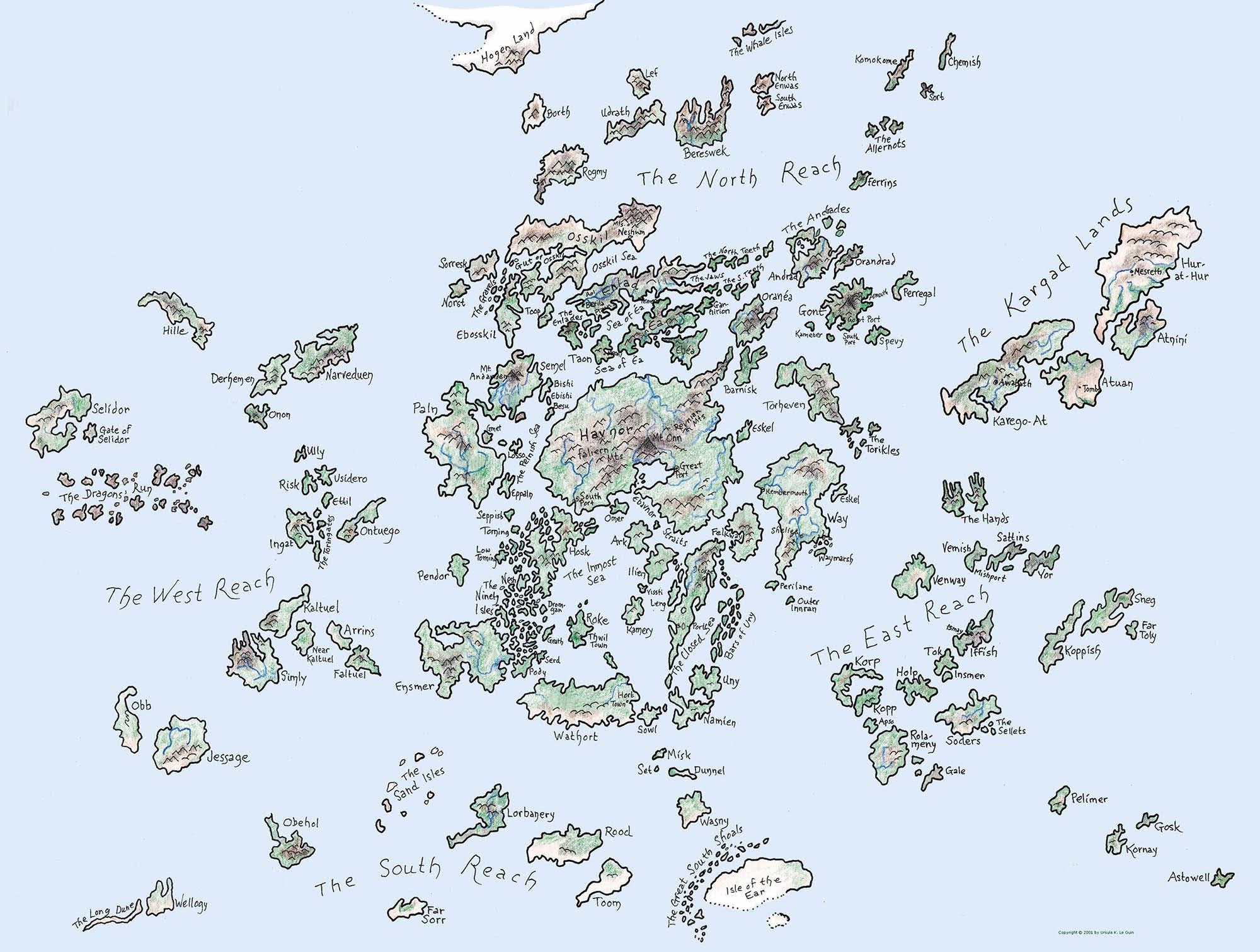
In this series, I’ll be working my way through Ursula K. Le Guin’s Earthsea works and analyzing her prose chapter by chapter. Spoilers follow.
First Impressions
We are returned to Earthsea at last. Tales from Earthsea collects a novella and four short stories into a single volume. Two of the stories (“Darkrose and Diamond” and “Dragonfly” were published previously. The full volume was originally published by Harcourt in 2001.
My copies are The Books of Earthsea: The Complete Illustrated Edition and an ebook, which is much easier to read in bed. The ebook lacks page numbers, but the version in the illustrated hardback occupies most of 184 pages.
Tales from Earthsea is the undiscovered country for me. I read parts of The Finder a few years ago, but I never finished it. I’ll be dividing The Finder into its small chapters, but I believe the rest of the book will be taken one whole story at a time.
Le Guin begins this volume with a foreword talking about the state of fantasy as genre, her purpose in writing these stories, and how Earthsea has changed and grown in the telling. I’m not much interested in discussing the foreword at the moment, but I found it perceptive and instructive, as I often find Le Guin.
Chapter 1: In the Dark Time
Length: 3 pages, 13 paragraphs
Setting: Havnor (after a fashion)
Le Guin begins this novella unlike any of the other Earthsea works. Le Guin begins with a sort of scholarly prologue. We jump almost immediately into an excerpt from the fictional Book of the Dark, which was “written some six hundred years ago in Berila, on Enlad.”
We learn that in between the legendary times of Erreth-Akbe, Morred, and Elfarran and the present, there was a dark age of sorts where magic fell into ill repute.
Warlords and pirates ruled the day, wizards practiced their craft in the shadows of these men, and sorcerers and witches (and women practicing magic generally) were distrusted and disparaged.
We also learn about the Hand, a group of people (believed to be but not actually all women) who practiced magic, taught it, and protected those who practiced it outside the circles of the great and powerful.
This organization and its involvement in the founding of Roke, the narrator suggests, have been largely forgotten. I like that Le Guin’s narrator ends this first chapter with a challenge to the Masters of Roke: If this isn’t how it happened, prove it.
Until next time.
 chasetriesagain.com