
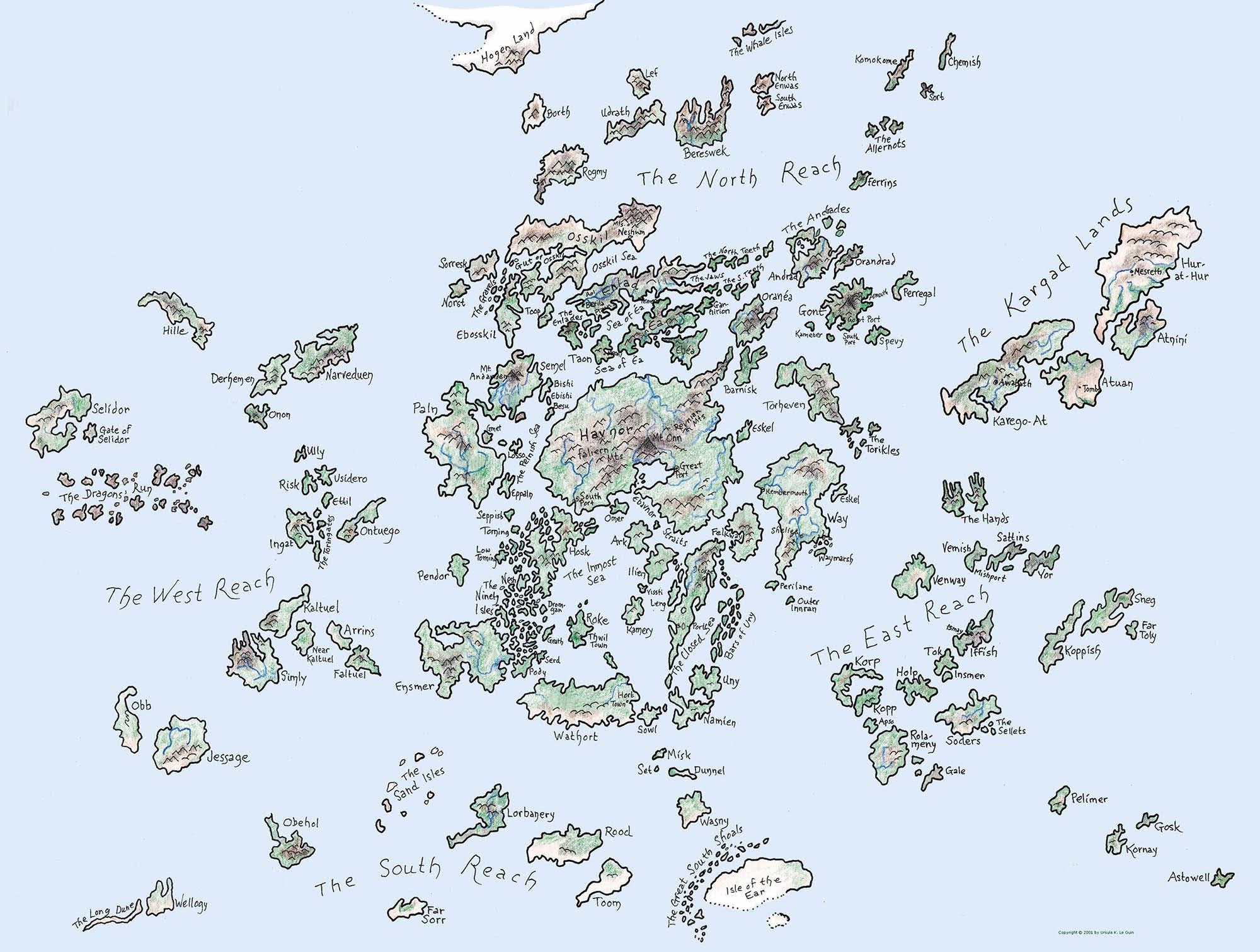
In this series, I’ll be working my way through Ursula K. Le Guin’s Earthsea works and analyzing her prose chapter by chapter. Spoilers follow.
First Impressions
The Other Wind is the last book of Earthsea though not the last story we’ll read. It was originally published in 2001 by Harcourt. It seems wrong that this book had already been in the world a year when I first picked up the seemingly ancient copy of The Tombs of Atuan in my middle school library.
As with Tales from Earthsea, I am reading an ebook but referring to my complete illustrated edition for page numbers. There are about 145 pages counting the afterward.
I have never read The Other Wind before now.
Chapter 1: Mending the Green Pitcher
Length: 31 pages
Setting: Gont
Poor Alder’s arrival at Gont and trip up to Re Albi feels like a cinematic montage. There is something bold in Le Guin’s persistent evolution of style in Earthsea. Each work seems to get further and further from that distanced, ancient voice used in A Wizard of Earthsea. To my ear, The Other Wind reads even more modern than Tales from Earthsea published the same year and written during the same period.
I was somewhat frustrated with how Le Guin handled Ged in Tehanu. Here I’m fascinated by his complexity. Ged, now powerless, doubts himself, though perhaps like the Patterner I am naive enough to believe his power could come back, that it is not truly gone. (This is something I meant to discuss with “A Description of Earthsea.” I don’t like the notion that magical ability is inborn in Earthsea. This seems an unnecessary restriction. That some people could have a talent for it is one thing. That some people could be innately incapable of magic is another and doesn’t seem to match the spirit of the world.)
Nevertheless, I love that Ged doubts to the end that it was wise or necessary for Alder to be sent to Gont, but it’s Ged, still the archmage deep down, who finds at least a temporary solution to Alder’s nightmarish visits to the afterlife (or the afterlife’s nightmarish visits to Alder). I especially love that it’s a kitten, contact with the living world, that does the trick.
I think Le Guin’s vision of the Earthsea afterlife is maybe the most revisioned of any aspect of the setting. Our first glimpse of that other night sky with its unmoving constellations came in A Wizard of Earthsea when Ged tried and failed to save Pechvarry’s son. Ged sees the little boy run on ahead of him down the hill into the dark. As that story progresses, Ged comes face-to-face with the shadow of his own death and must embrace it to end the threat of his gebbeth.
My impression when first reading A Wizard of Earthsea was that the stone wall and still stars were simply a way that wizard’s perceive the afterlife, not the whole picture (this is still true to my thinking), and that anything sinister in it has less to do with its reality than with our own fear of death.
When we get a closer look at that afterlife in The Farthest Shore, it seems a bit more grim, but there is a hint that the people there in the cities of the dead are not really the genuine article, the whole person. They seem to be shadows of life not the souls of the dead. Cob is driven by greed for life, to be himself eternally, and this threatens to make the whole world a shadow of life.
Now, it seems we need to revision our thinking on the afterlife again. It seems fair that Cob would fear such a place now that it seems true that you can be dragged into that listless sub-existence for all eternity.
We know Le Guin wasn’t always heading toward this story. She thought Tehanu would be her last trip to Earthsea. Still, I may be wrong. Maybe this was always how she viewed Earthsea’s afterlife. We’ll touch a bit more on that tomorrow.
“He said it aloud, ‘Lily . . .’ The sound of it was not like a white flower, but like a pebble dropping on dust.”
Until next time.

