
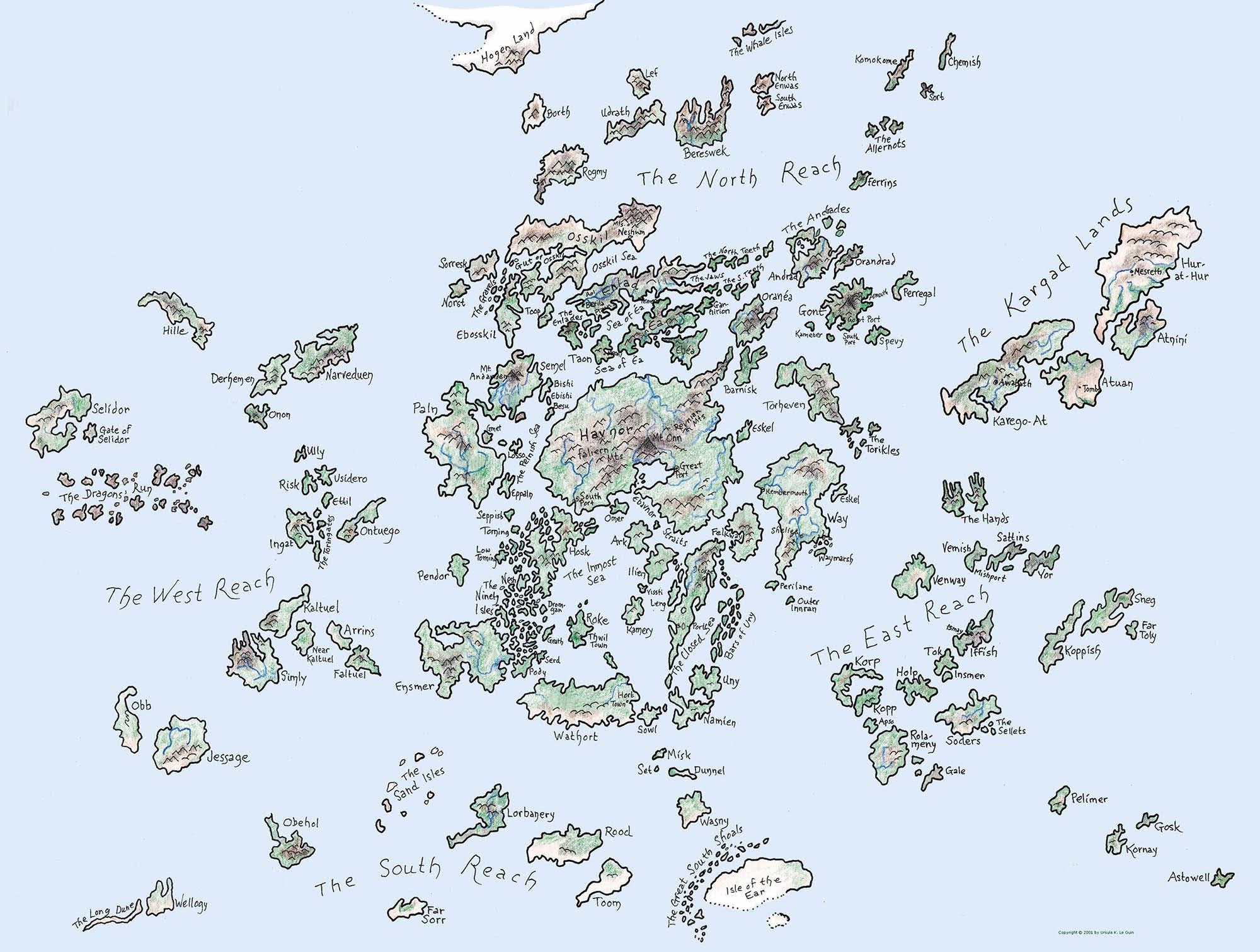
In this series, I’ll be working my way through Ursula K. Le Guin’s Earthsea works and analyzing her prose chapter by chapter. Spoilers follow.
Chapter 4: Medra
Length: 2 pages
Setting: Roke (after a fashion)
This fourth section of the novella is essentially an epilogue. Hound stays in Endlane. Losen is killed by his would-be successors. Medra lives out his days on Roke with Elehal in the Grove until she passes. Then we get that last essential piece of Roke as Ged knows it. Medra becomes the Master Doorkeeper.
I’ve failed to mention the stanzas of epic poetry that start each section. I haven’t thought much of them, but they’re an effective flourish.
In a sense this story, like Tehanu before it, marks a shift in Earthsea and maybe traces a shift in some parts of the fantasy genre.
To be perfectly honest, I am struggling to explain myself here, but the thing I’m focused on is how Le Guin places seeds of institutional rot in the very foundation of the House of the Wise. There are quarrels over the place of women in that institution, over whether wizards ought to be celibate, over whether this institution ought to exist at all.
Roke proves to be a great good for the world of Earthsea, and I don’t think Le Guin ever means for us to doubt that. But it is always compromised by these flaws that grow from its earliest days.
The first three Earthsea books take a more epic approach. It’s not that these very human flaws don’t exist there, but certainly in A Wizard of Earthsea we are not meant to cast a critical eye on the institution of Roke.
It’s a shift in approach. The early Earthsea books follow closer to the model of Tolkien. Tolkien’s Middle Earth is a novel trying to be the prose translation of an ancient, poetic epic. It has the concerns of an epic, and it’s characters are larger than life and grander. They’re still human, with human failings, even when they are hobbits and elves, but we are not invited to see Denethor as the product of institutional rot within the Stewards of Gondor.
This is, I think, what George R. R. Martin was getting at when he talked about Aragorn’s tax policy. Tolkien doesn’t encourage us to think about the Council of the Wise or the monarchy of Gondor as if it were a real institution. That’s not what he’s doing with the story, and it’s not true to the tradition of story he’s trying to emulate.
I think this is also true for the first book of Earthsea and increasingly less true for every entry after. Le Guin was helping shape another tradition in the world of fantasy, one with some science-fictional, simulationist, modern (or post-modern? I’m afraid my scholarship falls very short of that kind of distinction) sensibilities.
This is something that I need to do more reading and writing on, a bigger fish to fry than I can handle in a daily blog post. I’ll leave it there for now.
Until next time.

