
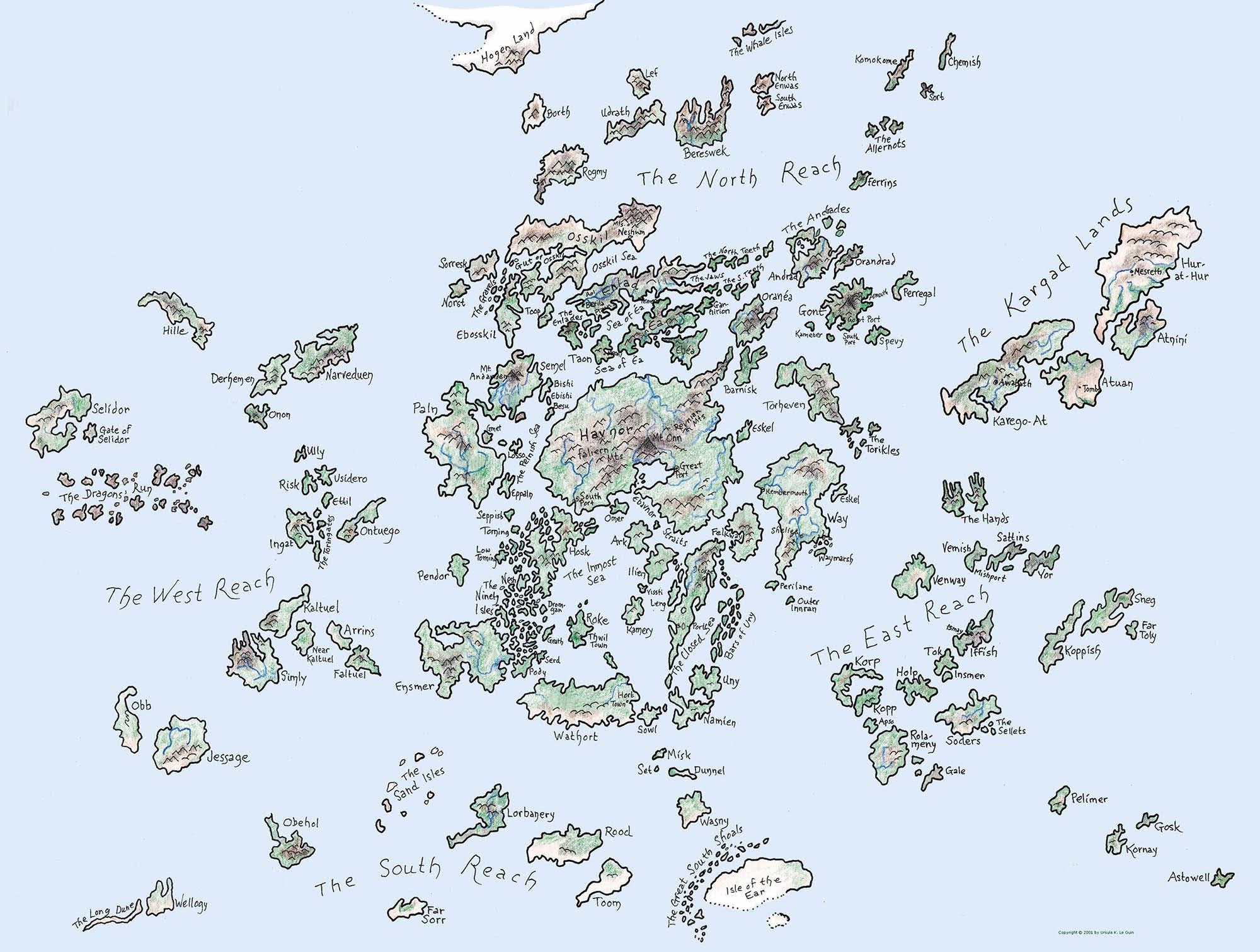
In this series, I’ll be working my way through Ursula K. Le Guin’s Earthsea works and analyzing her prose chapter by chapter. Spoilers follow.
First Impressions
I read The Tombs of Atuan as a pre-teen, A Wizard of Earthsea a few years later, and I didn’t get my hands on a copy of The Farthest Shore until I was in my 20s. I don’t think I read it until 2020 or early 2021.
The book is 13 unnumbered chapters with no prologue or epilogue and a total of 197 pages. Each chapter begins with one of Gail Garraty’s woodblock prints.
Originally published in 1972 by Atheneum, this book is dedicated to Le Guin’s children.
My copy is from the same 1989 Bantam release as the copy of The Tombs of Atuan, and it has the same cover format except it’s red instead of blue. This copy has seen better days, and the cover art by Yvonne Gilbert is almost totally covered by a secondhand shop price sticker. I suspect that sticker is doing most of the work of keeping the cover together at this point.
This book includes a map of Earthsea at the front, albeit a slightly different one than I’ve found in any of my other books. No map credit is immediately available. Interestingly, they’ve forgone a table of contents. Bantam has also neglected to share a SPECIAL OFFER on the final page in this volume.
Now to the actual text, this seems a chunkier book every capacity. Chapters are longer, paragraphs are beefier (and Le Guin is not shy about beefy paragraphs), and the subject matter seems a fair bit heavier, too.
This book won the 1973 National Book Award for children’s books, but my recollection of reading it the first time does not resemble a children’s book. Certainly, we have a young co-protagonist, but the matter of The Farthest Shore just doesn’t feel like it was aimed at children.
Now, to some degree I feel that way about all the Earthsea books, and in Tehanu we’ll definitely venture outside of that domain. Mostly, they may be appropriate and accessible for teens, but I don’t particularly feel like they were aimed at teens.
Maybe that’s just Le Guin refusing to fall to bad form and make the perennial mistake, the original sin of literature for children and young people: condescension. Or it might be the condescension of critics and tastemakers who have often felt that “Genre Fiction” was more appropriate for lonely children.
I digress.
Chapter 1: The Rowan Tree
Length: 12 pages, 80 paragraphs
Setting: The Court of the Fountain in the Great House, the Immanent Grove, and the Isolate Tower on Roke, Isle of the Wise
Characters introduced: Arren, Sparrowhawk, the Master Doorkeeper, the Master Patterner, Kurremkarmerruk
I suspect that many of Dumbledore’s scenes in the series best left forgotten exist in the shadow of Ged’s meeting with Arren in the Court of the Fountain, and indeed, I suspect this whole book shaped that character’s arc.
Our friend Ged is now the archmage, and he’s been busy since he returned from Atuan. We learn a few miscellaneous deed’s of Ged that we didn’t already know about, we learn that Ged’s name is known by only seven beings and save for the two dragons, we’ve met them all before, and we learn that since the Ring of Erreth-Akbe returned to Havnor, there’s been something like peace with the Kargad Lands. The current Master Patterner is from Karego-At.
But magic is disappearing around the edges of Earthsea, and young Arren has been sent by his wizardly father to petition the archmage for help.
There is something in Arren’s name meaning “sword,” and probably something else in Arren offering his sword to Ged, who refuses it conditionally.
I do find Le Guin’s prose in this book to be extra quotable.
“Fortune-telling and love potions are not of much account, but old women are worth listening to.”
and
“So the first step out of childhood is made all at once, without looking before or behind, without caution, and nothing held in reserve.”
Those are two of my favorite lines in the chapter, but it’s a hit parade. There are bits of worldbuilding, some humor, and a hint of dread.
I love that Ged takes us at last to the Immanent Grove, and once his business is conducted, he settles in for a nap.
It reminds me of some wise people I’ve known in my life who taught me not to be afraid to rest during a crisis, that particular calm of knowing you’ve done all you could in the moment and can rest until the next wave rolls in.
I should follow Ged’s example now and get some sleep, but one final thought occurs. In talking about The Tombs of Atuan and the priestesses there, I wondered if Gregory Maguire’s Brides of Maracoor might not have some Atuan in its DNA, but something in the opening of this book makes me wonder if there’s not some Earthsea roots in the whole Maracoor trilogy, where strange happenings on the oceanic margins of Maracoor come creeping into the capital. Something about Arren reminds me faintly of Leorix, too.
That’s all for now. Until next time.
 chasetriesagain.com