
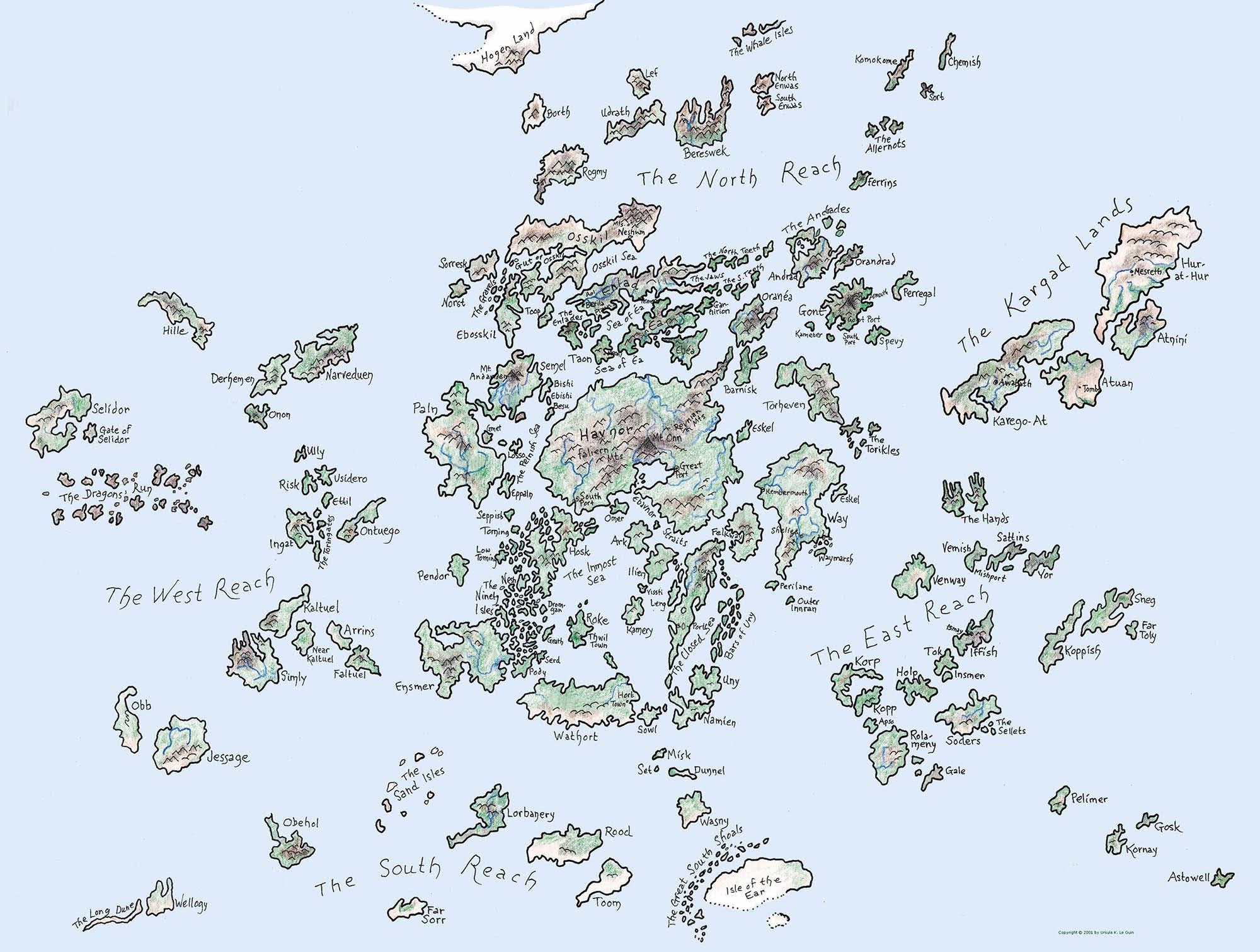
In this series, I’ll be working my way through Ursula K. Le Guin’s Earthsea works and analyzing her prose chapter by chapter. Spoilers follow. I should also note here that I didn’t notice until the second chapter of Tehanu that I had substituted “deep read” for the academic term “close read.” Alas, I am a writer and only a layman in the academic arts. I’ve elected to keep the title of this series as is because while I quite like this series of posts, I do not think it stands up as a close read.
Chapter 5: Bettering
Length: 23 pages, 164 paragraphs
Setting: Re Albi
Characters introduced: Fan (a weaver, mentioned not seen)
Fan is the only character to approach the stage in this chapter, but several others return from the murky past or are given names for the first time. We learn Tenar’s son is called Spark (struck off her husband Flint). Ged tells us about Lebannen. The other Re Albi wizard is named Aspen. Tenar remembers Kossil and Manan.
I am beginning (a little late) to notice a rough pattern here that I think started in The Tombs of Atuan and gained greater form in The Farthest Shore. One chapter will be heavy with events and the following chapter will be mostly the characters talking or thinking about those events concluding with a catalyst for the events of the next chapter.
I love Aunty Moss. I love how she’s more interested in how the eunuchs were made than in Tenar’s reflections on her childhood in Atuan. I love how she’s sure Ged will die and the idea that she’s a bit disappointed when he doesn’t. I love the reflection on how in some matters what the uneducated or untrained or uninitiated lack is not knowledge but the language to convey it.
I think I forgot to talk about Tenar and Kalessin’s eye contact. We were told a long time ago that it is dangerous for men to make eye contact with dragons. Probably at the time she first wrote it Le Guin meant that as the universal, genderless man, the poetic way to say human.
Le Guin consciously turns that on its head here. It is men who are imperiled by a dragon’s gaze. A woman can stare a dragon in the face and not be ensorcelled by it.
This could be misread as a gender essentialist notion, but I think Le Guin was thinking more about how the roles we are raised to play and pushed into by society shape us. Ged, though he is not so enamored with power as he was when he first got to Roke, still pursues mastery and the wild power of a dragon might overcome him. Tenar, who this chapter reminds us, has willingly given up the power offered to her in this life, is not so easily charmed.
But I’m not sure that Serret or Ged’s witch aunt, or even Aunty Moss would pass such an interaction unscathed.
A final note: It’s interesting to me how the naming scheme seems to have changed somewhat. Sparrowhawk stood out in A Wizard of Earthsea. Only a few other characters had names from English. In The Farthest Shore there is Hare, and there may be others that don’t immediately come to mind (I’m not counting Cob because I don’t think we’re meant to associate him with a corncob).
Here we have Flint and Spark and Lark and Shandy and Clearbrook and Townsend and lots of plants. There’s Apple, Aspen, Beech, Heather, Ivy, and Moss thus far. Le Guin can get away with this because she was so sparse with names in the earlier books, but it’s still interesting to me that she seems to have mostly given up the language-making exercises.
I think that shift in naming might mark a more significant stylistic shift than anything else in word choice or chapter shape.
That’s all for tonight. Until next time.
 chasetriesagain.com