
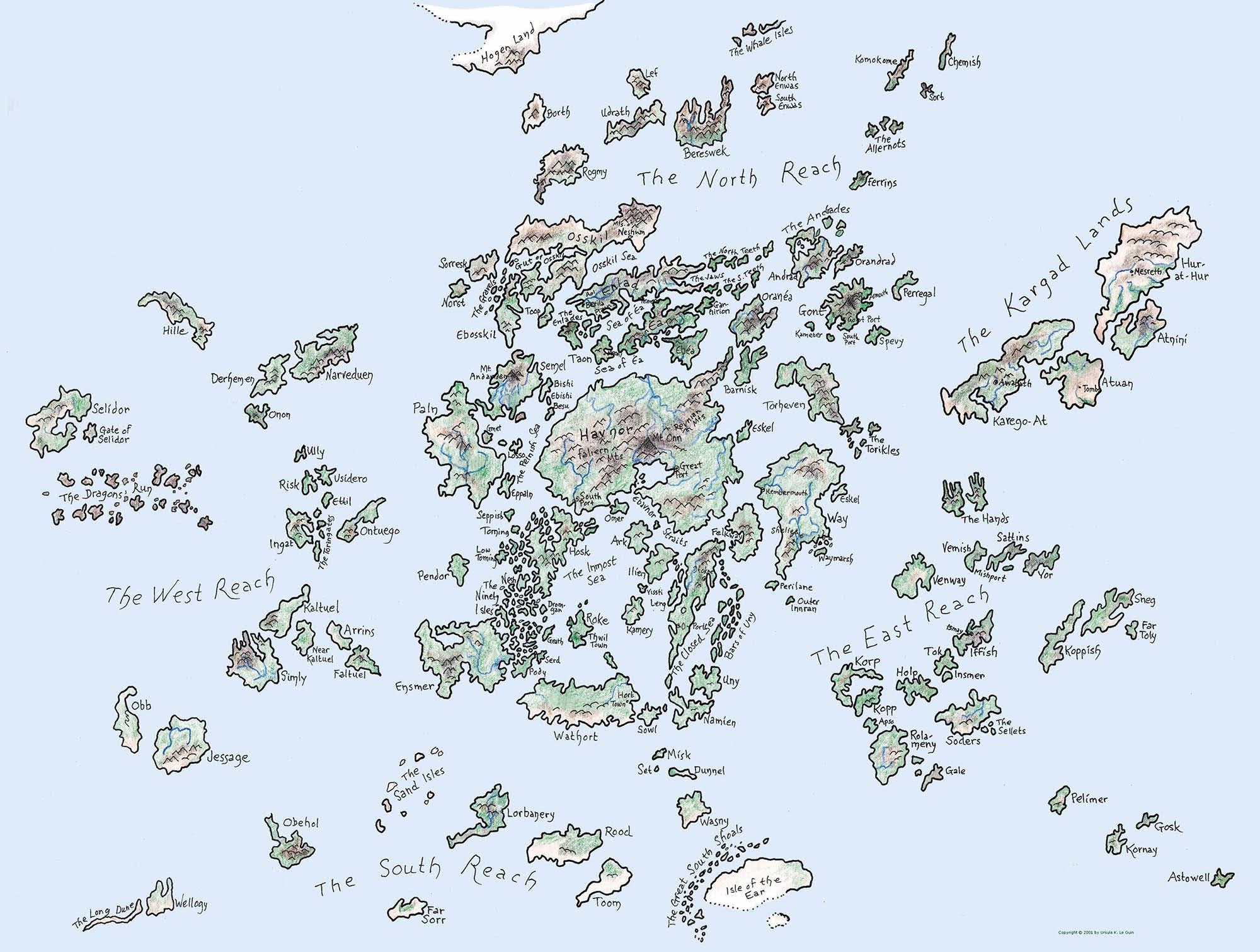
In this series, I’ll be working my way through Ursula K. Le Guin’s Earthsea works and analyzing her prose chapter by chapter. Spoilers follow.
First Impressions
Published 18 years after The Farthest Shore, Tehanu contains 14 unnumbered chapters in 252 pages. Originally published by Atheneum in 1990, my copy is a 1991 Bantam paperback in the style of their late ’80s, early ’90s releases of the previous three books.
Like my other Bantam editions, this book has cover art. This time the artist is John Jude Palencar. A painting takes up about a third of the front cover. It depicts a dragon visiting a woman on a cliff by the sea. There was a price sticker from the secondhand store I bought this copy from, which I have removed. I got it for $2 probably in 2016 or 2017. It was marked $5.50 upon release in 1991.
This book lack’s Gail Garraty’s woodblock style illustrations at the start of each chapter. There is no dedication, at least in this edition.
Several times the front papers and cover blurbs remind the reader that this is the final book in the Earthsea cycle. This turns out not to be true, but they can be forgiven for their failure as oracles. I believe I’ve read somewhere that Le Guin didn’t expect to write more Earthsea at the time.
There is a map here. This time it confines itself wholly to Gont.
I first read the book in late 2020 or early 2021. I confess I don’t think I did a very good job reading it at the time, though given the historical moment, I think I can forgive myself for being somewhat more of a surface reader then. I am somewhat more accustomed to the maelstrom now and better at dividing my attentions.
I’m further ahead than usual at this point in the deep read. I’ve made it through the first four chapters. The writing seems more brisk than in any of the previous three books though it’s a denser book. My immediate impression, probably influenced by having just reread “Earthsea Revisioned,” is that Le Guin is ever more deeply in her own voice, less the practiced voice of “EPIC FANTASY.”
This is not to say I find one better than the other. It’s just a difference in style; a classically trained pianist slipping back comfortably into the jazz she grew up with.
Chapter 1: A Bad Thing
Length: 5 pages, 34 paragraphs
Setting: The Middle Valley of Gont, especially Oak Farm
Characters introduced: Goha (we’ll realize eventually this is our old friend Tenar), Flint (her dead husband), Apple (her daughter), an unnamed son, Lark (her friend), Ogion (a wizard), Ivy (a witch), Beech, three tramps (two men and a woman), a burnt child left for dead (we’ll get the name Therru next chapter)
The first thing I noticed in writing this is that Tenar is more thoroughly entrenched in the daily life of her world than Ged ever was. Her friends and neighbors and brusque relations have names and jobs and the implication of their own lives. Ged might have had that many named ensemble players in the past three books.
The first thing I noticed while reading is how Le Guin guides us along toward the knowledge this is Tenar. She gives us a page to figure it out before Tenar reminds us she’s spent much of her life living near tombstones. We’ve picked up the game by the time her friendship with the Archmage and the business with the Erreth-Akbe’s ring comes up.
It’s interesting to get another view of the crisis happening during The Farthest Shore. Things are bad on Gont, though seemingly not as outlandishly bad as in the Reaches or even on Roke. Folks are troubled, but Tenar and her acquaintances don’t seem caught in the miasma of lethargy and paranoia that gripped the places Ged and Arren visited.
We’ll get a little deeper into that tomorrow. Until next time.
 chasetriesagain.com