
In this series, I’ll be working my way through Ursula K. Le Guin’s Earthsea works and analyzing her prose chapter by chapter. Spoilers follow.
Chapter 4: Dreams and tales
Length: 14 pages, 89 paragraphs
Setting: The Place of the Tombs
Characters introduced: Poppe, Nathabba, Munith, Punti
After Arha’s first visit to the Undertomb and first execution (a slow and grueling one), she takes ill. She has nightmares about the men she has condemned to die of thirst and hunger alone in the dark. It seems at the end of the last chapter and in the beginning of this that the characters believe it is some magic of the Undertomb that Arha most learn to cope with, but I think the text tells us it is the fear, guilt, and doom I spoke of in yesterday’s post.
The dark cloud is eventually dispelled by a visit from Penthe where Arha laughs again and learns that Penthe doesn’t really believe in all the gods worshiped at the Place of the Tombs, not in any serious way. Penthe wants to be reincarnated as a dancing girl.
I love of Le Guin dances around the edges here. Arha is appalled that someone should question the faith, that someone should want anything other than being what they are.
That’s how Arha has been raised. She is the Eaten One, but Penthe hasn’t been eaten. No great fate awaits her. She is a priestess because it was convenient for her family. She is at the Place of the Tombs because it was convenient for the Godking’s clergy.
Le Guin doesn’t tell us straight on, but what Arha is really upset about is not the lapse of faith but the notion that other folk are free.
A little later, she’ll reflect on how she is Arha, has always been Arha, will always be Arha. For everyone else around her, reincarnation is a roll of the dice, an opportunity for something different. For her, it is once more to be torn from a mother’s breast, to be taken to the Place of the Tombs, to kneel before an empty throne, to be eaten, and to serve the Nameless Ones.
Arha learns to love the Labyrinth and the Undertomb and the Hall of the Throne for the freedom they grant her. She can go where she pleases, spend her time there as she wishes because they are her domain.
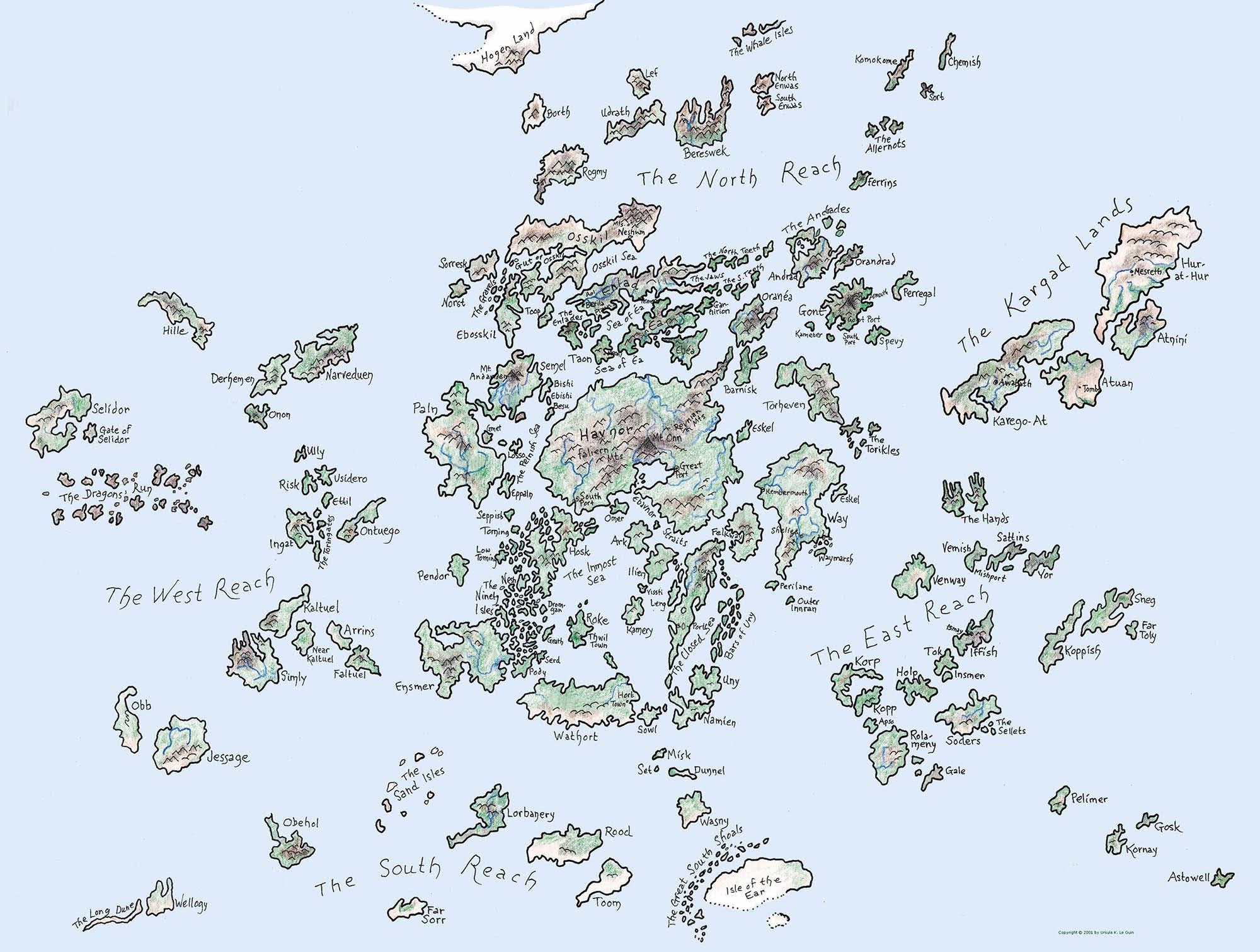
The chapter concludes with a long discussion between Thar, Kossil, and Arha about the history of Earthsea, Erreth-Akbe, and his doings in the Kargad Lands.
The contrast between Kossil and Thar comes into focus here. Thar enjoys telling stories, values knowledge, and she tells what she has learned and is honest about what she hasn’t. Kossil makes pronouncements from ignorance that glorify her position and damn those who are unlike her. My favorite bit is near the end, quite short.
“‘Lies,’ Kossil said.
‘Words,’ said Thar.”
We do get a good guess who those castaways were that Ged met in the first book and just exactly what that half ring was. They were descendants of Thoreg carrying the Ring of Erreth-Akbe, though A Wizard of Earthsea already tells us the latter part.
A final note, we have had some talk of words in an unknown language and of priests calling down lightning to fight sorcerers. I wonder how different the magic of Roke and the magic of the priests of the Kargad Lands is really meant to be at this point in the text. If Kossil could do magic, she would certainly have done so already.
That’s it for tonight. A light in the dark tomorrow. Until next time.
 chasetriesagain.com