
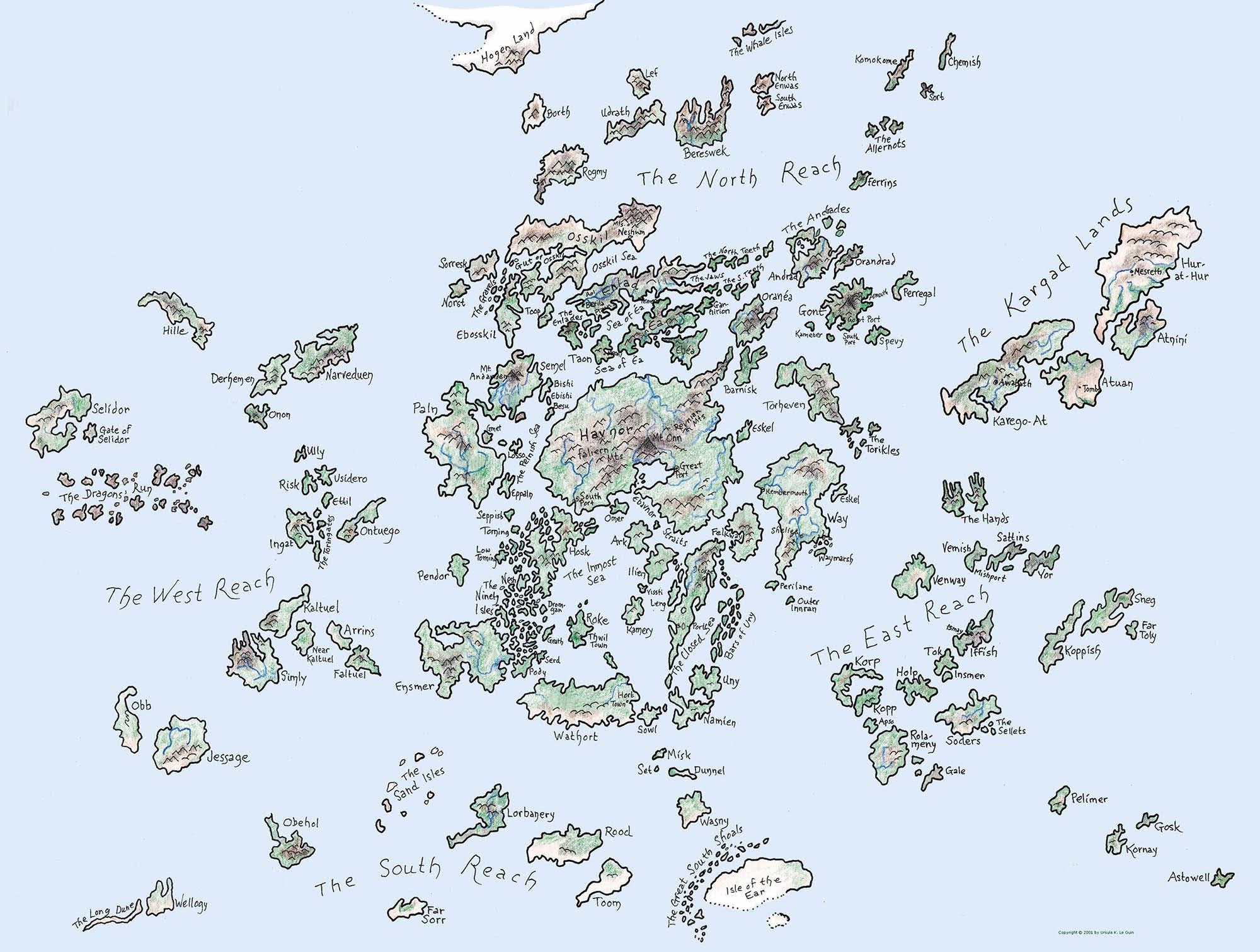
In this series, I’ll be working my way through Ursula K. Le Guin’s Earthsea works and analyzing her prose chapter by chapter. Spoilers follow.
Chapter 2: The Wall Around the Place
Length: 12 pages, 79 paragraphs
Setting: The Place of the Tombs
Characters introduced: Mebbeth, Penthe (Kossil and Thar are named in this chapter but appeared in the last)
We get an awful lot of worldbuilding and an awful lot of casual cruelty in this chapter. The two are not entirely separate. Manan tells Tenar (now Arha) how she was forcibly taken from her mother. Arha gives us a thorough rundown of the monotony and rigidity of life for the priestesses. We learn the priestesses have slaves. We see Kossil whip Penthe for what seems a minor disobedience.
We get a glimpse of the unknowing cruelty of children, repeating the harsh words of their elders: the flippant way that Arha and Penthe talk about the other peoples of the archipelago, how they are “the color of dirt,” how they trade in foul sorcery, and how the Godking of the Kargad Lands will eventually conquer them all and make slaves of them.
We also get a bit of the knowing cruelty of children: Penthe and Arha mocking the eunuch Manan who is, it seems, the only adult who shows any gentleness to Arha.
The Place of the Tombs is a cruel place with cruel rules in service of a cruel empire, and Arha seems to want to be cruel to fill her role in it but cries when her friend is punished in her place.
Beyond this, I’m impressed with Le Guin’s use of architecture to show us the layering of religion in this place, how it has changed over time and what the relationships are between the powers at play. The Godking is the most recent addition with the grandest temple befitting his real political power in the Kargad Lands. The Twin Gods are holy middle children, their temple eclipsed by the Godking’s but far more human than the nameless gods that Arha serves.
The Hall of the Throne is described as almost a part of the desert itself but still obviously constructed and falling apart, and it is outdated by the standing stones that are themselves the Tombs of Atuan. The nameless powers are ancient, feared, and neglected as much as possible by the other priestesses. Their great Hall of the Throne slowly falling into ruin.
I haven’t chosen a particular passage from this chapter. There’s lots of lovely description, but nothing stood out enough to me to reproduce. If I were to share something it would probably be the long description of the geography of the region. The whole chapter, though, seems to me a pretty masterful bit of stealth exposition that tells us as much about the character of the setting as the character of the protagonist.
Last year, I read all of Gregory Maguire’s Wicked Years, including the Maracoor books, which I had not read before. I may reread those later this year because I’m curious how much The Brides of Maracoor owes to The Tombs of Atuan. Both books feature a protagonist from a previous book landing themselves amongst a group of cloistered priestesses serving an empire by performing religious mysticism and rituals. I suspect this is not an accident.
Until next time.
 chasetriesagain.com