
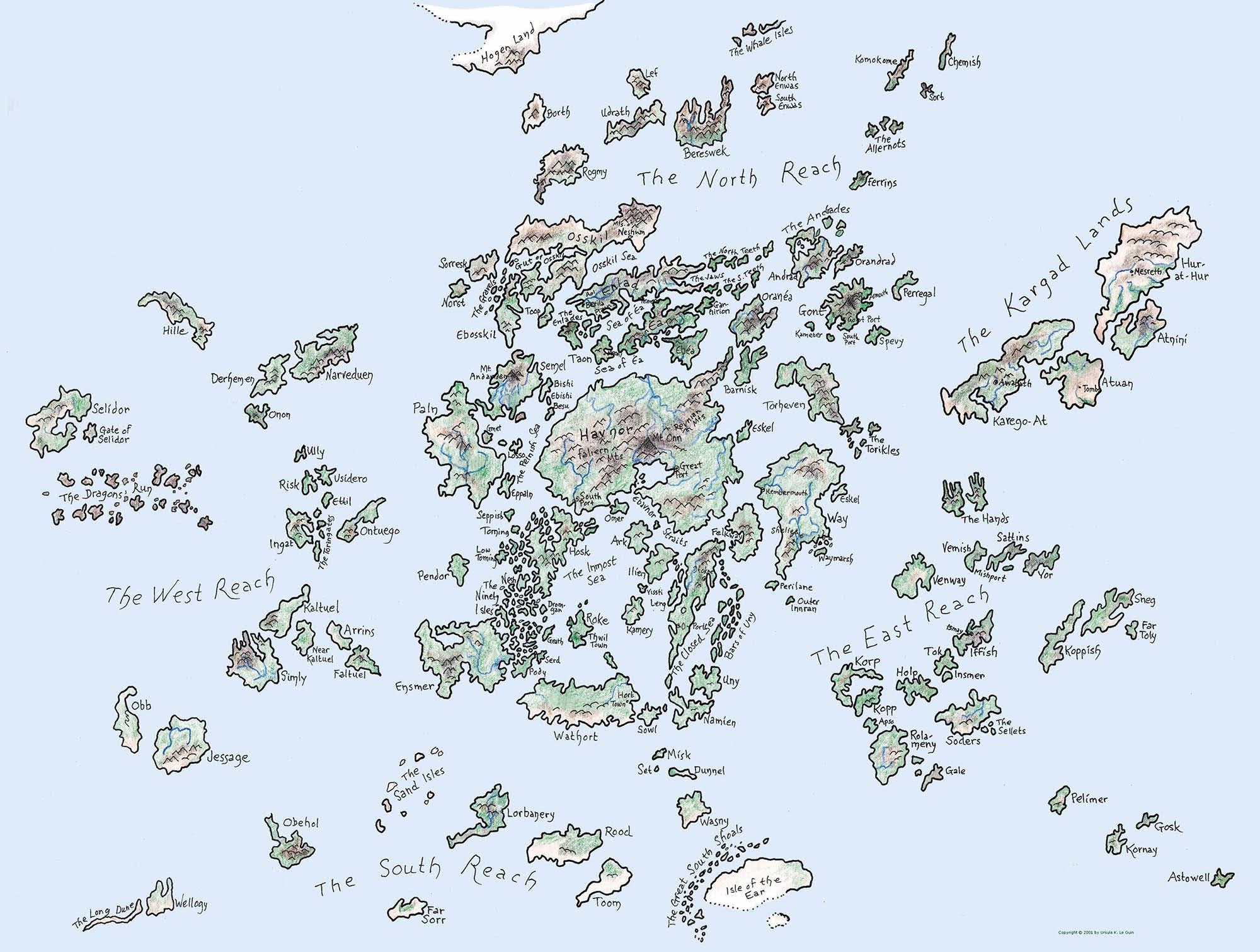
In this series, I’ll be working my way through Ursula K. Le Guin’s Earthsea works and analyzing her prose chapter by chapter. Spoilers follow.
First Impressions
The Tombs of Atuan served as my introduction to Earthsea. At the time, I thought it was a strange, dark book that asked more of me than C.S. Lewis had when, at last I worked my way through Narnia and went on to the next closest fantasy series.
Later I would be somewhat disappointed to return to Earthsea in A Wizard of Earthsea. There was a richness and a strangeness to Atuan and the Place of the Tombs that felt set apart from much other fantasy than did Ged’s first adventure.
I am not sure what I’m looking for in this book, having not read it in a few years. I know in the past, Le Guin’s prose has been powerful enough that, even as my eyes moved across the page, I could feel the deep and foreboding dark of the Undertomb and the Labyrinth pressing against them.
This book is 13 chapters including the prologue. My copy is 146 pages, though the start of every chapter is dominated by a half page illustration and some chapters have blank pages at the end so that each chapter always starts on the right-hand side. At least in this edition, the chapters are not numbered.
This is a 1989 printing from Bantam with a blue cover and a painting on the front that I have only just noticed because it’s only about a third of the page and partially covered by the price sticker from the secondhand store where I picked this copy up. The cover art was created by Yvonne Gilbert in 1984. Gail Garraty’s woodblock prints decorate the start of each chapter.
The book was originally published by Atheneum Books in 1971. The book is dedicated to “the redhead from Telluride,” but I’ve come up empty-handed looking for more information on this dedication. (Alas, I’ve only just learned that Le Guin’s son curated a temporary exhibit on his mother that ran until earlier this month. The exhibit included correspondence leading to the publication of the Tombs of Atuan. I would love to have visited.)
There is no post-script or epilogue, but there is a SPECIAL OFFER from Bantam adorning the bottom of the last page of the last chapter.
The first thing I’ve noticed is that this book seems, in just its first few pages, quite a bit closer in tone to Le Guin’s voice in her non-fiction and later books. There is a standoffish, high register narration in A Wizard of Earthsea that is less present here.
Prologue
Length: 2 pages, 7 paragraphs
Setting: Tenar’s family farm
Characters introduced: Tenar
We start with just the briefest glimpse of Tenar’s early childhood, the short time with her parents before she was whisked away to the Place of the Tombs to become a priestess in service of the Nameless Ones.
Chapter 1: The Eaten One
Length: 4 pages, 30 paragraphs
Setting: The Place of the Tombs (though we have not yet learned that name)
Characters introduced: Manan and two priestesses yet to be named
This is where the forward action begins. Little Tenar undergoes a ritual in the Hall of the Throne to become Arha, “the Eaten One.”
These chapters are so short, but I’m impressed by how much character Tenar gets from her passive participation in the ritual and dismissal of Manan who cares for her.
My favorite bit is that, amongst all the strange majesty of the ritual, when we begin to pan away from this sacred throne, too large for a human and too important to be sat in, it’s covered in dust and owl droppings and cobwebs.
Whatever dark powers are here, the natural world doesn’t fear them. All the strange ritual and obeisance of the priestesses cannot deter a bird from leaving its mark on a bit of old stone.
“The jewels inset in the huge clawed arms and the back were glazed with dust, and on the carven back were cobwebs and whitish stains of owl droppings. The three highest steps directly before the throne, above the step on which she had knelt, had never been climbed by mortal feet. They were so thick with dust that they looked like one slant of gray soil, the planes of the red-veined marble wholly hidden by the unstirred, untrodden siftings of how many years, how many centuries.”
It seems Tenar is not quite in awe of the powers honored by the Hall of the Throne, and perhaps we shouldn’t be either.
Until next time!
 chasetriesagain.com