
In this series, I’ll be working my way through Ursula K. Le Guin’s Earthsea works and analyzing her prose chapter by chapter. Spoilers follow.
Chapter 9: Iffish
Length: 16 pages, 84 paragraphs, 1 full page illustration
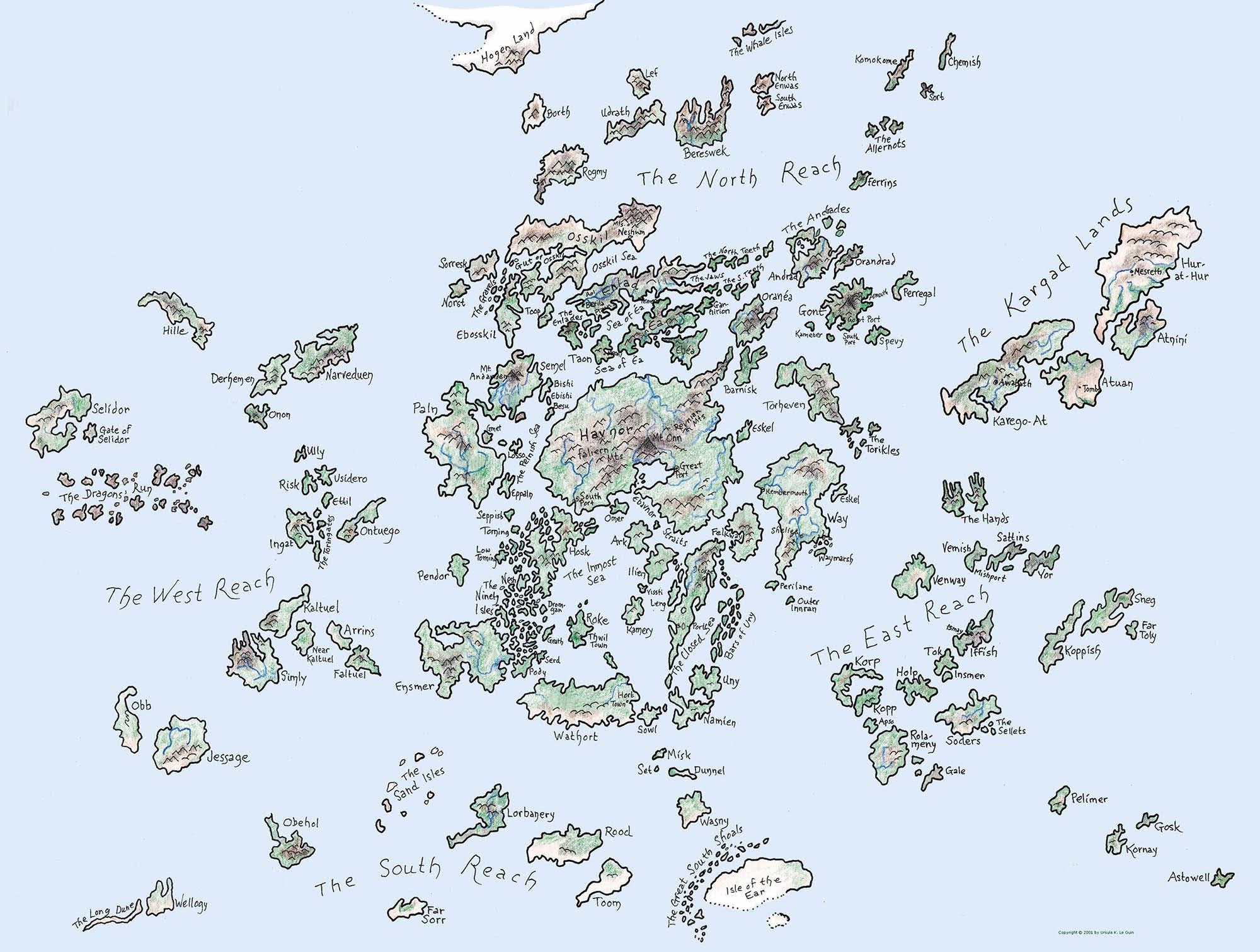
Setting: Iffish
Characters introduced: Yarrow, Murre
I am afraid as we reach the conclusion of this novel, I have less and less to say about it. Ged receives the ship Lookfar, and he visits Vetch at last. Vetch and his siblings are some of my favorite characters in Earthsea.
Yarrow, for her part, seems to break the mold of prominent women in this first installment of Earthsea. She is good and kind and not duplicitous, and I think readers could be forgiven for mistaking her for a love interest for Ged.
I do think, as we draw close to the end, that I may have been unfair in my reading of the women in A Wizard of Earthsea. It’s true that there are fewer named and prominent women than there are men, but I am not sure it is fair to say that they are more often evil or dark.
Ged’s aunt initially attempts some cruel magic when she discovers the boy’s powers, but she backs off immediately. I am not sure she is altogether worse than his seemingly neglectful father. Serret’s enchantress mother never takes the stage, and we have only Ogion’s theory and general implication to go on in that direction. She isn’t a good character, but beyond that, it’s hard to say.
Serret, for her part, is as much a victim of the Terrenon plot as a collaborator. Benderesk is the chief villain there.
The Lord and Lady of O are equally un-characters.
The castaway sister certainly isn’t a villain, nor the witch and the old woman in the Ninety Isles who see to Ged when he failed to save the baby. We meet goodly fishwives a time or two as well.
I think it’s Ged’s aunt’s initial attempt to bind him to her service and Serret’s collaboration with Benderesk that left me with a bad taste in my mouth, and that wasn’t entirely fair. Yarrow’s late arrival to the text meant that she’d left less of an impression on me.
(Aside: I meant to note the similarity of Ged’s visit to the Court of the Terrenon and “Sir Gawain and the Green Knight.” Alas, I forgot at the time. At some point when I have more time, I may dig a little further into this comparison to see if it goes beyond the surface. It may have more to tell us about A Wizard of Earthsea.)
I am interested by how heavily this chapter (and the next) will lean into the folklore of magic: the old man who gives Ged Lookfar and promises that his thanks “will look out of that blind wood for you and keep you from rock and reef,” Vetch’s “Avert!” gesture, and Yarrow’s admonishment about Ged’s missing the oatcake he eats when he is hungry at sea and how it is referenced as a sort of prophecy and promise of return home in the next chapter.
Le Guin seems to build a sort of counter-magic, just beyond superstition, a simple magic of the home as opposed to the grand and mysterious power wielded by Ged. The rules change in the Reaches for Ged’s magic, but the heartfelt, simple gestures of kind people seem to reach where Ged’s magic cannot.
Tomorrow, Ged goes to that strange, dry country under unending night. Until next time.
 chasetriesagain.com