
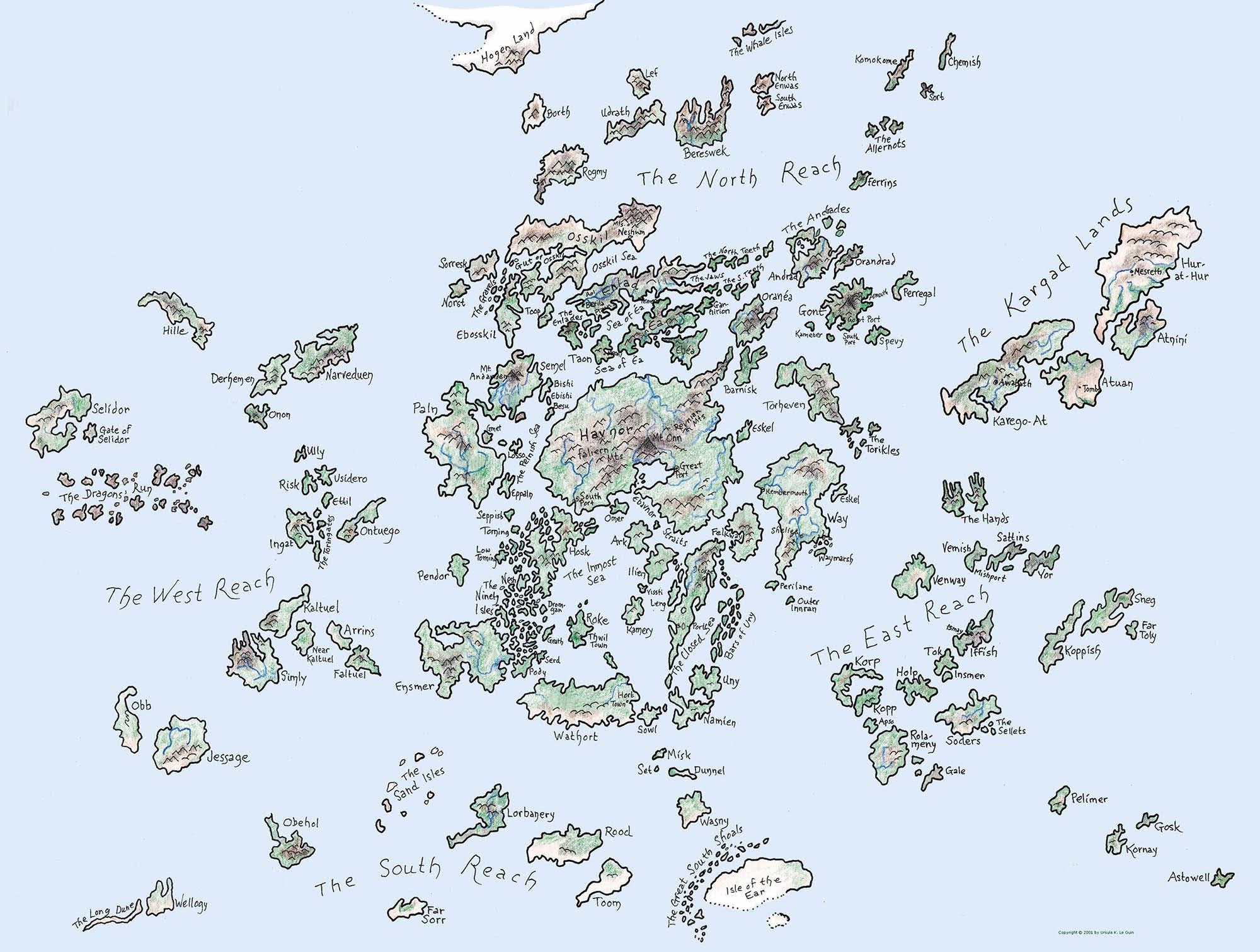
In this series, I’ll be working my way through Ursula K. Le Guin’s Earthsea works and analyzing her prose chapter by chapter. Spoilers follow.
Chapter 7: The Hawk’s Flight
Length: 20 pages, 118 paragraphs
Setting: The Court of the Terrenon, Osskil and Re Albi, Gont
Characters introduced: Benderesk
At last the enchantress’s daughter gets her name. Serret welcomes Ged into the Court of the Terrenon in what will become a dark mirror to Frodo’s awakening in Rivendell (I missed the comparison of last chapter’s finale with the flight to Rivendell following the encounter at Weathertop).
Ged’s entrapment in the Court of the Terrenon poses an interesting question. Just how long had the Terrenon and its would-be masters been scheming to bring Ged here?
Ages ago, Ged read the wrong page of one of Ogion’s books, and Ogion himself said that it may be the enchantress had some plan afoot. That’s our first glimpse of the gebbeth. The Roke-wind gave Ged some trouble from his very first trip to the Isle of the Wise. Nemmerle’s raven speaks of the Terrenon, and an agent of Benderesk finds Ged in his wanderings after he left the Ninety Isles.
It seems pretty clear that Ged was always being manipulated toward the Court of the Terrenon, but beyond Ged’s own speculation, we’ll never have a character step in front of the mic and say it plainly.
Regardless, Ged is responsible for his own actions. That much is clear. Whether Benderesk or the entity or the enchantress is scheming after him, they’re only taking advantage of Ged’s own mistakes. No one made Ged open the way to the afterlife on Roke Knoll.
I think some of the game of names that Le Guin is playing becomes more clear here. Serret and the gray-clad sorcerer Ged met in the last chapter (and maybe some more people I’m forgetting) have functioned like ninjas in Japanese theater.
In some Japanese theater (and maybe this concept is apocryphal), stagehands dressed in black would move set pieces and facilitate other background changes and effects. Their dark, simple clothes were meant to help the audience ignore them. Then sometimes somebody needed ninjas to stage a surprising assassination or something of the sort. What better surprise than to reveal that the stagehands were part of the show? Even more subtle than extras, ninjas materialized from the shadows the same way their historical counterparts might have blended into a crowd.
In the same way, Le Guin’s nameless NPCs like the enchantress’s daughter and the gray-clad sorcerer can direct the story in subtle ways that both Ged and the reader may take for granted. The reader is invited to treat these people as stage-dressing for moments in Ged’s story rather than characters with histories and agendas of their own. Ged, too, seems to take them for granted much to his detriment.
The poor otak doesn’t get any justice. This isn’t a story about flashy fights. Ged’s victory over Benderesk and the entity is only to escape back to the man he trusts most in the world, and Ged is finally ready to learn from Ogion.
Le Guin’s views on how one should move through the world are rather different than much of the western fantasy canon. I think there’s some friction with this books version of the right thing to do and Tehanu‘s. But Ged is at last set on the right course.
Maybe my favorite line in this installment of the Earthsea series concludes this chapter.
“Master, I go hunting.”
 chasetriesagain.com