
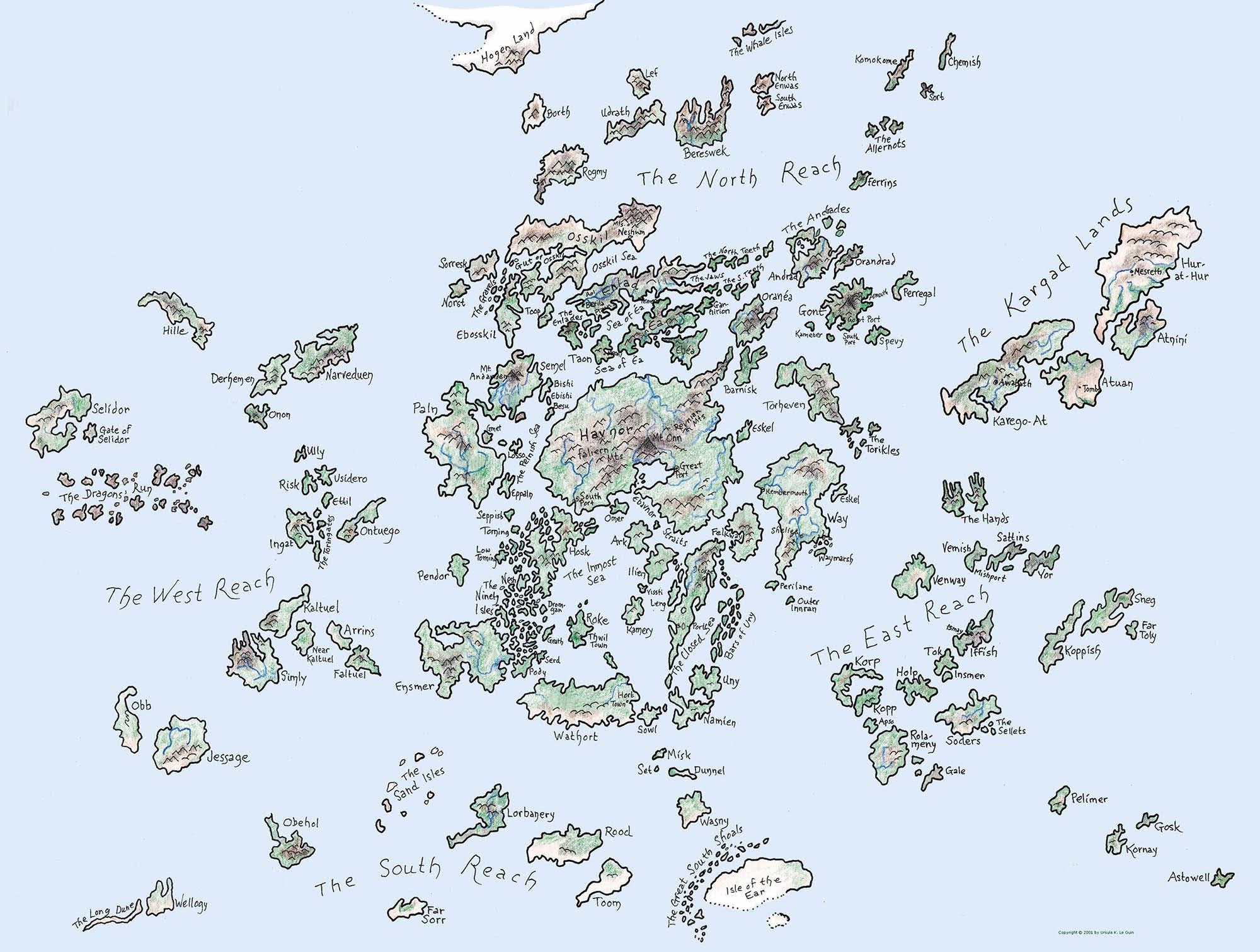
In this series, I’ll be working my way through Ursula K. Le Guin’s Earthsea works and analyzing her prose chapter by chapter. Spoilers follow.
Chapter 5: The Dragon of Pendor
Length: 18 pages, 91 paragraphs, 1 full page illustration
Setting: The Ninety Isles, Pendor
Characters introduced: Pechvarry, Ioeth, the Dragon of Pendor
Alas, I have very little time for tonight’s post because Emily the Dog has elected to be a holy terror. Even now she terrorizes the creatures of the night in our backyard.
There are several bits of beauty in this chapter. I think we learn an awful lot about the scale of magic in Earthsea. Ged can turn back nine dragons by magic and by the fortune of having guessed the Dragon of Pendor’s true name. But he cannot save a little boy from dying.
I think that juxtaposition is maybe the best bit of craft in the whole book. Life may be easily spent, but it is not cheap.
The gebbeth also grows in our imagination. If Ged is prepared to fight dragons and gamble on a guess, the gebbeth most be truly scary.
I also quite like that it’s the otak that brings Ged back to himself after his failed attempt to save Ioeth.
Le Guin’s depiction of the afterlife fascinates me, and I think that’s my favorite passage in this chapter. She describes the passage into the afterlife with such precision and consistency but such reserve over its appearances in the series that it has the quality of a recurring dream.
“Then he saw the little boy running fast and far ahead of him down a dark slope, the side of some vast hill. There was no sound. The stars above the hill were no stars his eyes had ever seen. Yet he knew the constellations by name: the Sheaf, the Door, the One Who Turns, the Tree. They were those stars that do not set, that are not paled by the coming of any day. He had follow the dying child too far.”
It’s haunting and strange, and there is the hint that maybe for the dead it is something altogether different.
I should have mentioned a couple of chapters ago my admiration for Le Guin’s use of textual ruins. All the bits of proper nouning and referring to legends we’ve never heard makes Earthsea feel a much larger place. The constellations in the afterlife are one example. Elfarran, Morred, Erreth-Akbe, and Orm. Done with care and an ear for tone, it expands the world, gives it breadth as well as depth.
That’s all for now. Until next time.
 chasetriesagain.com