
In this series, I’ll be working my way through Ursula K. Le Guin’s Earthsea works and analyzing her prose chapter by chapter. Spoilers follow.
Chapter 2: The Shadow
Length: 14 pages, 85 paragraphs, 1 full page illustration
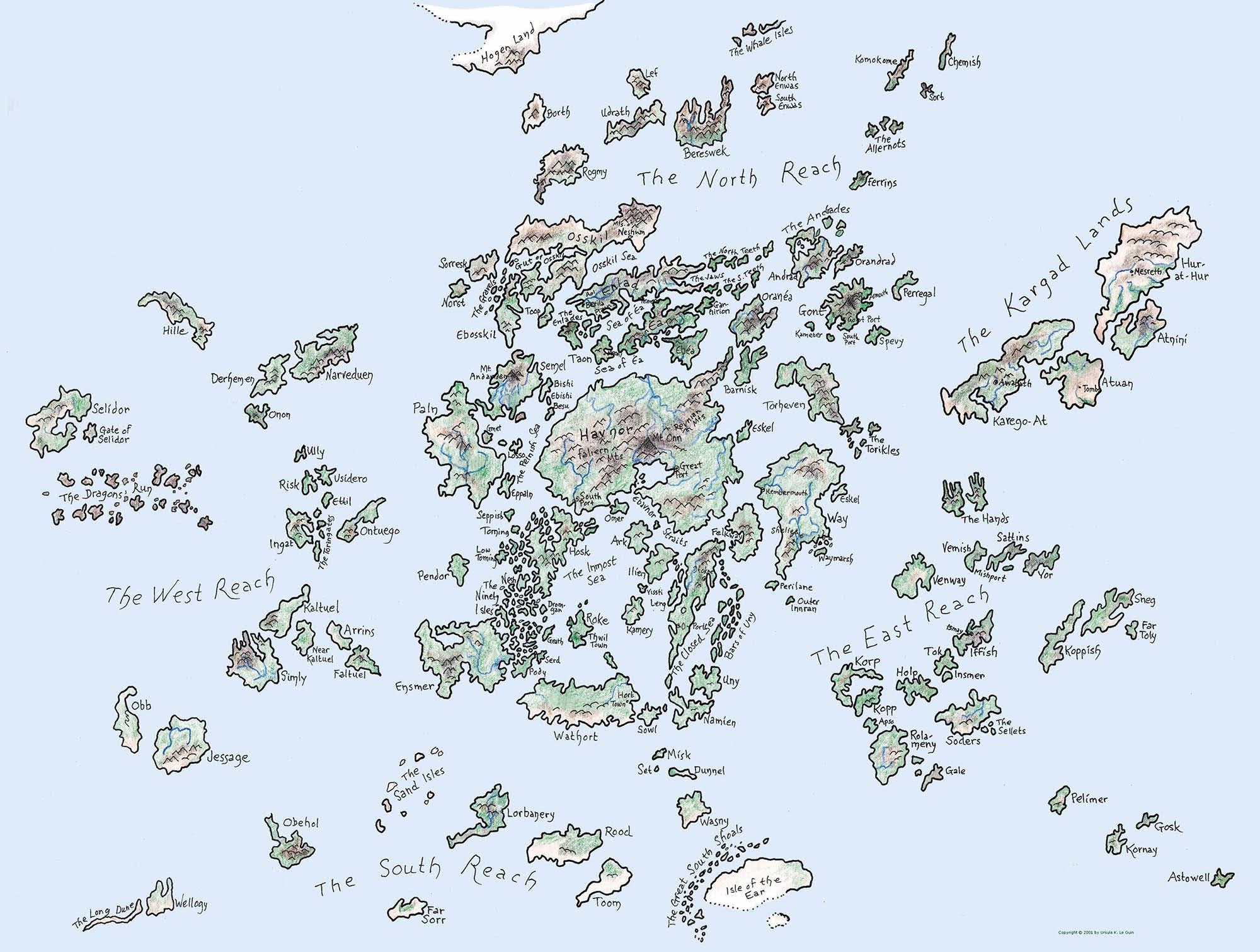
Setting: Re Albi, the Port of Gont, Thwil, Roke, and several places between the Port of Gont and Thwil mentioned in passing as the Shadow traverses the Inmost Sea
Characters introduced: The enchantress’s daughter, the shadow
No matter how many times I’ve read A Wizard of Earthsea, it still surprises me that Ged spends only nine pages as Ogion’s apprentice.
I am impressed with Le Guin’s mastery of youthful emotion. My favorite passage in this chapter is Ged’s internal struggle over whether to stay with Ogion or go to Roke.
Ged stood dumb, his heart bewildered. He had come to love this man Ogion who had healed him with a touch, and who had no anger: he loved him, and had not known it until now. He looked at the oaken staff leaning in the chimney-corner, remembering the radiance of it that had burned out evil from the dark, and he yearned to stay with Ogion, to go wandering through the forests with him, long and far, learning how to be silent. Yet other cravings were in him that would not be stilled, the wish for glory, the will to act. Ogion’s seemed a long road towards mastery, a slow bypath to follow, when he might go sailing before the seawinds straight to the Inmost Sea, to the Isle of the Wise, where the air was bright with enchantments and the Archmage walked amidst wonders.
“Master,” he said, ‘I will go to Roke.”
It’s a careful little observation about making big choices in life. It’s not the most exciting bit of writing in the chapter, but typing that ought, I’m impressed by Le Guin’s discipline in keeping the first chunk in just one paragraph of four sentences. I would be tempted to make “Yet other cravings…” start a new sentence, but I think it’s more effective keeping those two juxtaposed futures crammed in next to each other.
It makes Ged’s simple declaration of intention all the more effective. Ogion is a man of few words, and Ged’s statement seems Ogion-ish in nature.
Our only new characters worth observing are the enchantress’s daughter and the shadow, and I would not necessarily know to note the daughter if I hadn’t read the story before.
Le Guin introduces our major antagonist and one of the secondary antagonists in interesting fashion. The chapter is named “The Shadow” so our attention is drawn to it, it sticks, especially once Ged is aboard a ship called by the same name.
The enchantress’s daughter, on the other hand, seems like another of those characters like Ged’s family, that might be here to serve as a lesson and then forgotten as Ged’s story moves on. We’ll meet her again down the line.
I noted in my last Earthsea post that I was thinking a lot about depictions of women prior to Tehanu and especially in this first book. The daughter seems a little sinister, but there’s plausible deniability (and there will be some degree of plausible deniability when she returns). Ged’s aunt was the same way, and Ogion, though he warns Ged about the enchantress and her daughter, does not claim to know the enchantress’s intentions, only that she does not wish him well.
I have some thoughts about Ged, the enchantress and her daughter, and the shadow that will have to wait until later in the book.
I have to admit that my eyes glazed over during the travelogue segment this time around, but I do wonder if we’re immediately supposed to understand the storm as Roke trying to ward off the darkness around Ged.
I take it that way, but I also know that Roke has such defenses. We’ve seen relatively little of magic prior to this moment, but we are told that wizards can bat storms around just to keep their hair dry on an evening stroll.
That’s it for this chapter and for this post. Until next time.
 chasetriesagain.com