
In this series, I’ll be working my way through Ursula K. Le Guin’s Earthsea works and analyzing her prose chapter by chapter.
I just read A Wizard of Earthsea a couple of weeks ago, but as I want to dig more thoroughly into the writing and craft on display, I’m tackling it a second time. I started by flipping through the book placing bookmarks at the start of each chapter and getting a feel for the overall structure of the book.
First Impressions
I’ve read A Wizard of Earthsea three or four times at this point, so much of this information isn’t new to me. This first Earthsea novel was originally published in 1968 by Parnassus Press. Le Guin was asked to write a young adult fantasy, and per her introduction to The Books of Earthsea: The Complete Illustrated Edition, Le Guin wrote it without much of an outline.
My copy is a 2004 Bantam paperback edition. It’s 183 pages divided into 10 chapters. Without taking the time to count, I think most chapters are closer to 10-12 pages and a couple of longer chapters make up the difference.
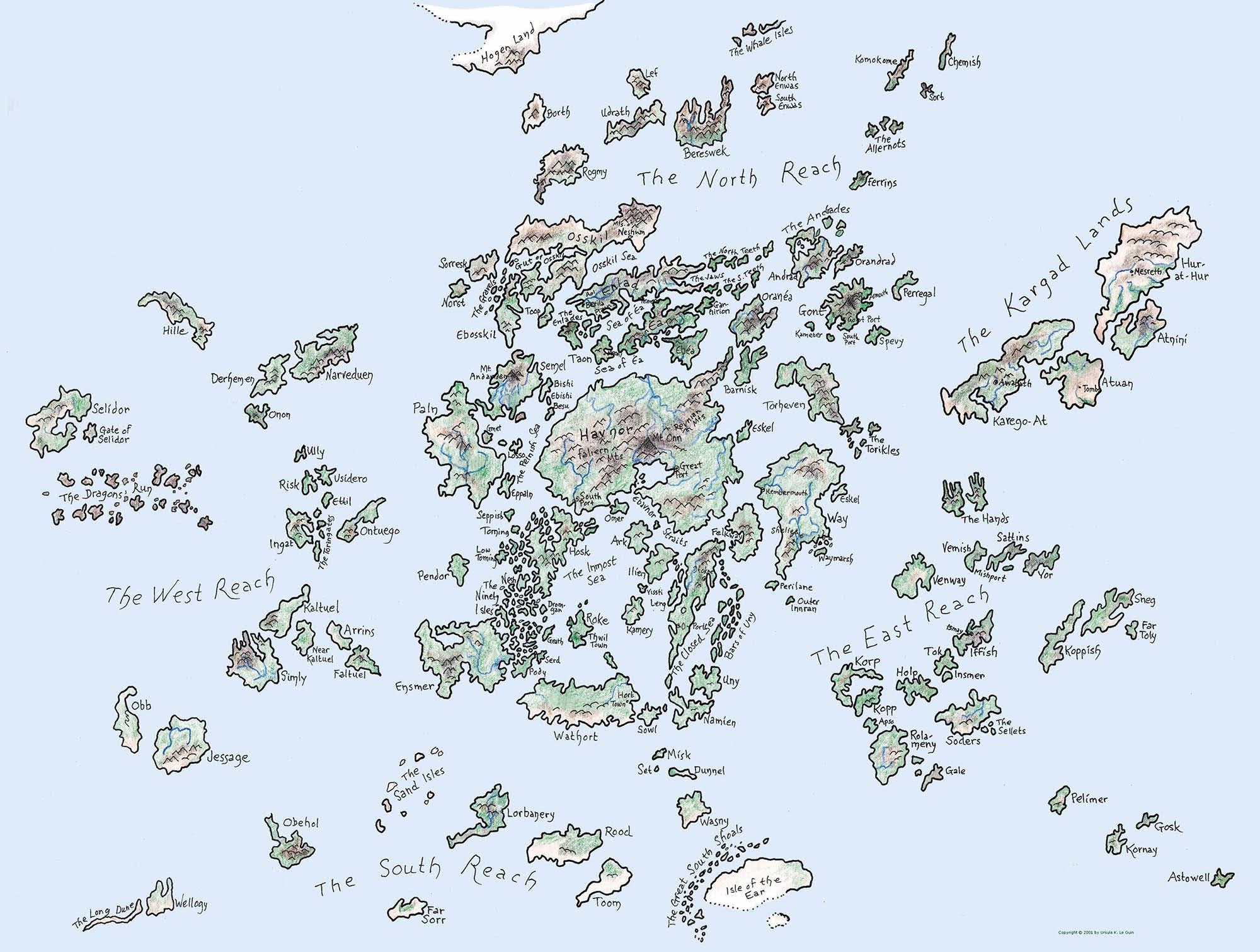
The book has a map of Earthsea. There are a couple of maps zoomed into more detail placed throughout this edition of the book. They’re not super in-depth maps. Those secondary maps are mainly there to save you flipping back to the front.
Le Guin’s chapters all have titles. The book starts with a short poem just before the first chapter and ends with a half page epilogue of sorts. The poem, epilogue and a few sentences in the text (usually early on) suggest that this story is a forgotten part of a larger legendarium.
In her introduction to the illustrated edition Le Guin talks about the shifting role of gender in her approach to the Earthsea books. In the first three books, she says, she was somewhat unconsciously writing the traditional male hero because that was the ambient background noise of the fantasy writing she was trying to emulate. With the fourth book, published almost 20 years later, she was much more aware of this and deliberately set out to write from her own experience as a woman.
This is not the only place Le Guin has talked about this shift in the Earthsea narrative. My first Earthsea book was The Tombs of Atuan because it was a fantasy book in my middle school library directly next to C.S. Lewis on the bookshelf. By the time I picked up A Wizard of Earthsea for the first time in college, I was vaguely aware of this shift in her approach but not quite ready to appreciate it.
After reading the book again last month, it sticks out to me how negatively many of the women in A Wizard of Earthsea are often portrayed. If I was reading this totally blind, I might assume some unkind things about the author.
The book is also dedicated to Le Guin’s brothers. I really get the sense that A Wizard of Earthsea was written for boys between 10 and 13 in a way that none of the rest of Earthsea really seems to be.
Chapter 1: Warriors in the Mist
Length: 15 pages, 51 paragraphs
Setting: Ten Alders, Gont
Characters introduced: Duny/Ged/Sparrowhawk, Ogion
The first chapter starts by telling us about Gont, the island our protagonist was born on. Gont gets a bit of personification as it “lifts its peak a mile above the storm-racked Northeast Sea.” Gont seems to be a bit of a backwater, but one known for producing great mages.
We learn in the first graf that our protagonist, known as both Ged and Sparrowhawk, will eventually be one of the most legendary mages of Gont and will be an archmage and a dragonlord. He’ll have stories told about him in future, namely the Deed of Ged.
When our story really gets underway, we learn that Ged is currently a little boy called Duny whose mother died in childbirth, whose older brothers leave home to become sailors and smiths, whose father is a gruff, maybe neglectful bronze-smith, and whose aunt is a witch with little interest in him.
By page 5 we learn the gist of the story. Ged is going to become a great mage and that path is going to lead him to “hunt a shadow over land and sea to the lightless coasts of death’s kingdom.”
We learn a fair chunk about magic in this first chapter. I think our first real sign of magic is a perfect microcosm of the magic of Earthsea. Ged learns a spell just by overhearing his aunt as she talks a goat down off a roof. (Not everyone, it seems, could pull this off. Little Duny has a gift.) Ged uses that partial spell to charm the village goats, but as it turns out, using magic without discipline and understanding can have unforeseen consequences.
Overall, we get a sense of both “mechanical” rules of magic as well as the social realities of magic in Earthsea.
- Magic relies upon true names to some degree.
- Magic can exhaust the user to the brink of death.
- You need discipline and understanding to use it properly.
- There are things called the Balance and the Pattern that inform the use of magic for better educated mages. These mages are probably “wizards.”
- There are many disciplines of magic both in terms of types of magic (binding, revealing) and magical trades (weatherworkers, healalls)
- It’s not clear what a sorcerer is, but a sorcerer is not a wizard.
- It does seem clear that a witch is a woman who uses magic and it comes with some negative connotations.
- Ignorant mages (like village witches) have muddled together truth and folklore, and some of their spells don’t work. Some of their magic is also ill-used and wicked.
- There is still a delineation between crude uses of magic and true evil.
- There is also a distinction between the day-to-day charms and curses of a witch and invocations of the “high arts” and trafficking with the “Old Powers.”
- It also seems that magic done for the wrong ends can tempt you along in dangerous directions.
In this read, I’m really interested in the depiction of Ged’s aunt. Like most of the characters in this section, she’s not named. When she sees that Ged, still a small child, has some innate skill for magic she immediately tries to bind him to her service and is further startled by his power.
The narrator informs us that “wicked as women’s magic” is a common phrase in Earthsea, and we learn that Ged’s aunt does use her magic toward some cruel ends. Nevertheless, she’s “no black sorceress,” and she tries to teach Ged along the straight-and-narrow as best she’s able, though focused on the power and prestige he could achieve.
Ged’s aunt, for an unnamed character, seems complicated, but in a book with so few women, the message seems to be pretty firm that in (early works) Earthsea, women magic users aren’t to be trusted.
Note: I want to clarify that I feel rather fortunate to be able to see Earthsea evolve so much from this first chapter until its end. The gap between A Wizard of Earthsea in 1968 and Tehanu in 1990 is worlds and worlds large. Le Guin was always a progressive writer, and to see Earthsea grow from her own analysis and revision is, I think, a unique experience in the genre.
We learn about the Kargad Lands and the raiders that come from there and get a hint of their religious drive.
I do appreciate that Le Guin lavishes proper nouns upon islands and towns and landmarks and regions, but characters get exactly as much name as their role demands. The only properly named characters in this first chapter are Ged (who gets THREE names!) and Ogion, who immediately feels like somebody who could shame Gandalf for his frivolity.
My favorite passage in this chapter is Ged’s experience with the goats.
He yelled the rhyme aloud, and the goats came to him. They came very quickly, all of them together, not making any sound. They looked at him out of the dark slot in their yellow eyes.
Duny laughed and shouted it out again, the rhyme that gave him power over the goats. They came closer, crowding and pushing round him. All at once he felt afraid of their thick, ridged horns and their strange eyes and their strange silence. He tried to get himself free of them and to run away. The goats ran with him keeping in a knot around him, and so they came charging down into the village at last, all the goats going huddled together as if a rope were pulled tight round them, and the boy in the midst of them weeping and bellowing. Villagers ran from their houses to swear at the goats and laugh at the boy. Among the came the boy’s aunt, who did not laugh. She said a word to the goats, and the beasts began to bleat and browse and wander, freed from the spell.
The goats are a great choice for the imagery. They’re just weird enough to get really uncomfortable. That’s also such a perfect childhood moment, laughing as you get away with something, try something new only to panic when it gets very much out of hand. I imagine most of us have at least one memory of feeling panicked and scared and maybe really being endangered only to have adults laugh simply because while the danger was real to us, they had it well in hand.
This is also another neat bit of magic exposition. Ged knows part of the spell but not how to control it, and his aunt shows what mastery looks like. Dismissing the goats is simple for her. It also reveals that poorly controlled magic has a somewhat sinister, unnatural effect on the world.
That’s all for now. I’m off to watch the Fallout finale and crash. Until next time!
 chasetriesagain.com