
Saturday Worldbuilding is a weekly project wherein yours truly builds a world from scratch in a disorganized bid to express what I think makes a world useful and interesting. Check out last week’s entry here.
In the first Saturday Worldbuilding post, I selected a central tension: democracy versus autocracy. Our goal is a TTRPG setting, and I’m stealing Matt Colville’s fantasy Cold War scenario.
Last time, I started building a city. Our city is the capital of an outlying nation on the nominally democratic side of the conflict. Situated at the mouth of the river, it is a rare (for this region) stone city sinking into mangrove swamps. The more common local architecture features stilt-houses and treehouses. Rice is a staple crop, and they also grow mulberry, guava, persimmons, mangos, and Asian pears in the wet soil.
Their livestock includes pigs and some sort of fantastic aquatic cattle. They also raise silk moths for silk and produce this world’s equivalent to Tyrian purple. They trade silk, dyes, nifty local ceramics, candied fruit, and rice for weapons, metal, foreign alcohol, dried meats, and wheat flour.
The city is divided into five districts: a farmer’s market connected to the shore by a famous bridge, a sprawl of treehouses and stilt-houses on shore that make up the poorer part of the city, the docks where adventurers hang out, a district for artisans, and a city-center built around a palace.
We also got the city’s most famous tavern: the Egret and Egg.
Now that we’ve got the basics of what the city is like and how it survives, let’s dive into politics. Last time, I mentioned a palace, but I cut a brief mention of what I think the local political situation is.
This old stone city was once the colonial center of a long-gone empire. The empire passed out of mind some time ago, and a local monarchy was established or re-established. We don’t need that much information about the ancient past, this is plenty for this point in our worldbuilding.
We’re on the democratic side, and this monarchy is on the way out, being replaced by some parliamentary assembly. I’m thinking the old king was something of a reformer, helping empower his parliament and stepping away from rule himself, sensing that the distant and impersonal monarchy was growing unpopular (and for some reason, jaded about the institution himself).
The old king passed, and the crown passed to his granddaughter, who was prepared to abdicate as soon as feasibly possible. Scheming uncles and viziers are a staple, and I think we’re going to give our young queen a scheming aunt, envious of the crown herself.
So we’ve got our central tension in this microcosm. The young queen is prepared to abdicate and allow the full transition of power to some sort of parliament or senate. Her aunt wants the crown for herself and probably wants to return the power to the throne.
I think this kingdom is on the border between the two powers, maybe its port opens onto a sea that splits them in two. Probably, the aunt’s supporters include some agent or agents of the autocratic faction, though I think she’s willfully unaware of this.
Crucially to the conflicts ahead, I think the old king was an inefficient reformer. He served as a tiebreaker, greasing the wheels of a slow, clunky fledgling democracy that could not meet the needs of its people alone.
I have a few characters and factions in mind. We’ll probably get into these a bit more later, but I want to lay them out while they’re on my mind. The queen has a loyal agent, an oldster who has served at least three generations of her family. He appreciates her ideals, but he sees the threat her aunt poses and wishes the queen would wait for a better time that’s not coming.
There’s somebody in an influential place who is openly fascinated with the trappings of monarchy, vocally in favor of democracy, but quietly just there to drum up as much chaos as possible on behalf of some enemy power.
There are competing factions of royalist brigands and republican rabble rousers. If I run an adventure here, whichever faction the players meet first will be initially portrayed positively. The royalists are young people aspiring to knighthood and chivalry. The republicans are generous merchants and farmers eager to prove they can keep the peace without the need for landed nobles with fancy crests.
On the flipside, the royalists are a disorganized bunch of status-jockeying lowlifes and ousted lesser nobles hoping that supporting the right claimant to the throne will get them somewhere in life. The republicans are overeager to take justice into their own hands, and the wealthiest among them are angling to buy representation in the assembly.
On that note, I don’t think guilds are terribly powerful here. I think there’s too much internal competition within industries for cohesive guilds to form, and instead, one or two wealthy merchant families from each major industry end up scrambling for power and doing what they can to make their lot easier and more profitable.
As a final note on the politics for now, I think a core problem that adventurers turn up to solve is that the local guard is perpetually stretched thin. They need more resources, but the assembly is slow acting and deadlocked by the nobles that have traditionally patronized the guards.
Onto landmarks, I think our baseline does a pretty good job symbolizing the central tension. I think these people were traditionally led by groups of elders and village assemblies, so I think there’s some association with the people and tradition tied up in their wooden houses.
The houses are designed to respond to the moment, weathering a season, easy to rebuild, possible to move. The stone city, on the other hand, is the remnant of a foreign power, cold, distant, ill-suited to the environment, and surviving despite that, weighing down on the landscape even as the swamps try to devour it.
I think we need to carry that contrast with us into other landmarks. The farmer’s market district has some sort of religious structure. Maybe it’s an ancient circle of mangrove trees that have grown together to form a sort of natural cathedral. I think a district of stone was built up around it, and it’s probably encircled with pillars in a sort of aqueduct design. I think an open-air bazaar has grown up around it, and the district gets its name from whatever that grove is used to worship.
The palace district also has a temple, and I think that one needs to be styled after a Greek temple or cathedral. All stone and fire as opposed to the wind and water of the grove.
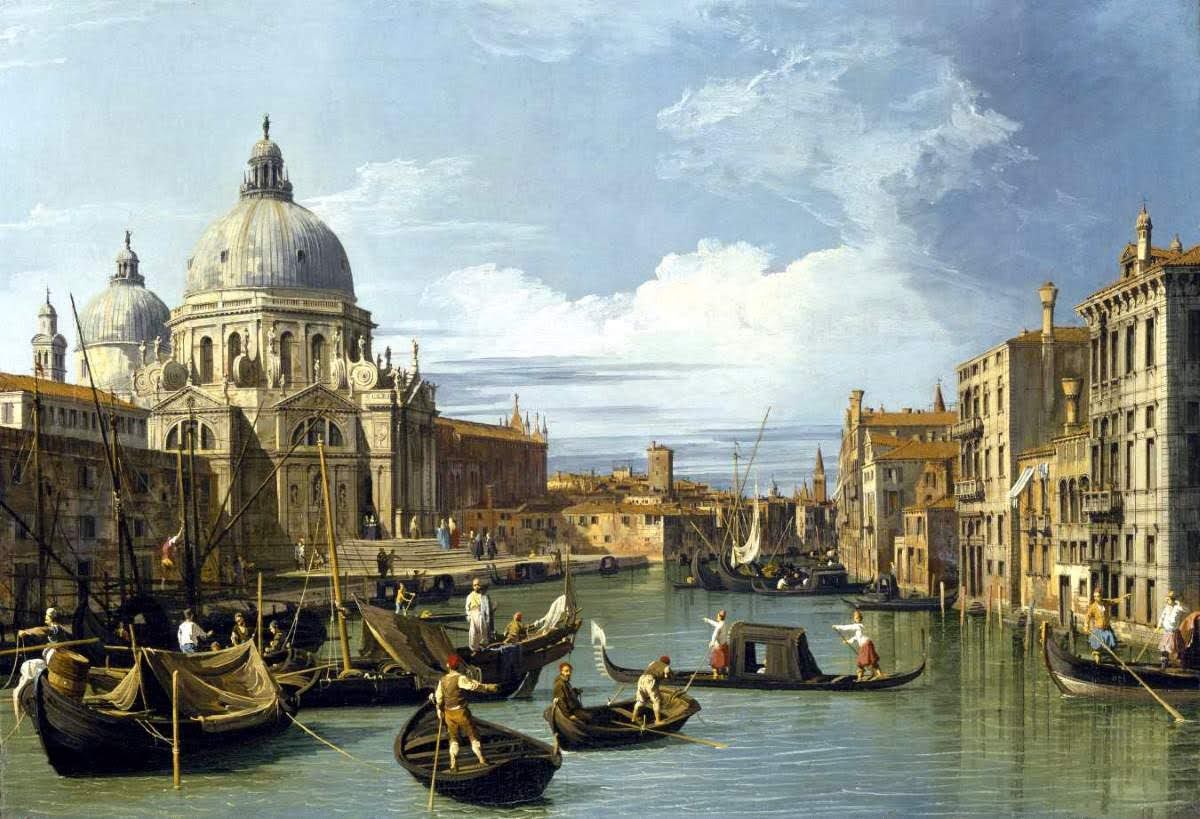
I think the Egret and Egg is a more subtly neutral space. I really like the visuals of Venice, it’d be interesting to play around with some more natural-looking wooden additions hanging out over a canal.
I’m not sure yet what function it serves, but I think the artisans need something kind of bold in their district. My current thinking is a manor-turned-public-space that is absolutely covered in colors. Brightly dyed curtains, brightly painted facades, ornate examples of local pottery. It uses every color except Tyrian purple because the dyers could make it, but they weren’t allowed to use it themselves.
Finally, I think our district of hovels needs something kind of interesting. I think they’ve recently reclaimed an ancient amphitheater from the moss. It’s become a communal space for art and local meetings. There’s a couple of neat layers of contrast there.
Next time, we’re going to talk moths and festivals and sketch in some details before we start to zoom out.
 chasetriesagain.com
2 Comments