
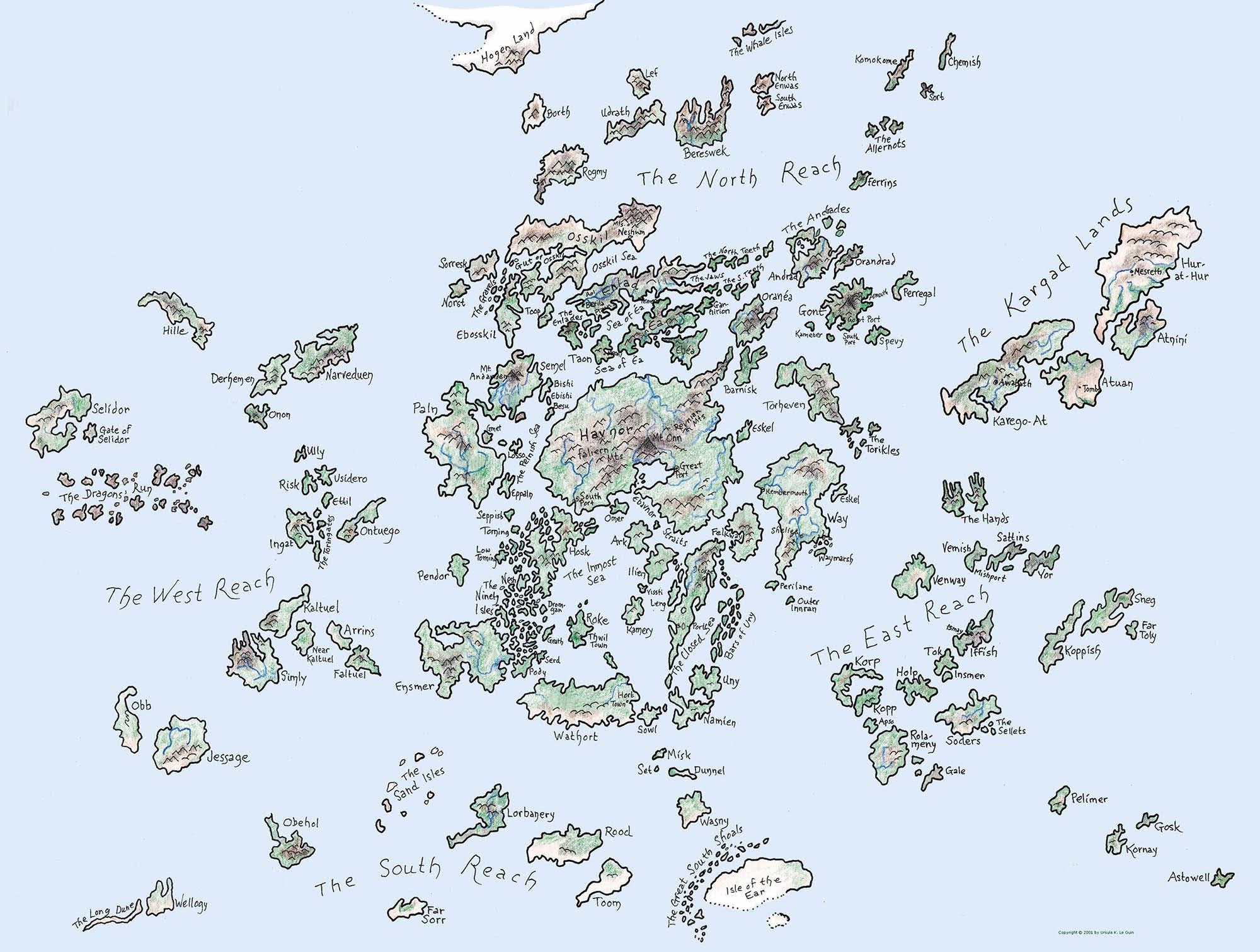
As I’ve been writing the Appendix C entries, I’ve noticed that I spend a lot of time discussing worldbuilding. I’ve seen mountains of worldbuilding questionnaires and detailed guides to plate tectonics, but while I am an inveterate over-builder myself, I don’t think these things in particular build a good world or a good story.
So every Saturday for an indeterminate amount of time, I’m going to do a worldbuilding write up. In the end, we’ll have a world that I think I could write an interesting story in or build an interesting campaign from. And we’re going to worldbuild in the opposite direction, from narrow to broad rather than from broad to narrow.
First, let’s rule out some other starting places. Tolkien quotes are usually drawn upon in discussions about maps and conlangs and world history. Tolkien built a mythos from scratch that defined a genre and stands as one of the great works of literature from the 20th century.
But when we use Tolkien for a model of how to build a world, we tend to forget some key details. Tolkien was a talented artist and renowned philologist. His method for building a world was rooted in his life experiences and the skills of his trade.
Maps and conlangs and ancient histories are building blocks we’ll certainly play with, but they’re not essential starting places. I think understanding those as tools, not as rules is essential.
A couple of other topics I see get a lot of traction in worldbuilding discussions that I think are actually terribly over-discussed are races and magic systems. I’ve seen no end of Reddit posts about how to build good magic systems and whether elves are overused.
Scrap all that. Ball it up. Throw it out right now. We’ll touch on races and magic systems, too. Tools, not rules. First, we’ve got two questions.
1: This is the easy question. What is this world going to be used for? Are you going to write a novel or a series of short stories? Are you going to play a D&D campaign? Just want to come up with a world for some fantastical creatures to draw?
2: This is the harder question. What’s the theme or the central tension? I’m cribbing notes straight from Matt Colville on this, but if you want a world with interesting conflicts, with characters with intersecting motivations, with juice, a clear theme or a central tension helps.
As Colville says in his first politics video, not every good setting, campaign, or story needs this to work. but I think it helps, so we’re going to make it part of our process. (Check out Colville’s video here.)
Colville gives a few examples like the North versus the South in the Civil War and Republic versus Empire in Roman history (or in Star Wars). These conflicts aren’t the start and end of every bit of setting detail or characterization, but they’ve got layers and give a dynamic background to set stories against.
In Tehanu one of our central tensions is between society’s expectations for women and a woman’s own needs and desires. The central tension in The Space Trilogy is between unchecked scientific progress and the natural order. The central tension in Final Fantasy X is between dogmatic tradition and progress.
Dael Kingsmill proposed a D&D alignment axis using two central tensions. This could also be a useful spin on things for you. (Check out Dael’s video here.)
Central tensions needn’t be immediately about two universal concepts, though I think they will be eventually, as you explore them. D&D’s Blood War is about devils versus demons, but it boils down to order versus chaos once you get past the surface. Jedi versus Sith could be a central tension in Star Wars. If you’re having trouble thinking up central tensions, the folks at r/mattcolville did some brainstorming on that subject a while back.
For a novel, my progress is a little more freeform. I can change things on the fly without confusing anyone because no one else is seeing the sausage get made. So for this project, I’m building a TTRPG world. I’m not going to worry about using a specific system just yet.
I’m going to crib more notes from Colville and Kingsmill in this instance. I want a fantasy Cold War between a democracy and an autocracy. There’ll be elements of other tensions, but the defining conflict will be between two powers.
So that’s the starting place. Next week, we’re going to build a city.
Until next time.
Next Post: Building a City Part 1
 chasetriesagain.com
1 Comment