
Inspired by the Appendix N from the AD&D Dungeon Master’s Guide, Appendix C is an ongoing series of short posts recommending works that have been influential for me as a writer and Dungeon Master.
I first encountered C.S. Lewis’s Space Trilogy in perhaps the worst way possible. In sixth grade, I was tearing through all the available books in the school library. I’d worked my way through The Chronicles of Narnia and made a pitstop at Ursula Le Guin’s The Tombs of Atuan.
When I returned that book to the library, I went again to the L’s, hoping to find more Lewis or Le Guin, and found the third book in the Space Trilogy, That Hideous Strength. That Hideous Strength is not suitable for an 11-year-old. In fact, I’m not sure That Hideous Strength is suitable for much of anyone, though it certainly infected my young imagination.
Years later, I would finally get my hands on copies of Out of the Silent Planet and Perelandra, both of which I found just as infections and several times more enjoyable.
I recommend the Space Trilogy (or at least its first two books) with a couple of caveats. The books were written by C.S. Lewis, and if you last encountered him as the author of beloved childhood literature, I expect there can be a bit of shock hidden in the pages. Lewis was, after all, a straight white guy cloistered in academia and writing as a conservative Christian apologist over 80 years ago.
His views about the world are, not surprisingly, different than our own. There are things in his works that I find wrongheaded and objectionable even as I find his writing and worldbuilding fascinating. My faith has also changed since I was a Christian teen looking for something more erudite than televangelism, and while I still appreciate some of his perspective, I also find some of his religious views wrongheaded and objectionable.
Also, if you’re a lover of hard sci-fi, these aren’t the books for you. Lewis certainly stretched out his fingers toward serious science, but much of what he wrote regarding space travel and extraplanetary geology and biology is nonsensical by our standards. Out of the Silent Planet was published almost 20 years before the first attempt to launch an artificial satellite into space.
Published between 1938 and 1945, the Space Trilogy was Lewis’s attempt to refute the notion that religion and science fiction were irreconcilable. Hitting the shelves 12 years before The Chronicles of Narnia, Lewis’s love of myth and his theological vision of the world are evident from the outset.
Angels in the Space Trilogy are very real, extradimensional beings living alongside us but with a loose relationship with physical space. Mars and Venus (and presumably other planets besides) are overseen by their own archangels called an Oyarsa. It becomes evident over the course of the books that the Oyéresu (that’s the plural) of Venus and Mars inspired the Venus and Mars of Roman myth and the Aphrodite and Ares of Greek myth.
Life on Mars is older than that on Earth, and while it has experienced a fall of sorts, it is not “bent” or sinful like life on Earth. Three races live on Mars, and it is replete with unique flora and fauna.
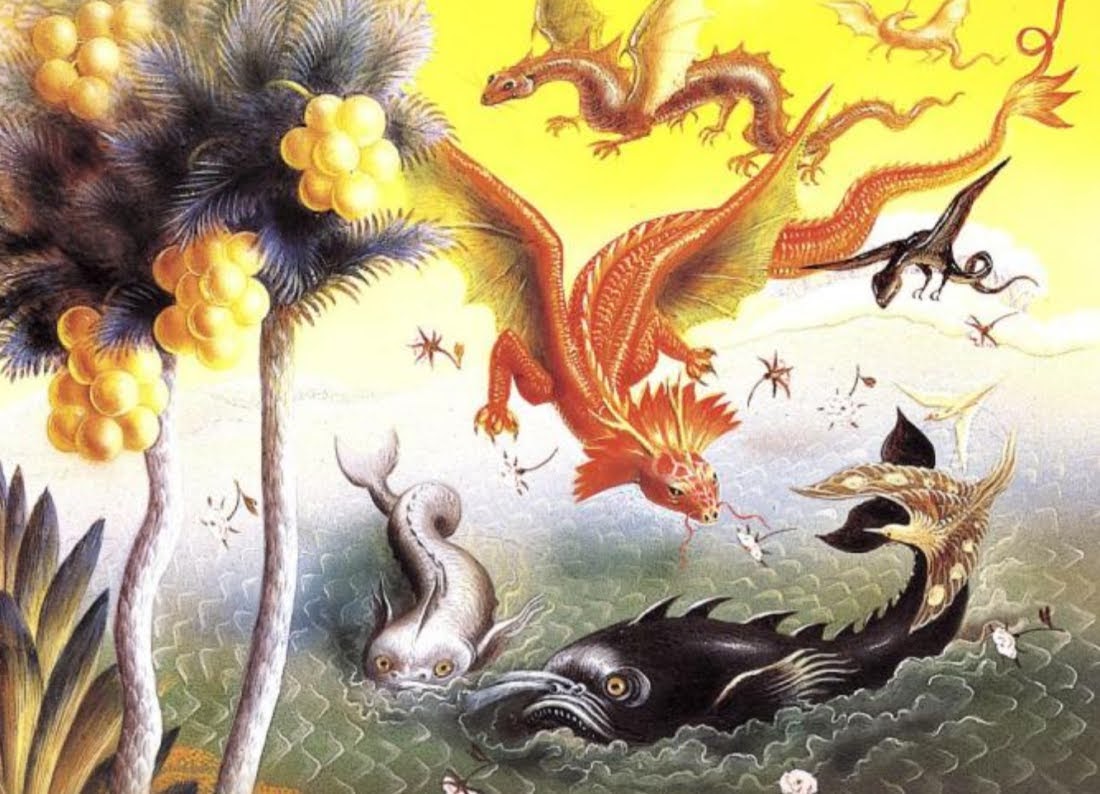
Life on Venus is newer and more humanoid, but the world itself is a wonder. Enormous islands of reeds or grass float across a global sea with few bits of solid land sticking up. The wildlife there is straight out of medieval illuminated texts.
I think Ransom’s (the protagonist) journey into the depths of Venus (or Perelandra) is the thing that sticks with me the most. In that journey, Lewis envisions ancient life and primordial entities living alongside but apart from the Christian sphere of life in the universe.
The worldbuilding is fascinating (and it does seem that’s the thing I talk about most in these posts), but it also accomplishes something I find critical to good fantastic fiction whether it’s a book or a movie we experience alone or a game we play together.
The Space Trilogy’s world expresses the author’s view and the themes of the work from the top down. We don’t need to believe in the physical reality of Perelandra or Malacandra (Mars) to see how they are themes given form.
I find that each book stands on its own reasonably well. It’s not even clear that That Hideous Strength is a sequel until some ways into the text, and once again, I think the third book is entirely worth dismissing. There are some neat ideas (Merlin returning, a literal talking head, and a friendly bear), but it’s a drag of a work, reveals a rather nihilistic view of the modern world, and has a really bigoted portrayal of a lesbian.
It’s also worth checking out the Space Trilogy just because, despite its relative obscurity, it’s been referenced by quite a few different writers. That Hideous Strength also contains references to Tolkien, with an ancient civilization called Numinor.
Until next time.
 chasetriesagain.com