

Inspired by the Appendix N from the AD&D Dungeon Master’s Guide, Appendix C is an ongoing series of short posts recommending works that have been influential for me as a writer and Dungeon Master.
As a kid growing up in small town Alabama, I didn’t realize they still made comics. That error was corrected for me when I was eight or nine, but I’d only set foot in a comic shop once before I started college.
I’ve probably shared that factoid before. What I knew about comics, I learned from two big stacks of yellowed comics from the late ’60s, ’70s, and ’80s. Their covers were torn, and at least a quarter of them didn’t have a thing to do with superheroes.
I didn’t really start reading comics from beyond those big stacks until I was about to graduate high school, but a host of influences would define my vision of the superhero. Some of those influences will be subjects for later Appendix C posts, but they attuned my taste for a work that would galvanize what I love most about superhero stories.
Astro City is a superhero anthology series begun in 1995. Written by Kurt Busiek, the series features art from Alex Ross and Brent Anderson. The series has been through four publishers, has won numerous awards, and has been collected in 17 volumes so far.
Astro City presents a world that blends the whole scope of superheroics with characters and history that feel real. The history of comic books and its various movements reflects the history of our own society, and Astro City translates that into a narrative.
Astro City formed in response to the “Dark Age of Comics” in the ’80s and ’90s. The foundational works of that dark age tackled serious subjects using a medium that adults and critics had long dismissed as kid stuff. However, many of the works that followed left the serious subjects behind, adapting the grim tone and bloody aesthetic alone.
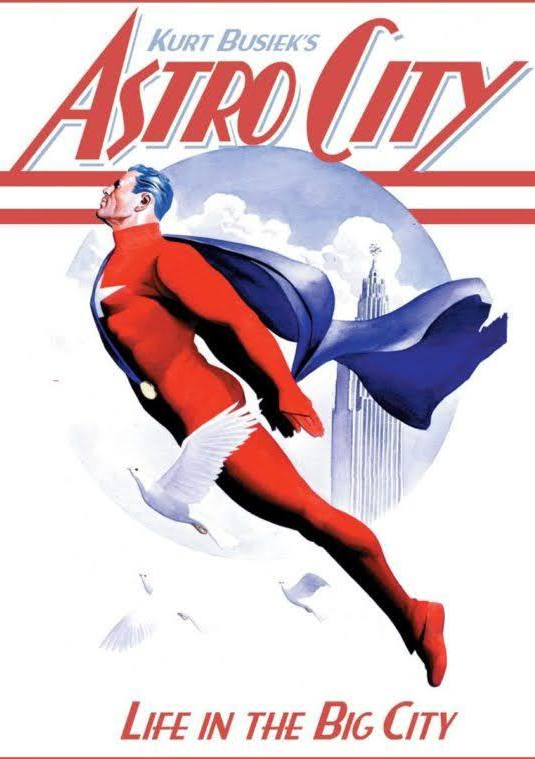 Busiek and his colleagues tried to restore some of the hope and optimism of older comics while still tackling serious subjects. The resulting work took almost the opposite approach from Alan Moore’s Watchmen. One of the foundational works of the Dark Age (and another of my favorites), Watchmen asks, among other things, what superheroes would look like in the real world. Astro City asks what real people would look like in a superheroic world.
What I take from it as a writer and gamemaster is pretty simple. If you want to make a fantastic world seem real, a couple of things come in handy.
The first is giving even your most outlandish, super-powered characters and giving them real wants and needs. Samaritan, the Superman of Astro City, is constantly aware of all the disasters he could prevent and the crimes he could stop, all the people that need saving, and he has the power to do something about it and the conscience to spend all his time getting it done. But he desperately wants time for himself. The world is heavy on his shoulders.
The second is to adapt your world’s institutions for the practical reality of whatever fantastic elements abound. In one Astro City story, a reporter witnesses a series of borderline miraculous events, but his editor demands that he only write what he can prove, ending up with a story about sharks on train tracks. Meanwhile, there are laws governing superheroics, institutions dedicated to the research and regulation of superpowers, and embassies for alien species.
If you’re interested in picking up Astro City, I highly recommend starting with the first collection, Life in the Big City. It’s not the most action-packed, but its stories are personal and do a good job of presenting the scope of the series. I’m also a sucker for, I think, it’s oldest cover. I love the aesthetics of Astro City, and the Saturday Evening Post layout with Alex Ross’s art is perfect.
 chasetriesagain.com