
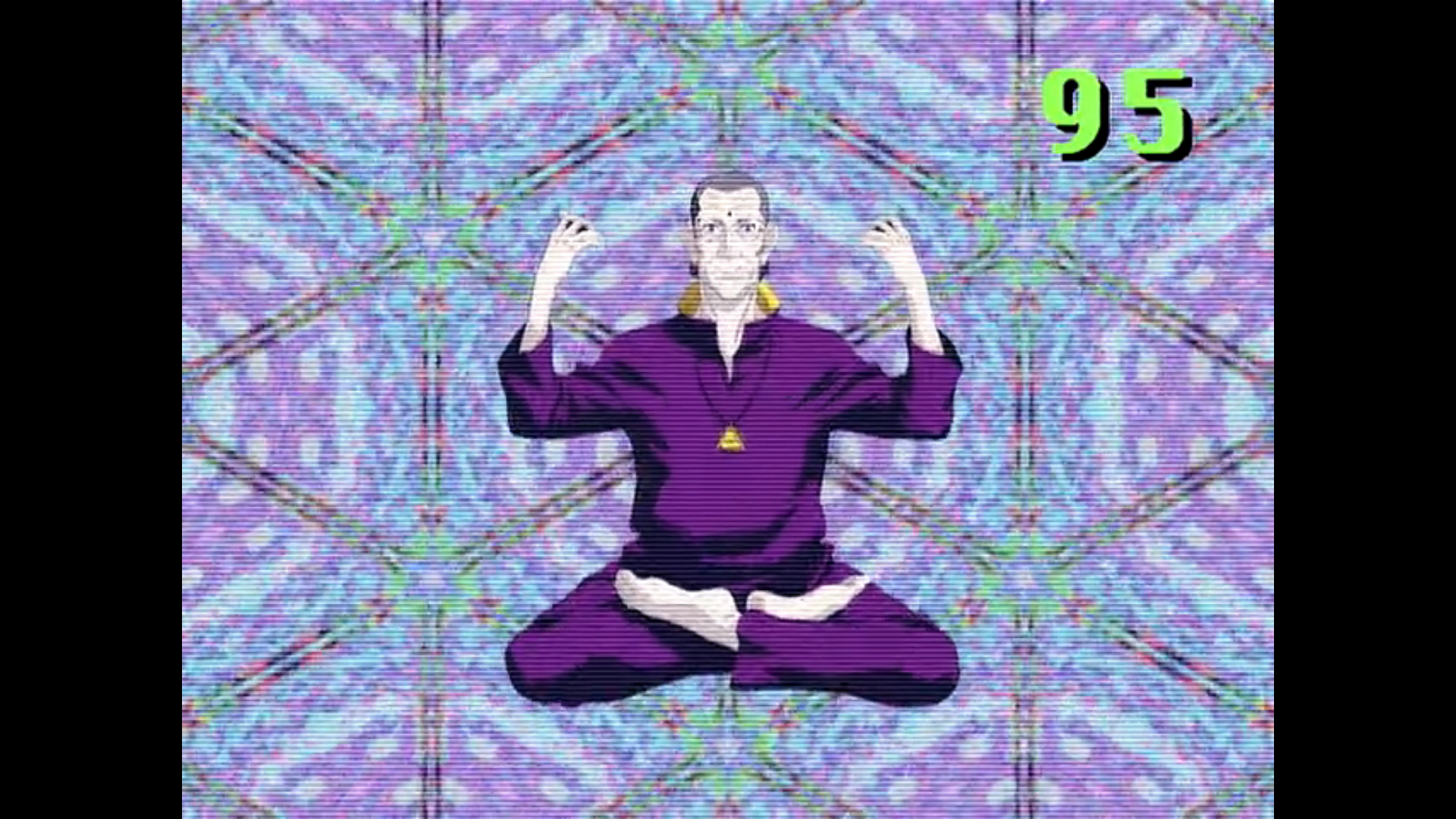
This episode’s preview is narrated by Andy. Andy claims he’ll come back and beat the cowboys in the next episode. It’s nice to see the last of Andy.
Session #23: Brain Scratch
Original Airdate: April 3, 1999
Written by: Dai Satō
Title Card Song: “Hip-Hop Bebop” – This is an unreleased track.
We’re almost done now, and Cowboy Bebop has a couple of things left to handle before we can get to the end. First of all, it’s got to punch a hole in the fourth wall.
This episode would be at home in Ghost in the Shell, and its use of VR headset as a tool for mass murder shouldn’t be too unfamiliar to anime fans. Let’s get the plot out of the way quickly.
Londes is a virtual persona created by a 15-year-old hacker who has been trapped in a coma, dying for two years. Londes is a bit of a nihilist and started a death cult centered around migrating the human mind to machines. Faye goes undercover and gets caught. Spike goes to save her and almost suffers the same fate. Jet and Ed find the genuine article in his hospice bed and disconnect him from the Internet. Ein is the one that figures out how Londes is actually killing people, saves Jet from it, and then hacks the system himself using little doggy dream twitches. (Jet is totally oblivious to Ein’s hacking shenanigans, while Ed calmly watches, fascinated.)
There are tons of video game and television references seeded throughout the episode. The start of the episode is in Spike’s first person view flipping channels and getting different perspectives on Londes’s cult. We occasionally jump to television cutaways throughout the episode, including the announcement that Big Shot is being canceled. Spike and Jet even learn about Faye appearing to join the cult via television.
Londes’s scheme is a pretty standard Lotus Eater gambit. He lures people in with false promises of a dream life without the burdens of the real world, they lure in more people, and slowly but surely, he kills them all off. He even has a separate trap for bounty hunters who he puts to sleep and leaves to die.
The question we’re meant to ask at the end of the episode is, “What did all that mean?”. There are plenty of possible answers. Here are some samples.
- Television is responsible for emotional desensitization. We sensationalize and distance ourselves from events and thus no longer truly feel their impact.
- God is a creation of man.
- Human’s are slaves to our own creations.
There are more you could take away as the possible meaning of this episode, but I’ll argue that Bebop isn’t particularly interested in any of those answers.
The person (within the narrative) that leaves us grasping for a meaning is a sick child. He may be an especially bright, capable child who is suffering a slow, lonely, horrible death alone in a hospital bed, but he is still a child. Ed is an especially bright, capable child, and she is not a font of wisdom. Ein, an especially bright, capable dog, was able to crack the defenses of this cult leader.
I haven’t been a 15-year-old boy in awhile, but I have been one before. I have been around 15-year-old family members on occasion sense then, and, shockingly, I have been on the Internet. These experiences leave me dissatisfied with the notion that Bebop intends a 15-year-old boy to be the voice of this episode. Now, I don’t mean that teenagers can’t be bright, capable, possessed of a wisdom beyond their years or anything of that sort. However, I have found that teenagers are not particularly satisfactory arbiters of large scale philosophical judgments.
Spike and Faye never really concern themselves with Londes’s philosophy, only his actions, and Jet, the most philosophical of the crew, only muses that, left to dream alone, it was inevitable that Londes’s dreams would grow dark.
This episode isn’t about the power of media or the nature of religion. This episode is about choice. Londes wants to deprive people of choice. He suffers, so he wants others to suffer like him. Meanwhile, the whole television sequence at the beginning is an exercise in choice. Spike changes the channel when he gets bored. He turns it off when he stops being interested. The cult members choose to join. The bounty hunters choose to chase Londes. No one is compelled. Big Shot is being canceled because the ratings are low, meaning that people are choosing not to watch.
The power these other notions have over people is given freely, not taken or extorted.
There is no final card. Instead we see the individual lights that make up Londes’s electronic face and then nothing.
 chasetriesagain.com