
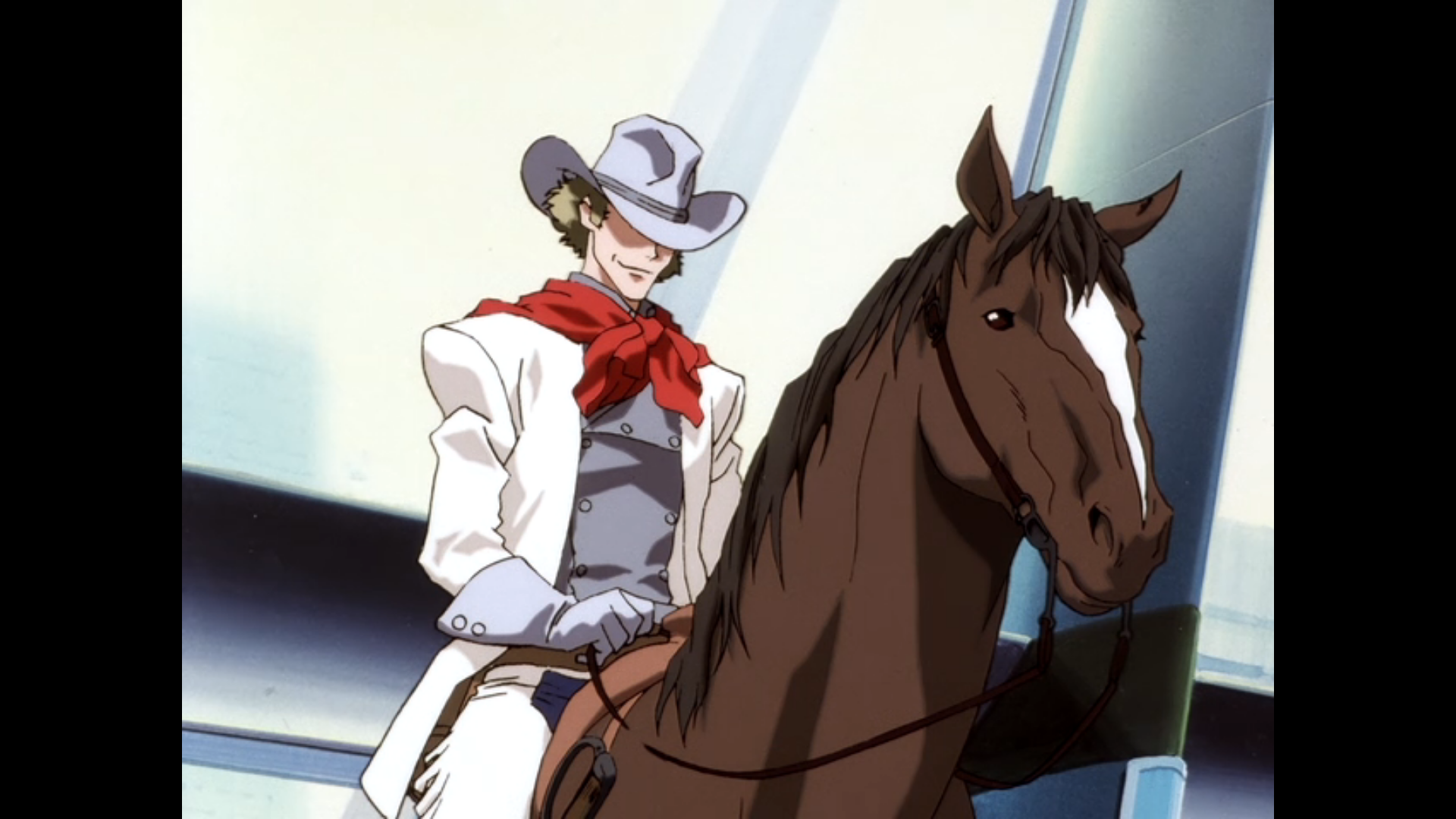
Jet narrates this preview like the trailer for a spaghetti western.
Session #22: Cowboy Funk
Original Airdate: March 27, 1999
Written by: Keiko Nobumoto
Title Card Song: “Go Go Cactus Man” – Released on Cowboy Bebop Blue, this track is a pastiche of the iconic spaghetti western themes, particularly the work of Ennio Morricone.
This is the last pure fun episode of the series. From here, we’re diving straight into the heavy stuff.
The highlight of this episode for me is when Faye decks the Teddy Bomber and catches him without issue.* But the bounty head in this episode is really off center for the plot. Instead, our main guest character is Andy, and Andy is a trip.
If Faye’s realization aboard Andy’s ship (which looks like the iPhone to the Bebop’s Nokia flip but with the inside decorated by a demented Liberace) wasn’t enough to clue you in, Andy is a palette swap and parody of Spike. I have seen some people draw too close a comparison to Spike and Andy. Andy isn’t Spike with the “cool” filed off. Andy is Spike with all his redeeming features filed off.
Spike”s surface is cool, aloof, and go-with-the-flow, but that’s not why we like Spike. That’s just why we give him a chance. As a bounty hunter he’s shrewd, capable and determined. Beneath his polished surface, he’s reckless, short-tempered and entirely too willing to turn off his brain and solve problems by punching and kicking them. But at his core, Spike is self-centered but not selfish. Spike is bent on his own goal of dying (we’ll come back to that) and complains about every possible inconvenience, but time and again he accepts new people into the Bebop crew, goes out of his way to help people, and proves himself to be thoughtful and considerate when he wants to be.
Andy is self-centered and selfish. He’s a bounty hunter because he wants to be a cowboy. He toasts his own reflection. He lacks any ounce of shrewdness that Spike has, unable to deduce who the Teddy Bomber is, even when he’s standing there in a teddy bear costume. Andy is Spike boiled down to a short-tempered, reckless, and mostly stupid set of fists with a single-minded approach to chasing down the next bounty head.
Andy brings out (most) of the worst in Spike because that’s what he is.
Now as for the death thing, as I said above, Andy is a bounty hunter to fulfill a childish wish. Spike is a bounty hunter to fulfill his death wish. Spike’s philosophy, like so much of Bebop, is murky at best, but it’s clear he has convinced himself that he should have died when he faked his death to get out of the syndicate. He toys with the idea that parts of his life are a dream and that he might even already be dead. For Spike death could be atonement, redemption or relief, and he has designed his afterlife from the syndicate to pursue that.
In a universe where he could have easily gotten radical cosmetic surgery and lived out his days in a planetoid made of space junk, Spike chooses a much riskier, much more public life. See, the Teddy Bomber recognizes Spike as one of the solar system’s most notorious bounty hunters. This is not the low profile that someone who is supposed to be dead should be keeping. Spike is a risk taker in a risk taker’s profession, and Andy is a rich boy hobbyist.
This episode has a troubled airing history. It didn’t air as part of Bebop’s first run on Japanese television. When the dub came to the U.S., this episode was delayed for a few months after 9/11, and Jet’s shirt was changed from a pot leaf to a peace sign.
Andy gets to say “See you, Space Cowboy,” and I think he’s the only character to say the full phrase out loud. When he rides off into the sunset dressed as a samurai, we get the card “SEE YOU SPACE SAMURAI.”
 chasetriesagain.com