
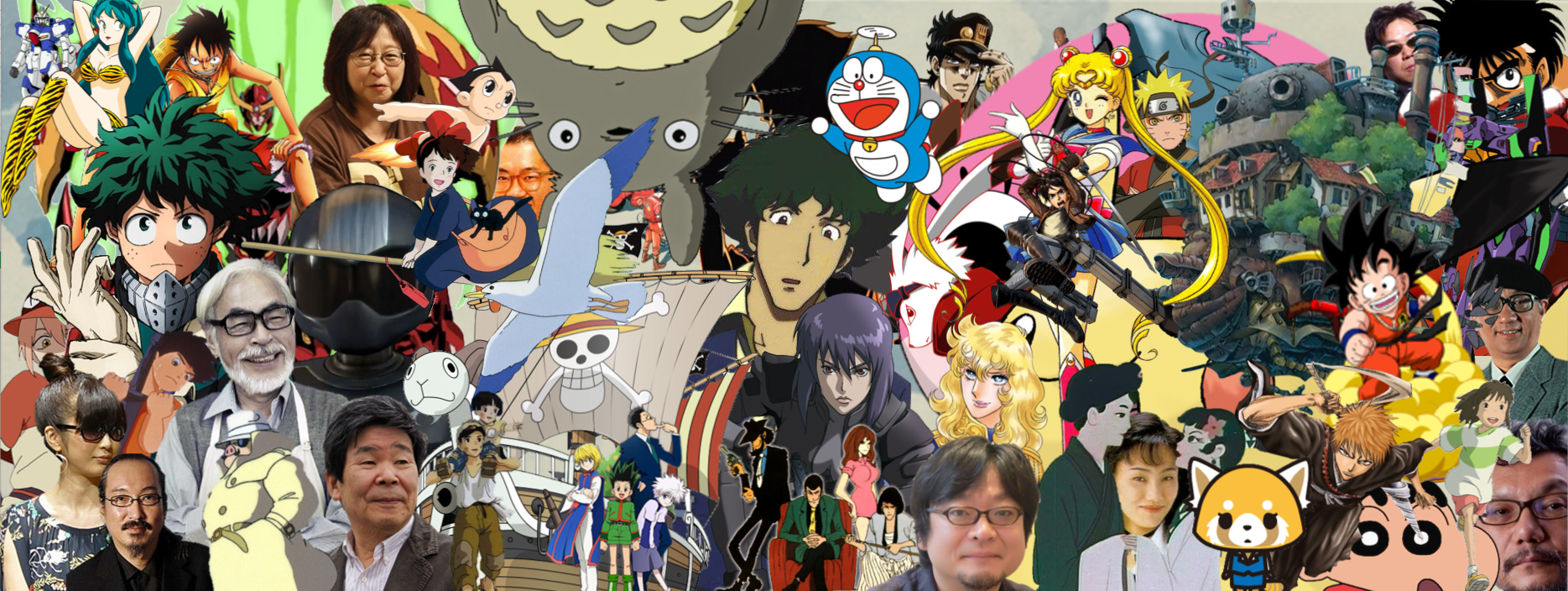
Back in June I started this challenge to get myself writing again and to keep me watching and thinking about anime in the build up to Anime Weekend Atlanta. I told you back then that I’m not an expert, and I’m not really here to offer a treatise on the medium. I’m still no expert although I’ve learned a lot doing the research for 14 weeks worth of writing.
I felt like the final day needed to be something overarching. I needed to finish strong and with a broad look back. This required that I consider the possible questions and answers I could deal in.
There are plenty of pleasantly twee things I could have done here. I could have talked about what anime means to me. I could have tried to divine the future of a complex, multinational industry. I could have talked about the anime community. But (and maybe my writing thus far has made this clear) those things really aren’t my style. So what I’m going to write about is the attempt to define anime.
What I’m really after here is to figure out why this question comes up so much by trying to answer it. There are perennial arguments about whether series like Avatar: The Last Airbender are anime despite their American origins, and I think there are some valid points in the “Avatar is anime” camp. I think the core issue we’re going to run into here is that the country of origin of a work and the intended audience of a work are not necessarily helpful qualifiers when what we’re really interested in is the content of the work.
After all, most of us aren’t interested in anime just because it’s from Japan. We’re interested in anime because its styles and subjects appeal to us.
I said months ago that I wasn’t going to try to sum up an entire mode of expression in a handful of maxims about art. I’m still not going to do that. I also said that anime is and can be a lot of things, any of the things that any creative work can be. I’m going to stand by that. But in the same paragraph I said that anime is Japanese animation, and that’s what I’m going to quibble with just a bit.
I’m going to remove the anticipation here. The conclusion I’m about to argue for is that anime isn’t a useful term when we’re trying to categorize and understand a complex, multinational industry that has strong patterns of influence in Japan and outside of Japan. If we want to get scholastic about it we’re talking about a series of interrelated artistic movements in animation with shared origins in the blending of Western and Japanese media in the decades closely following World War II. If we’re just being casual then “Japanese animation” is probably good enough. We’ll start with what anime definitely is not.
Anime is not a genre. Genre is a pretty complicated term with a lot of definitions that are not mutually exclusive. In literature genre can mean epic, tragedy, comedy, short story and novel. Any of those genres can also fall under the genres of prose and poetry. And then we get into the more familiar territory of specific genres like fantasy, sci-fi, mystery and romance. Then we can step into subgenres like harlequin romance and urban fantasy.
So for anime, genre could be split a number of ways. You could split them into short form series (26 episodes or fewer), long form series and movies. You can also split them, as we’ve done previously, using the more familiar usage of genre. So you get mecha anime and magical girl anime.
Anime is also not really the medium. The medium is animation as opposed to sequential arts like comics and manga or the written word like novels and poetry. While anime is literally just the Japanese word for cartoon, I don’t think we want to be that broad here. I’m not interested in a definition of anime that includes Family Guy and Shrek.
The next logical step we might take is to say, as I did in June, that anime is Japanese animation. It may not be the medium itself, but you could argue that it consists of Japanese works that make use of the medium. But this creates a complex question that isn’t easily answered in the digital age. What is a Japanese work in the field of anime?
We can’t really argue that anime is animation intended for Japanese audiences because that assumes we always know the intent of the creators, and in some cases where we do know the intent of the creators works like Terror in Resonance have been created as much for international and especially American audiences as for Japanese audiences.
We can’t argue that anime is animation that is initially debuted for Japanese speaking audiences or with Japanese voice casts. Space Dandy isn’t the only work to premiere outside of Japan that we would definitely call anime. Tokyo Godfathers made its premiere in New York City at the Big Apple Anime Fest.
Anime also can’t be limited to works with only Japanese involvement in their original production. Many studios outsource some of their work to smaller studios outside Japan. The Animatrix was produced by the Wachowskis. The 1995 Ghost in the Shell movie was a co-production with the British distributor Manga Entertainment. IGPX: Immortal Grand Prix was a co-production between Cartoon Network and Production I.G.
If we decide to rank anime-ness based on degree of Japanese involvement we’re going to find a brand new crop of problems. Mushi Pro was a frequent outsourcing partner for Rankin/Bass Productions, and they worked on Frosty the Snowman among other things. This kind of outsourcing is common.
We also can’t really limit anime based on its art style or content. There are lots of subsets of style and genre within the larger continuity of what most of us recognize as anime because it’s produced with or at least associated with Japan.
Takahata’s works featured a huge variety of art styles, and Cowboy Bebop, Aggretsuko and Crayon Shin-chan look nothing alike. I think we get hung up on the common big eyes and colorful hair and miss a lot of the technique and storytelling choices that have less clear boundaries.
What I find really interesting is that there are huge, long arguments about whether or not Avatar: The Last Airbender is anime, but I don’t see much discussion of two older series with interesting relations to anime.
Robotech has the most obvious connections to anime because it’s built out of three mecha anime Frankensteined together. The story of the series was largely the work of Americans adapting three shows into one, and it’s still very much a mecha show, which at the time was much closer to exclusively Japanese. Most people seem to have no problem calling Robotech an anime, and I don’t either.
We definitely wouldn’t call Batman: The Animated Series anime, although it would be much more comfortable on the shelf next to contemporaneous anime than with a lot of America’s animated output of the era. Batman makes artistic choices like using black paper for the base instead of white that, while not inherently Japanese techniques, are much more in line with the ambitious works of Miyazaki and Takahata than they are with Hanna-Barbera’s Fish Police. Batman even makes deliberate references to Cagliostro.
So we didn’t really get anywhere with those two paragraphs. Let’s go back to Avatar. Avatar is a Western series by Western creators, but it uses a distinct variation on a common anime art style. But it’s not just its art style that it takes from anime. It uses the themes, motifs and tropes of shounen fighter anime series. We see character progression expressed through growth in a magical martial art. We’ve got a coming of age story that involves lots of fights and adventure. The Asian-inspired setting and art style are really non-factors in my verdict on Avatar.
Like I said above, if we’re making this an academic issue, anime just isn’t a good delineation. The art style and genre can’t really be limited. The industry and audience are both multinational. This leaves us arguing about the percentage of Japanese people involved in the production and which dub was done first, and I’m not interested in being the FDA for anime.
So I’m dodging the question. I don’t know what anime is. The definition is necessarily broad, and fans identify it on an “I know it when I see it” basis. But I have an answer for Avatar. To get that answer we’re going to have to take a side road.
German expressionism was an artistic movement that peaked in Germany in the 1920s. Films from that movement like Nosferatu went on to influence works like 1931’s Dracula movie, which in turn set the scene for the Universal monster movies. Dracula isn’t a German film, but it is an example of expressionism.
Avatar isn’t Japanese animation, but it is an example of a shounen fighter series. Megas XLR and Sym-Bionic Titan aren’t Japanese animation, but they are mecha shows. And that’s all I really need to know about them. They’re part of those same artistic movements and patterns of influence rooted in post-war Japan. Drawing the line of what a shounen series can be based on its level of Japanese-ness is like drawing the line at what a superhero comic can be based on whether the creators are American.
So I’m not going to tell you what anime definitely is. It’s amorphous. It’s art. Sometimes it’s great. Sometimes it sucks. It’s a lot of fun to write about and think about. Until next time. Thank you for reading.
SEE YOU SPACE COWBOY…
 chasetriesagain.com