
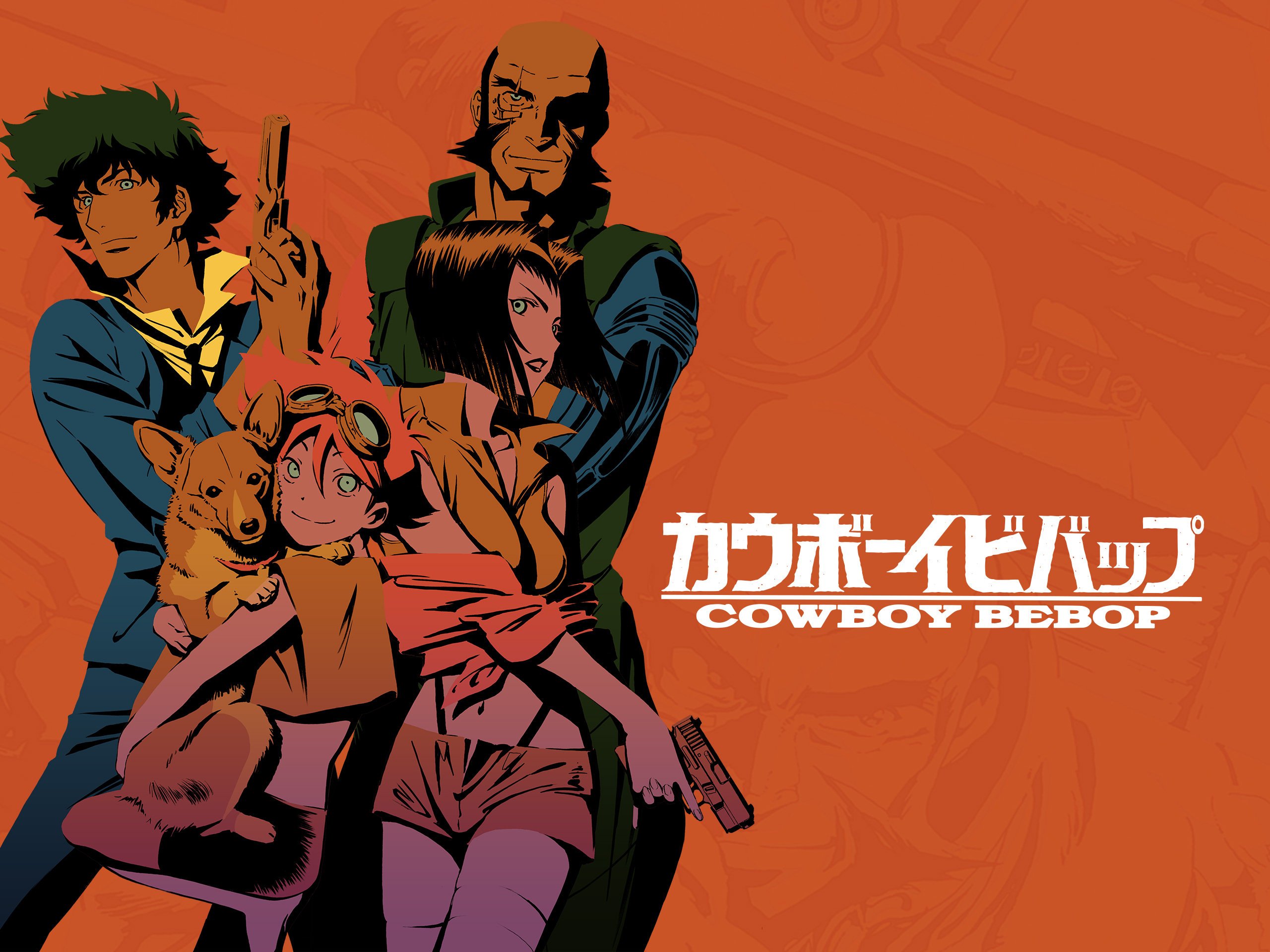
I think it’s time we blow this scene. Get everybody and the stuff together. OK. Three. Two. One. Let’s jam!
Title: Cowboy Bebop
Episodes: 26
Released: 1998
Director: Shinichirō Watanabe
Studio: Sunrise
Turns out I can go 97 days without talking about Cowboy Bebop “at length.” That’s about 96 days more than I thought. Now to say something worth waiting all this time for.
Back in 1998, this was Watanabe’s first outing as a solo director. I consider it his magnum opus. While Samurai Champloo is a close competitor, nothing else he’s directed in the 20 years since Bebop holds a candle to his first work.
Bebop‘s production is a pretty common tale in the world of anime. Bandai’s toy division needed something to sell spaceship toys. Sunrise was going to oblige. Watanabe was given the helm and told that he could do whatever he wanted so long as there were spaceships.
What Watanabe wanted was something that would be brand new to audiences, a work that would become a new genre onto itself. When Bandai saw early footage of the show, it became immediately clear that they were not on the same page as Watanabe and team. Believing that the show wouldn’t sell toys, Bandai’s toy division pulled out of the project, only for Bandai Visual to step in as a sponsor.
The show was credited as being created by Hajime Yatate, a pseudonym often used to acknowledge the collective contributions of the Sunrise team. The actual production staff is littered with veterans of some of anime’s most standout productions.
Watanabe, of course, is director, and Yoko Kanno provides one of the greatest scores in television history. Mecha designer Kimitoshi Yamanae worked as the mechanical designer, and his other credits include multiple Gundam productions and dives into other sci-fi franchises like Space Battleship Yamato and Eureka Seven. Bones co-founder Toshihiro Kawamoto served as character designer, and he’s another Gundam veteran as well as working on several entries in the Fullmetal Alchemist franchise. Screenwriter Keiko Nobumoto worked on Akira, Macross Plus and Tokyo Godfathers. Dai Satō, one of the set designers, would go on to work on both seasons of Ghost in the Shell: Stand Alone Complex, Samurai Champloo, Eureka Seven, and Lupin the Third: The Woman Called Fujiko Mine. Another set designer, Shōji Kawamori was already a veteran and co-creator of the Macross franchise. Kawamori’s credits include entries in franchises including Macross, Gundam, Patlabor, Space Battleship Yamato, Eureka Seven, Ghost in the Shell and Outlaw Star.
Another Bones co-founder Masahiko Minami was producer, and he’s also worked on Gundam, Fullmetal Alchemist and Sword of the Stranger. The other producer Yoshiyuki Takei has credits in the Escaflowne franchise, Fullmetal Alchemist, Eureka Seven, and Wolf’s Rain.
With all this talent engaged it seems almost unfair to give Watanabe so much credit for the success of Bebop. But that much talent can also create a lot of conflict, and it’s too Watanabe’s credit that he was able to keep the team focused and moving toward a shared vision. Watanabe also played an important role as cheerleader for Bebop, believing it would be a huge success even when the rest of the team doubted it entirely.
The resulting show is classic Watanabe. It wears its Western influences on its sleeve. It’s most episodic with a loose overarching plot. Its characters all have deep backgrounds, and the primary cast is a trio of two men with contrasting temperaments and a woman with the addition of a young girl and dog for part of the series.
But that doesn’t really get down to the brass tacks of why I think Bebop is such an excellent series. I suggest Bebop to everyone, all the time because I think it’s accessible to just about anyone who likes a good story. The sci-fi setting is unique. They have a form of hyperspace, but everyone is struggling to get by. They have an interplanetary society, but there are no aliens. There are holograms but no laser guns. The world of Bebop is one where most of society is still struggling to get by. It’s almost an anti-Star Trek.
It’s also got a little something for everyone. The series blends John Woo and Bruce Lee style action with Westerns, Japanese Yakuza movies, gangster flicks, co)medy, ’70s blaxploitation movies, classic sci-fi like 2001: A Space Odyssey and Alien, horror and film noir detective tales. There are episodes that would feel at home next to later series as diverse as FLCL, Paranoia Agent and Psycho-Pass. (The central characters, by the way, are inspired by Lupin, Jigen and Fujiko from Lupin III.)
But, while I think the accessibility is a critical part of Bebop‘s staying power, what I really love about it is that it seems to hew closest to Watanabe’s artistic goal. Watanabe has said before that he sees music as a universal language and the music is at the heart of most of his productions. For Terror in Resonance music was an inspiration. For Macross Plus music was a plot point. For Kids on the Slope music was a way to tell the story. For Samurai Champloo music was a sort of thesis statement about the themes of the show. But Cowboy Bebop is music.
Kanno and Watanabe had an unusual working relationship on Bebop. Kanno began the jazz and blues band Seatbelts to create music for the show, and they began producing music before characters, story or animation were finalized. In addition to planned music, throughout the production, Kanno would come up with pieces of music that she thought might fit the show but without any specific scene in mind. Watanabe and the rest of the team would find ways to work her music in and even create new scenes or change existing ones to better use her music. This sort of improvisational back-and-forth turned the series into a sort of prolonged jam session.
The individual episodes also play like jam sessions, too. While jazz, western and opera music are used throughout, individual episodes often make use of other genres like metal and funk. The interactions between the characters have a sort of jazz rhythm to them. Our four leads each have distinct tones to the stories centered around them and play out distinct variations on central themes of nostalgia and melancholy. In a series where the consistent character interactions are what link us episode to episode, this jazz rapport is an essential ingredient for success. While Spike is clearly the lead, the other members of the quartet get “solos” that totally shift the tone while never shifting the central themes. Jet provides a solid, unfaltering bass. Faye’s voice, when highlighted alone, is gentler reflection of Spike’s melancholy. Ed is a high energy wild card that can change the entire motion of the story with just a few lines.
Bebop, like a lot of great works, is sort of a happy accident. In hindsight, it’s impressive that Watanabe was seemingly never in doubt that it would work. The ending to the show, while open to interpretation, is very final, and this was Watanabe’s intention. Watanabe was concerned that the show would be such a hit that he’d end up working on it for the rest of his life if he didn’t give it an ending.
The real secret to Bebop‘s success is that it’s about people, not caricatures. While most of us don’t know former gangsters or women with amnesia, we do know people who have baggage. The cast of Bebop have history, and that’s not just something tacked on to make the plot complicated. They carry that history with them into every interaction, it defines them and gives their narratives weight and momentum.
So that’s Cowboy Bebop. I haven’t talked about the trio of old men that serve as a sort of Greek chorus at points in the show. I haven’t talked about Vicious and Julia. I haven’t talked about any of the numerous side characters and background info. I could write another 1,200 words. I could write another 2,400 words, but I’m going to put this to bed here. The title, for the uninitiated comes from cowboy, an in universe slang term for bounty hunters, and Bebop, the name of the ship they live on. Until tomorrow.
Bang…
 chasetriesagain.com
1 Comment