
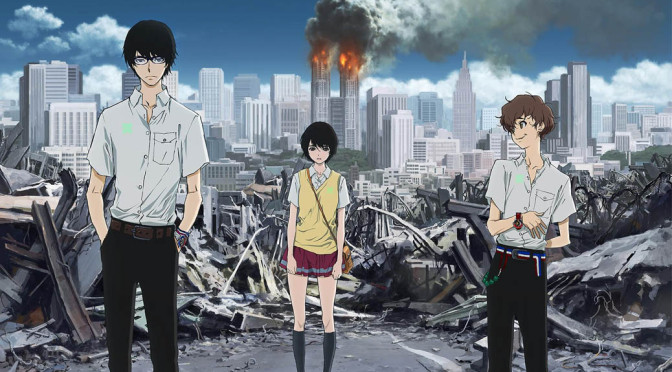
Title: Terror in Resonance
Episodes: 11
Released: 2014
Director: Shinichirō Watanabe
Studio: MAPPA
I didn’t really know Terror in Resonance existed until June or July of this year. When it debuted on noitaminA in 2014, it was a little overshadowed by Space Dandy. Resonance saw Watanabe reuniting with Yoko Kanno and character designer Kazuto Nakazawa (an alum of Champloo and Kids on the Slope). The series was inspired by the music of Sigur Rós, an Icelandic band, and Watanabe said in 2014 that it was something he’d wanted to do for quite awhile.
Resonance follows teenage terrorists called Nine and Twelve as they try to use a series of non-lethal bombings to draw attention to the Athena Project that abused them as children and to Japan’s creation of atomic weapons. Opposite them are the Tokyo Metropolitan Police, primarily Detective Shibazaki who starts the series in the records department after angering officials by trying to suss out a government conspiracy. Shibazaki, members of police and Nine and Twelve all find themselves working against a cadre of FBI agents and high-ranking Japanese officials in the end.
The series reinvents some of Watanabe’s staple motifs while abandoning others. While the series features another excellent Kanno score, the music isn’t as essential, and the series just makes a handful of references to Iceland to reference the inspiration. The series also features a prominent main plot rather than the more episodic storytelling of most of Watanabe’s catalog.
However, Watanabe plays with his trio formula a lot. Nine is cold, aloof and intellectual. Twelve’s smile gets compared to summer, and while he’s no intellectual slouch, he’s much more physically expressive and active than Nine. They’re accompanied by Lisa, a runaway whose mother has gone insane with grief after Lisa’s father left them.
However, as Mugen and Jin face their opposite numbers in the finale of Champloo, Nine and Twelve are mirrored by Shibazaki who works as part of a duo with a couple of different partners. Shibazaki’s records partner Mukasa serves as an unlikely assistant when Shibazaki works on some of the riddles the terrorists use, and during the show’s crescendo, Shibazaki is accompanied by the passionate Hamura.
Lisa also gets an opposite number although she’s not part of a trio with Shibazaki. Five is a girl who was also abducted by the Athena Project and lived alongside Nine and Twelve. She sees herself as an intellectual rival to Nine, and she works with the FBI. When the FBI takes over the investigation, she’s willing to let innocent people die just to back the boys into a corner.
The show also makes use of lots of Western symbols and motifs. The terrorists call themselves SPHINX, and they use myths, legends and Biblical apocrypha in the riddles they pose. The main myth they use is the tale of Oedipus, and Nine eventually tells Shibazaki that he is their Oedipus.
Resonance is an overtly political show. It’s critical of bullish voices in Japanese politics and American foreign policy, and it spends a lot of time exploring government corruption. But while the show clearly wants us to be sympathetic toward the terrorist protagonists, it never steps back from calling their methods reprehensible.
Shibazaki is the main conduit for this balance. The detective is clearly willing to go against the government when he believes they’re in the wrong, but he is also disgusted and outraged by the boys’ methods. He is a second-generation victim of the Hiroshima bombing, and the knowledge that the duo are planning to leverage a nuclear threat as part of their plan is what drives him to chase the case so hard. Even in the end, when he has learned the truth about the Athena Project and wants to help the boys get justice, he never forgives their methodology.
But the show has a lot of problems. Lisa is the first problem. She doesn’t have much in the way of character or contribution to the story. A stray dog would have been equally impacting. Her love story with Twelve doesn’t really go anywhere. Her mother is portrayed as horrifying, but the series doesn’t have time to flesh it out so it lands firmly in melodrama territory.
Five is another problem. There were always some sci-fi elements in the boys’ background. There was always a superhero kind of thing happening with Shibazaki playing Batman to Nine’s Riddler. But Five is a cackling, albino lunatic willing to torture and kill scores of people just to get the upper hand on Nine.
The backstory between Nine, Twelve and Five is provided through vague flashbacks. Watanabe has used this same technique masterfully, but here it fails to give us the narrative impetus to believe this blood feud between a terrorist and an FBI agent who should both be in high school.
The second half of the show gets harder and harder to buy into. The stakes escalate without ever giving us the narrative hooks to believe them. The show also never gives us the chance to really connect with Nine and Twelve. They’re both stand-offish with Lisa and other characters they interact with and by proxy the audience. We may feel sorry for them, but we don’t get time to care for them, totally undermining the series finale.
So that’s Terror in Resonance. For my money, 2014 was not Watanabe’s year. Space Dandy’s comedy never sticks the landing, and Terror in Resonance really just doesn’t feel like his work. It’s got its positive points. I really like Shibazaki, but the show as a whole feels like a less compelling Death Note or Psycho-Pass.
Terror in Resonance is the last Watanabe show I watched. The next post will be about the first Watanabe show I ever watched. The next post will be about Cowboy Bebop. Until tomorrow!
 chasetriesagain.com