
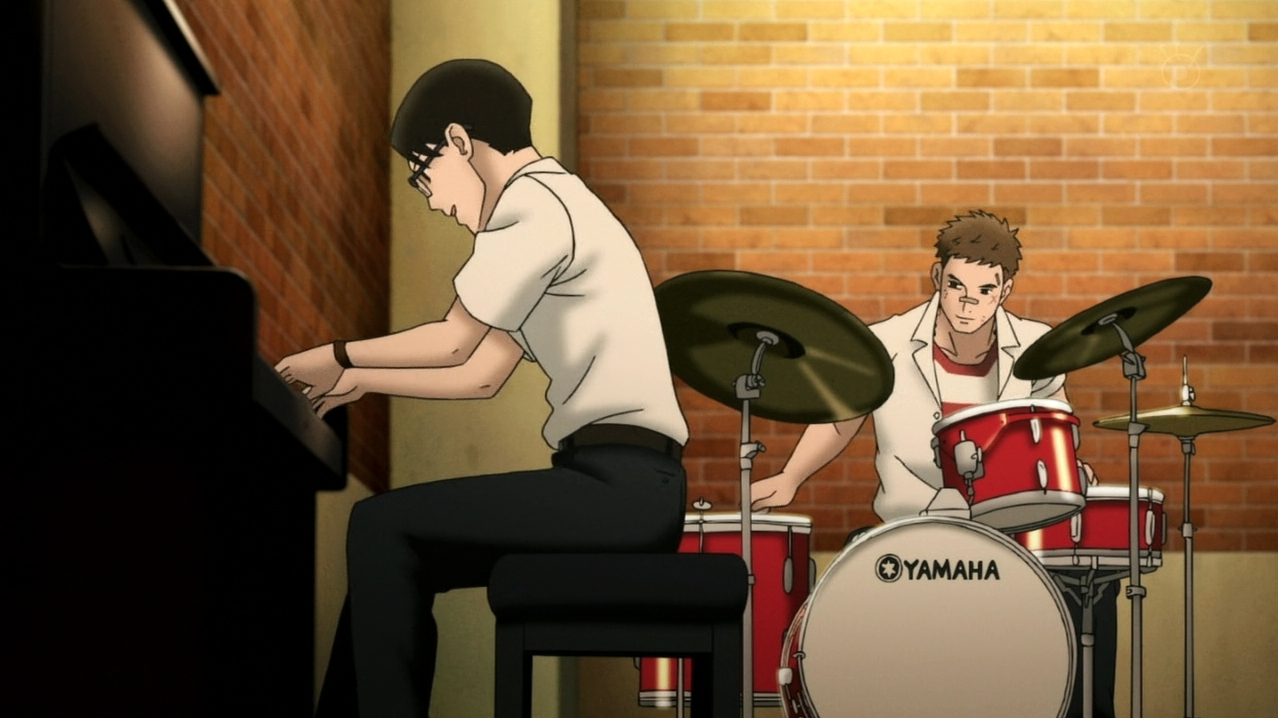
Title: Kids on the Slope
Episodes: 12
Released: 2012
Director: Shinichirō Watanabe
Studio: MAPPA and Tezuka Productions
Based on a manga by Yuki Kodama, Kids on the Slope is the first production by MAPPA. When I first saw it, I watched all 12 episodes in a single day. The story follows three Japanese teenagers of the ’60s from very different backgrounds who bond over jazz, and I’m a sucker for jazz and period pieces.
This is the only show I’m aware of where Watanabe manned the director’s chair for an adaptation of another person’s work. Nonetheless, it’s got a lot of Watanabe’s favorite things. There’s a trio made up of two guys with very different temperaments and a girl. All three protagonists carry some heavy baggage. Western imports, namely jazz and Christianity, are key elements. And the music is woven into the work’s core.
The music here is provided by Yoko Kanno, and is therefore nearly immaculate. I’ve never read the manga, which is quite a bit longer than the anime, but I have trouble imagining this story without Kanno’s composition. For its part, the manga did win the 57th Shogakukan Manga award for general manga, but I have to imagine it’s something utterly apart from the anime.
Macross Plus uses music as a plot element. Samurai Champloo uses music as a way to translate the cultural context and values of its protagonists. Kids on the Slope uses music to tell its story, and the story here is about friendship, growing up and life on the cusp of adulthood.
I’m going to heap a lot of praise on Kanno and the animators here, but it’s a credit to Watanabe’s direction that a few key scenes work as well and as subtly as they do. So rather than go on about symbols and motifs, I’m going to breakdown a key scene. There are spoilers after the break.
I’m not going to give you any context for this scene beyond that it occurs in episode seven. I don’t think you’ll need it whether you’ve seen the show or not. Kanno’s score, some smart cinematography and a few subtly animated expressions should tell us just about everything we really need to know.
Kaoru is on the piano and Sentarō is on the drums. There’s obvious tension and confusion for the first 60 seconds as Kaoru’s playing lures Sentarō to his instrument. When Sentarō gets comfortable at about 1:05, there is an audible resolution to that tension as their musical conversation starts.
But it’s not until 1:17 when they start to riff off one another that suddenly this performance becomes must see for the entire school. At about 1:40 Kaoru leads into the first transition in the medley, and we see Sentarō grimace slightly as he tries to keep up with the shift. By the two minute mark, Sentarō is really enjoying himself while Kaoru improvises. Shorty after that, their schoolmates are literally running out of first floor windows to get to the auditorium faster.
And at 2:10 Kaoru starts setting up moments for Sentarō to show off. At 2:20 Kaoru musically suggests another shift, and Sentarō sets it up for him. Throughout the last piece, Moanin’, Kaoru and Sentarō alternate improvised and show off moments.
When the song begins it’s obvious there’s tension between the two friends. We witness a conversation with some give and take all happening musically and exemplifying the trust and familiarity between the two friends. While Kaoru and Sentarō are very different, the scene shows us through music that they have a deep bond.
This isn’t the first or last scene in Kids on the Slope that tells us the story via a jam session. It happens at least once an episode. The characters express themselves and the show tells its story through jam sessions, including the very end of the story.
Kids on the Slope aired on the noitaminA block in Japan, a block of anime that I’m more and more interested in as time goes by. All the episodes share their titles with jazz songs. It hasn’t made quite the same impression on American anime fans as Cowboy Bebop and Samurai Champloo, and I didn’t even know it was Watanabe the first time I watched it. Despite this and the fact that it’s not his original story, I tend to consider it the third part of a trilogy with Bebop and Champloo.
The next show we’re going to cover is Space Dandy, one of two Watanabe-directed series to debut during 2014. Until tomorrow!
 chasetriesagain.com