
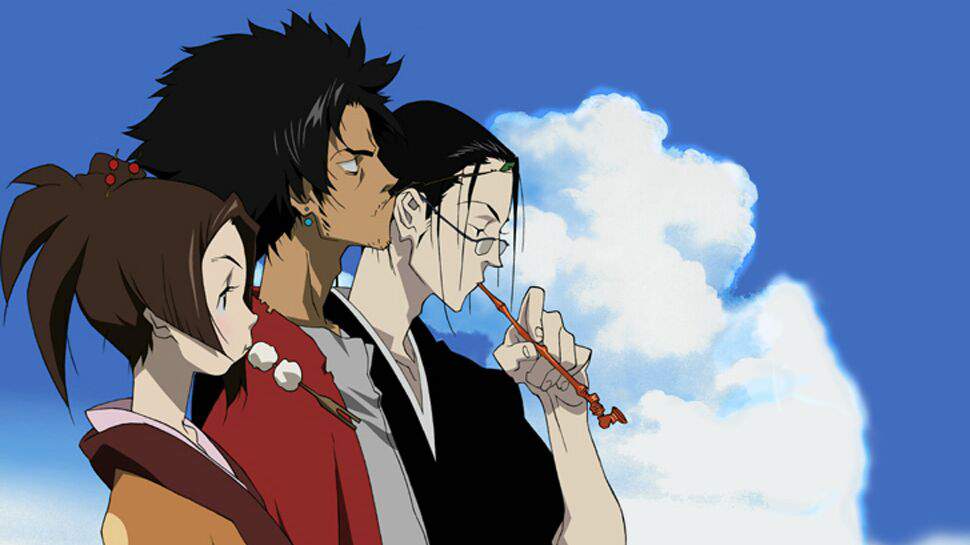
Title: Samurai Champloo
Episodes: 26
Released: 2004
Director: Shinichirō Watanabe
Studio: Manglobe
We’re skipping Cowboy Bebop for now. I’ll explain why later. Samurai Champloo is Watanabe’s hip hop infused second work as a full fledged director, it’s a spiritual successor to Bebop, and it’s the first work released by Manglobe. The “champloo” in the title comes from the Okinawan word chanpurū meaning to mix or hash. So the title comes out to something like Samurai Remix, a straightforward explanation of the concept.
Our tale takes place in Japan’s Edo period. Like almost all of Watanabe’s shows, Champloo centers on a trio of protagonists, two men and one woman. Mugen is a reckless, hot-tempered misanthrope with a criminal past. Jin is a cold but honorable rōnin born in the wrong era. Fuu is a plucky but naive young woman who ropes the two into her quest to find a samurai who smells of sunflowers.
Champloo is a prime example of the chanbara subgenre of jidaigeki works in Japanse media. Jidaigeki is a genre of period dramas usually set during the Edo period, and chanbara literally means sword fighting. But while Champloo checks all the boxes, it also shakes things up.
Champloo is mostly episodic, but the search for the sunflower samurai serves as an overarching plot. Individual episodes mix genres like horror and sports into the show, but what really makes it a remix is the massive presence of anachronisms. The show weaves historical fact and fiction in a way that shows a lot of historical research and little concern for big picture accuracy. The show has so many anachronisms that there’s a website just to list them.
In addition to remixing Japan’s own history, the work’s use of hip hop soundtracks and aesthetics layers on further anachronism, but maybe more importantly hip hop and Western motifs are used to help the audience understand the characters and background in ways that a period drama can’t do on its own. But to talk about that, we’re going to have to spoil some things.
Edo period Japan had a complex relationship with outsiders and especially the West. The shogunate was suspicious of Westerners and their Christianity. The Edo period begins around 1600, and by the 1660s Christianity in Japan had been all but eradicated and most foreigners were expelled from the country. The six decades between there featured massacres of Christians and mass expulsions of Europeans and the Shimabara Rebellion in the late 1630s, in which Catholic samurai and peasants rose up. The rebellion lead to Christianity being illegal in Japan for over two centuries, and it’s a pretty important part of the background of Champloo.
The samurai that smells of sunflowers is Fuu’s father who participated in the rebellion and went into hiding to protect his family. While not central to the point I’m chasing here, sunflowers aren’t native to Japan and are used as a symbol of foreignness and Christianity in Champloo, and I get a kick out of it.
So the overarching plot of Champloo is caused by the ban on Christianity, but Watanabe doesn’t stop there. It seems like he really has a thing for playing with Western motifs and ideas, and for much of his career he’s played with Christian symbols a lot.
In the last three episodes, Mugen and Jin become traditional Western Lit 101 Christ figures, and while Watanabe doesn’t beat the audience over the head with it, it’s done so seamlessly that I refuse to believe it’s a coincidence.
The two swordsman are fighting enemies (who happen to be dark mirrors of themselves), and during their fights both men fall into the water and emerge. These are symbolic baptisms. After their baptisms, their fights continue, and both men save Fuu at separate points. When Mugen saves her she’s literally strapped to a cross. In the process of saving Fuu, both men are seemingly killed and then come back to life. What I find most interesting about this is that we see two Christ figures being made almost simultaneously, blending Eastern notions of duality with a central Western literary motif.
The hip hop is also there for more than just rule of cool. Our trio is identified with hip hop a Western import to Japan with an implied rebellious edge. Hip hop is used to reinforce that our heroes, whatever else they might be, are outsiders in their own culture because they’re willing to accept ideas outside of the cultural norm.
The soundtrack was provided by Japanese artists Nujabes, Tsutchie, Fat Jon and Force of Nature. The first Manglobe production would turn out to be a bit of an all-star affair. As I mentioned earlier in this series, Sayo Yamamoto worked on Champloo as did Mamoru Hosoda. Mechanical designer Mahiro Maeda is a veteran of Miyazaki productions Nausicaä of the Valley of the Wind, Castle in the Sky, and Porco Rosso along with other Ghibli works and Neon Genesis Evangelion. Redline director Takeshi Koike worked on the opening animation.
Samurai Champloo is probably Watanabe’s second most recognized work after Cowboy Bebop, but tomorrow we’re moving into even less familiar territory. The next work we’ll discuss is Kids on the Slope. Until tomorrow.
 chasetriesagain.com