
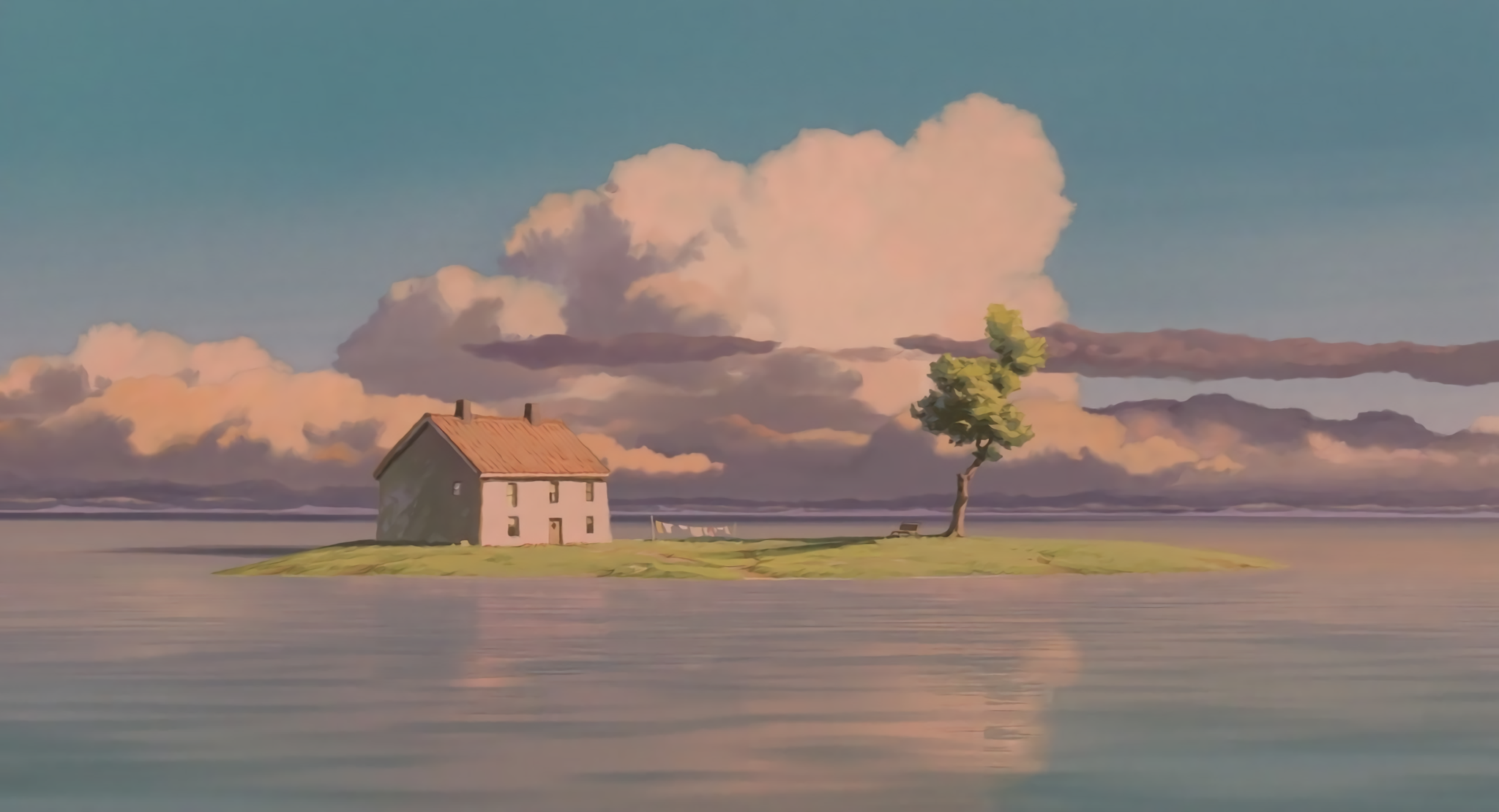
Hayao Miyazaki
Birthday: January 5, 1941
Notable Works: My Neighbor Totoro, Princess Mononoke, Spirited Away, Howl’s Moving Castle
What is there left to say about Hayao Miyazaki? It’s bad form to start one’s writing with a rhetorical question, but I’m at a bit of a loss. I’ve set myself up with a difficult task trying to find a few hundred words for the most talked about anime director ever.
Miyazaki’s father owned Miyazaki Airplane which made the rudders for fighter planes during WWII. The family moved around during and shortly after the war. At the age of four Miyazaki witnessed the bombing of Utsunomiya. After the war, his mother suffered from spinal tuberculosis for nearly a decade. In college at Gakushuin University, Miyazaki studied political science and economics. He also participated in the Children’s Literature Research Club and spent free time at his middle school art teacher’s studio sketching and discussing politics and life.
Inspired by 1958’s Hakujaden, the first full color anime feature film, Miyazaki pursued animation as a career. He got his start at Toei in 1963. This is where he met Takahata, and this is where the trajectory of his career becomes clear. I have already talked about so much of this that I’m at great risk of being redundant.
Roger Ebert once suggested that Miyazaki might be the greatest animation filmmaker to have ever lived. He has often been compared to Walt Disney, one in a long line of Japanese animators to be given this title, but I think that comparison is built on radical misunderstandings of both men.
Disney was an optimist and a capitalist that believed industry could lead to a better future for everyone. Miyazaki is a pessimist who has disavowed capitalism and tends to see uncontrolled industry and globalization as destructive and soul crushing.
Disney strove to keep his business on the cutting edge of technology. When they couldn’t be the first to do something, he found a way for them to do it better, more profitably. Miyazaki has spent his life mastering animation by hand and has only accepted advancements in technology begrudgingly and with strict limitations.
Disney was a master showman. Miyazaki is a master craftsman.
But one thing Miyazaki and Disney have in common is a willingness to pour all of their energy into their work and to embed everything they believe in in their works in an effort to make the world better and to create something positive for children.
We know Miyazaki’s pacifism, his environmentalism, his feminism by his works. We see in his movies his disdain for greed and hatred. We see the importance he places on relationships and on generosity. We see his concerns about industry, capitalism, globalization and progress for progresses sake. Miyazaki and his work are honest in ways that make people entrenched in their politics uncomfortable. If you would like to know what he thinks about anything, you have only to ask. He is unafraid of provoking people, left or right, Japanese or American.
I don’t see any point in doing more than listing the tropes and motifs he loves. He uses them to different ends at different times, but many things are ever present in his filmography. His protagonists are usually young women. He loves to animate flight and high places. He likes pigs because they are unpretentious and maligned. His characters emote with their entire bodies, even their hair. He likes to mix Meiji Era and European aesthetics. He likes to draw machines of all sorts like he did as a boy before he learned to draw the human figure.
Miyazaki has a reputation as a cranky and cantankerous pessimist. This isn’t unearned. In The Kingdom of Dreams and Madness Miyazaki says he is manic depressive and he constantly has a sense of doom about him. He seems convinced that Ghibli will fall apart, the animation industry will fall apart and that the world will fall apart. And he isn’t shy about these thoughts.
He is also a demanding director. Animators and colleagues all approach him on tiptoe, never sure if they’ll encounter the melancholic, the outraged or the bemused Miyazaki. Though never shown to be quite as autocratic or aggressive as Takahata, those who work with him seem to discuss him with a mix of affection, annoyance and fear.
For all his bluster and mood swings, Miyazaki can also be a kind, grandfatherly presence. He always takes time to chat with the delivery woman that stops by the studio everyday. He is seen in archival footage leading a sing-a-long at a company gathering. He seems to remember birthdays and children and ill parents. He officiated his assistant’s wedding, and he seems genuinely hurt that she hid her pregnancy from him during the production of The Wind Rises.
Miyazaki is especially concerned with children. This makes his rocky relationship with his son yet another contradiction in a man who seems to be made of them. Gorō Miyazaki has said he was raised by his father’s movies, not his father. The elder Miyazaki was absent for much of his son’s childhood. He is said to have tried to cause a strike at Ghibli during the making of Gorō’s Tales from Earthsea. When the movie came out, Miyazaki left the theater during the debut, and he publicly said his son should stop making films. During the production of Gorō’s second feature From Up On Poppy Hill Gorō had to leave the studio to work on storyboards because his father wouldn’t leave him alone.
As an artist, Miyazaki has high standards for himself and all those around him. An English professor who served as an intellectual mentor while I was in college told us often that good art was about truth and beauty. A good novel or film or painting should show us something true or possibly true and do so beautifully. This, I think, is Miyazaki’s belief as well. His critique of the anime industry seems to be that it has become to inwardly focused and too self-referential, both in form and content. Miyazaki tries to render his cursed dreams in ways that are both visually and emotionally true to life.
It also seems that Miyazaki finds automation and computerization replacing humans is disrespectful and harmful to the human spirit. In the clip below he is “utterly disgusted” by an AI’s attempt to create a walking animation.
Miyazaki has gained a reputation as a misanthrope and a Luddite, but I don’t think either of these is really a fair assessment if we look at his statements and works with some nuance. Miyazaki doesn’t dislike technology simply because technology bothers him. He dislikes when technology comes before nature and before people. Miyazaki doesn’t dislike people, he dislikes greed and ignorance and ego. His primary concern isn’t environmentalism or feminism or pacifism.
His primary concern seems to be about war and industry and greed and ignorance and ego stripping away the basic dignity of humanity and of nature. He seems to be afraid that in our haste to do more, better, faster, easier with simpler solutions we will deprive ourselves of the things we ought to really value.
There is also a palpable sense of nostalgia in Miyazaki’s works. Often this nostalgia doesn’t seem directed at specific targets or moments in Miyazaki’s own lifetime. Rather, this nostalgia is more about moments of personal and cultural innocence that we have rushed by en route to the next goal, the next achievement. He is fascinated by the unreachable moment.
I have written all of this knowing that if Miyazaki were to read it, he would probably tell me I’m all wrong and be insulted by the attempt to get a read on him. There’s a lot written about Miyazaki, and I’m not sure I’ve brought anything new to the conversation. I still felt the need to write about him because he’s a major influence on me as a writer, and I’m glad he’s still out there making movies even though he keeps saying he’ll retire.
That’s it for Miyazaki. Tomorrow we’re moving on to Shinichirō Watanabe. Until then!
 chasetriesagain.com
1 Comment