
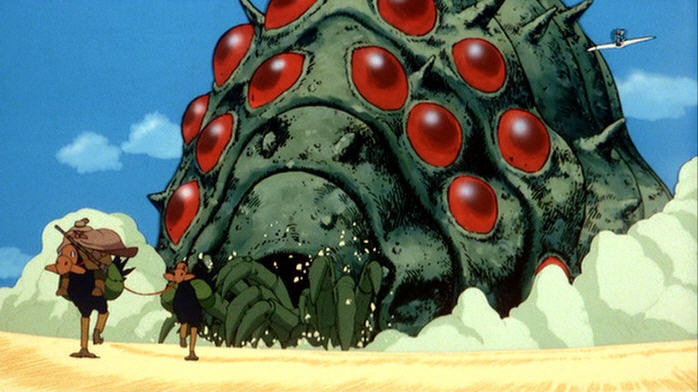
Title: Nausicaä of the Valley of the Wind
Run time: 117 minutes
Released: 1984
Director: Hayao Miyazaki
Studio: Topcraft
There are two stories about the origin of Nausicaä of the Valley of the Wind. The indisputable fact is that it was a manga first, serialized in Animage, a magazine edited by Toshio Suzuki. The manga began running in 1982, and Miyazaki would work on it around his other projects until 1994.
One take on the origin is that Nausicaä came about because executives wouldn’t finance Miyazaki’s idea of it wasn’t based on an existing property. The other take is that Suzuki commissioned Miyazaki to create a manga for Animage, and Miyazaki picked a story he felt would be difficult to animate.
But we wouldn’t be talking about Nausicaä if it hadn’t been animated anyway. I tend to trust the latter story because I’ve seen interviews with Suzuki and Miyazaki that lineup with this account more closely than with the former, though the two don’t totally contradict.
Regardless, Nausicaä would arrive in theaters in 1984, and it is a full-fledged Miyazaki film. Our protagonist is a brave, energetic girl with character flaws. There’s lots of flying and different airships. The plot centers on a conflict between man and nature. The backgrounds are detailed and beautiful. The characters are full of personality. The animation is fluid and dynamic. About the only missing from the recipe that brings most Miyazaki’s works to life is the presence of a clear bad guy, and I suppose you could even debate that.
Nausicaä is set 1,000 years after an apocalyptic war waged by humans with technology more advanced than our own. Despite advanced flying machines and the presence of gunpowder, humanity lives in kingdoms that are reminiscent of medieval living. Nausicaä is the daughter of the king of the Valley of the Wind, protected from the world-spanning poisonous jungle by sea breezes and an old forest.
The jungle is so full of poisonous plants that it’s dangerous for humans to breath there without a mask. It is full of insectoid creatures as small as dogs and as large as elephants. Humanity is on the brink of being wiped out by this deadly growth, even as they harvest valuable resources from it. The creatures that many humans consider to be the biggest threat are the Ohms, enormous, segmented beings that remind me of horseshoe crabs.
I have seen critics say that there is no evil portrayed in the film, but I’m going to have to reject this outright. Nausicaä’s father was bedridden and dying, and during an invasion by a foreign power, he is shot dead so they can takeover. There’s nothing ambiguous about that in my book.
I was amused by the visual similarities between Nausicaä’s Kurotowa and Cagliostro’s Count. Nausicaä’s design is also similar to Clarisse from Cagliostro. While Miyazaki’s men get more diverse overtime, the women are often similar except for their costumes. This is an odd quirk of Miyazaki’s style that is a bit surprising considering how often his protagonists are young girls.
The world and story of Nausicaä were inspired by literature like Earthsea and Lord of the Rings. Miyazaki has also sighted the mercury poisoning of Minamata Bay and the way nature thrived in the poisoned area as inspirations for the movie.
The movie, like so much of Miyazaki’s work, has a vast influence on animation. The opening sequence received an homage in Disney’s The Rescuers Down Under. The Giant Warrior that serves as a crucial plot point in the movie is also the origin for all the living or part-living mechs in later anime. This is (at least in part) because the Giant Warrior was animated by Hideaki Anno (handpicked by Miyazaki), who went on to create Neon Genesis Evangelion.
Nausicaä marks the beginning or reunion of multiple creative partnerships as well. Isao Takahata reluctantly stepped in as executive producer. Sumi Shimamoto who voiced Clarisse in Cagliostro would voice Nausicaä. This also marked the first collaboration between composer Joe Hisaishi and Miyazaki, and the cementing of a relationship with Tokuma Shoten, the publisher of Animage and financier of the movie. Nausicaä and the relationship with Tokuma Shoten would be the fuel that lit the fire of Studio Ghibli the following year.
Nausicaä is also responsible for Ghibli’s strict policy of not allowing cuts on their movies. There is an awful cut and dub of Nausicaä called Warriors of the Wind that was released in 1985. The changes to the movie altered its essence and so offended Miyazaki that it would take over a decade and the influence of Disney to get more Ghibli works released in the United States.
That just about covers my notes for Nausicaä. The next movie on the list is Porco Rosso. Until tomorrow!
 chasetriesagain.com
Another great movie.
LikeLiked by 1 person