Title: Lupin the Third: The Castle of Cagliostro
Run time: 100 minutes
Released: 1979
Director: Hayao Miyazaki
Studio: Tokyo Movie Shinsha
With Miyazaki we’re starting at the beginning. Miyazaki was involved with the first two Lupin III TV series in the ’70s and made his feature film directorial debut with The Castle of Cagliostro. Based on the manga by Monkey Punch, Cagliostro is the second Lupin III feature film after The Mystery of Mamo.
Lupin is an odd fit for Miyazaki. The manga and many adaptations lean toward adult content. Lupin and his supporting cast are usually selfish rogues who only do good in extreme situations. Sex and violence are pretty common fare in the franchise, but this is a Miyazaki movie.
The movie gets some flack because Miyazaki’s version of Lupin is unambiguously heroic. Monkey Punch was not pleased with the adaptation at first because it wasn’t true to his manga. Overtime though, and especially as Miyazaki has gained notoriety, opinions have changed, including Monkey Punch’s. Now it is sometimes regarded as a great movie if not a very good Lupin story.
The story involves Lupin and Co. rescuing Lady Clarisse, princess of Cagliostro, from the clutches and impending nuptials of Count Cagliostro himself. Lupin and Inspector Zenigata also end up collaborating to bust a counter-fitting operation. In terms of plot, there’s nothing revolutionary, and in terms of themes, there’s nothing that just screams Miyazaki to me. What’s really interesting in Cagliostro is the first appearances of some recurring motifs and imagery in Miyazaki’s work.
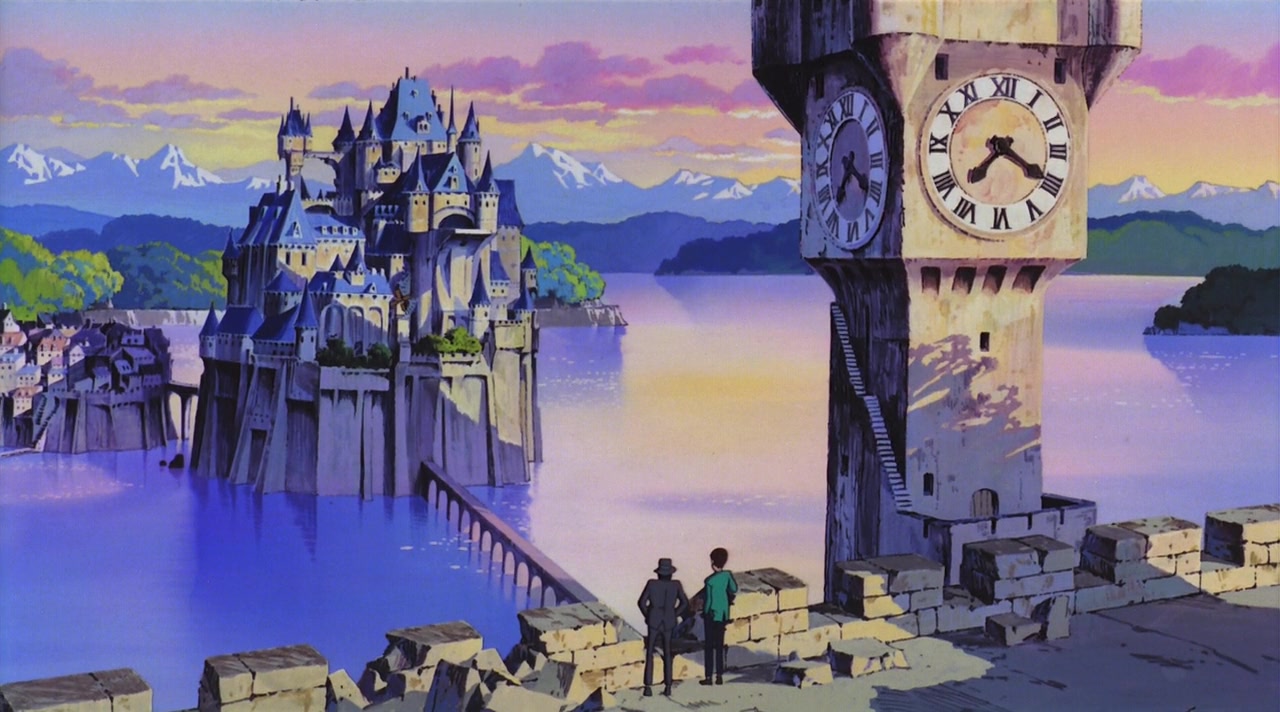
The castle itself is inspired by the castle in Paul Grimault’s Le Roi et l’Oiseau. Miyazaki’s fascination with high, dangerous places and vantage points begins showing up in scene after scene. We also get Miyazaki’s roof-running and flying scenes and an unusual flying contraption.
Backgrounds throughout the movie were inspired by Miyazaki’s sketchbooks for Heidi, Girl of the Alps. Cagliostro makes use of lots of beautiful, detailed wide open spaces. It also uses these spaces for quiet moments. Miyazaki began experimenting with moments of silence as punctuation here.
Elements of the story were taken from various works about Arsène Lupin as well as from Le Roi et l’Oiseau. Lupin and Clarisse’s cars are odd choices for a luxury-loving master thief and a princess. The Fiat 500 that Lupin and Jigen drive was head animator Yasuo Ōtsuka’s car while the Citreon 2CV was Miyazaki’s first car.
The film was not very successful when it was first released. Miyazaki’s name wasn’t a draw on its own then, and its differences from existing Lupin III works were a bit of a deterrent. However, it has been popular with animation buffs and animators for a long time.
I was especially impressed at one point during the oft-imitated clocktower fight. Lupin is standing on one rotating gear while the Count stood on the other. There’s a close up of Lupin’s upper body, but you can follow his rotation based on his shoulders while following the counts rotation based on the subtle turning of Lupin’s head. It’s so smooth and subtle that I had to watch it twice to make sure I wasn’t imagining the detail.
The clocktower fight has been homaged in Batman: The Animated Series and The Great Mouse Detective. The aqueduct fight and the car chase are also frequent subjects for homage in animated works, and the Fiat 500 shows up all over the place.
While not centered on the themes that Miyazaki focuses so much attention on later in his career, it’s still an important piece of his filmography. It showcases his early mastery of motion and scale, and it’s also just a solid movie.
The next movie we’ll discuss is quintessential Miyazaki on every level. Tomorrow it’s Nausicaä of the Valley of the Wind. Until then!
 chasetriesagain.com
2 Comments