
Isao Takahata
Birthday: October 29, 1935
Notable Works: Hols: Prince of the Sun, The Grave of the Fireflies, Pom Poko, The Tale of the Princess Kaguya
Isao Takahata was the son of a junior high principal. In 1945, he and his family survived a major air raid on Okayama City. After the war, his father would become the education chief of Okayama Prefecture.
Takahata attended University of Tokyo, where he graduated with a degree in French literature in 1959. While a student he encountered the then incomplete French animation Le Roi et l’Oiseau, a collaboration between director Paul Grimault and poet Jacques Prévert. It was this unfinished work that sparked Takahata’s interest in animation.
He landed a job at Toei where he was mentored by Yasuo Ōtsuka until he took on the challenge of Hols: Prince of the Sun. I have already talked a lot about the names and dates and places of Takahata’s career in my brief history articles from July. I have also talked a lot about his creative partnership and rivalry with Hayao Miyazaki. I’ll resist repeating myself.
Takahata’s background in French literature carried over as an influence on his interests and then on his works. As a filmmaker he was influenced by the French New Wave. He and French animator Michel Ocelot also admired one another’s works.
Though Takahata is not as well known or beloved as Miyazaki, he is an indispensable aspect of the career of Miyazaki, the history of Studio Ghibli and the development of animation as a global medium. Miyazaki got his first taste of real creative freedom and collaboration under Takahata on Hols: Prince of the Sun. Fellow Ghibli founder Toshio Suzuki has suggested that Takahata’s mentorship is responsible for much of Miyazaki’s artistic and political philosophies.
Takahata earned the nickname Paku-San due to his habit of rushing in late, munching bread (the Japanese onomatopoeia for “munch” is “paku paku”), but he was not known for his laid back attitude. Throughout his career, Takahata was known for being an aggressive, demanding presence. He wanted perfection, and he didn’t care how long it took, how much money it required or how hard his team had to work for it. His movies were notorious for arriving late and over budget.
Takahata was so hard on his staff that Suzuki and Miyazaki both expressed concerns that it would drive people away from the studio. In fact, when animator Yoshifumi Kondō died in 1998, multiple people including Takahata speculated that the stress of working with him is what killed Kondō.
I’ve tried to find unifying themes in the works of the directors I’ve covered so far. This hasn’t always been easy, and Takahata was especially difficult to crack at first. Takahata’s filmography is unrelentingly diverse in style, tone and substance, and it stretches across six decades.
But you pick up on things over time, and for Takahata it seems the big picture theme he kept coming back to was community. Sometimes this was wrapped in with the conflict between industry and nature, but community is the theme that appears in everything Takahata made. And it seems that for Takahata, family is just an aspect of community, a predefined set of relationships meant to define how we interact with and support the community at large but not inherently more important than the community at large.
This community theme is at play as early as Hols: Prince of the Sun. The village is a sort of collective character that grows and changes, and many families within the village are seen to have relationship-defining disagreements on what’s best for the community. The villainous Grunwald also delivers an interesting twist on the family aspect of the community. Part of his plot to destroy the humans is to make Hols and Hilda his brother and sister.
Two decades later in Grave of the Fireflies we encounter the community-as-character idea again. As much as Grave of the Fireflies is about the horrors of war and the dangers of pride, it is also about a community under stress. Seita gets a lot of criticism from audiences for being the cause of his sister’s death (in fact, I’ve watched and read enough bad criticism of Grave of the Fireflies that I’m probably going to have to write about it again). And Seita is at fault, but the movie repeatedly points out that he’s just a boy trying to grow up in a sudden and difficult situation.
In Grave of the Fireflies we have to understand this community theme to really understand what Seita did wrong from the story’s perspective. Seita didn’t just refuse to make peace with his aunt. He chose to abandon the community and try to take care of his sister without help. When he finally starts asking for help, it’s already too late, but we also see that the community has broken under duress. As much as Seita fails Setsuko, the community fails them both by refusing to help and expecting a boy to become a man overnight.
The subject is less harsh in Only Yesterday where the community life of school and the countryside are contrasted with the colder life at home and in the city. As children, Taeko’s classmates undergo similar trials even when they’re squabbling and they make decisions as a group. And when Taeko and one of her classmates don’t like certain foods, they help one another clean their plates. At home, Taeko has no control over decisions, and she often feels alone because everyone is so much older than her. When Taeko asks her father if he’ll finish her vegetables, he agrees to and then has the mother clear the table. The mother then chides Taeko for wasting food.
As an adult in the countryside, Taeko is a valued part of a community working toward a common goal. The families in the area seem to work together and share labor so that everyone makes it to the next year. While we see very little of Taeko’s life as an adult in the city, we know that she lives alone and that her family still tends to be critical of her choices when they interact.
In Pom Poko the central theme is the conflict between an expanding city and the forested habitat of tanuki, but this is still played through a community filter. The humans are depicted like bad neighbors, and the tanuki work together to try to get the humans’ attention. The tanuki have to resist infighting to try to save their homes, and when they fail to push the humans back or convince them to stop, some of them integrate into human society via magic.
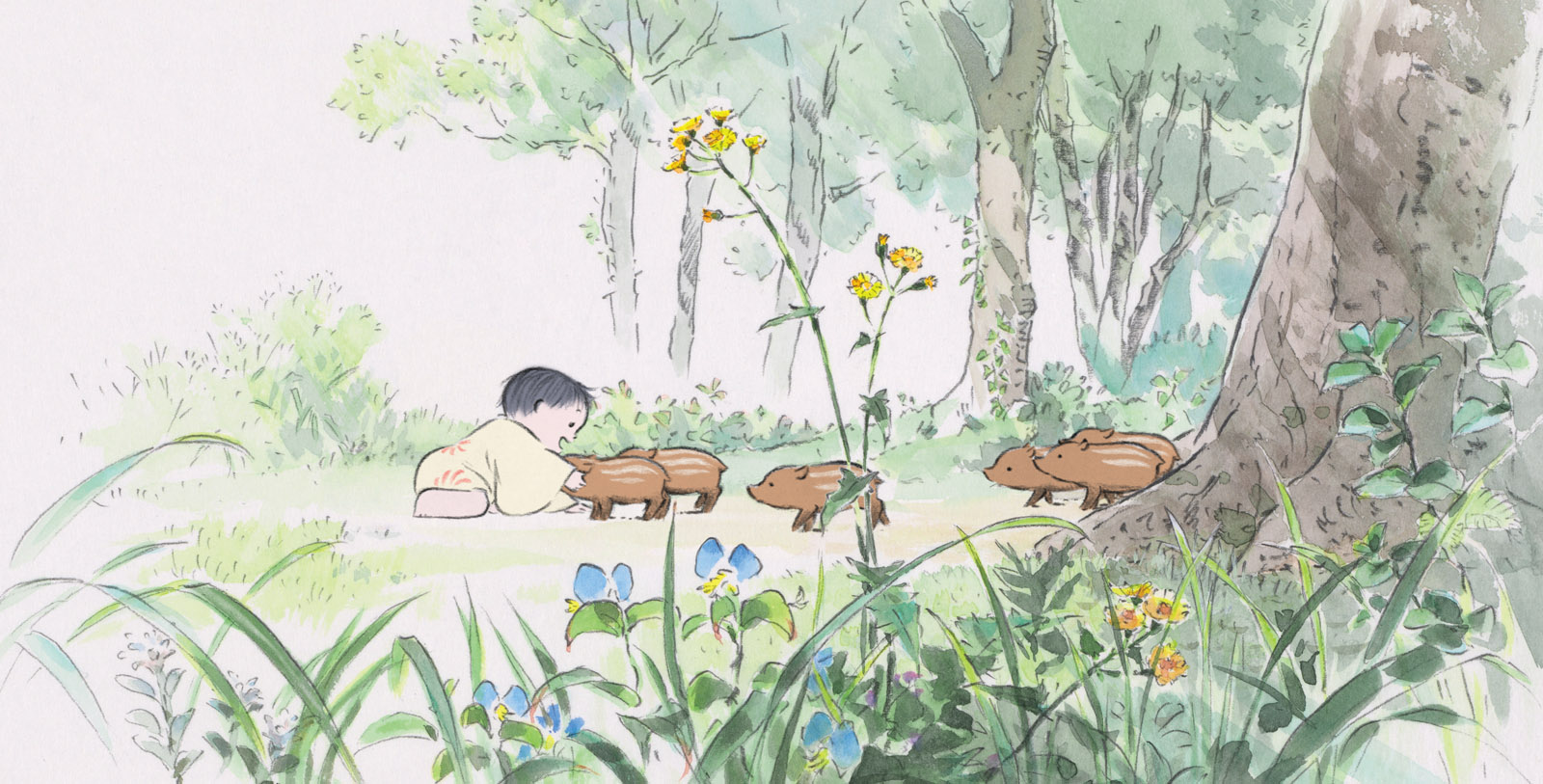
The community themes are least obvious in The Tale of the Princess Kaguya, but I’ll argue they’re still present. When the bamboo cutter takes Kaguya to the city and keeps her locked away in the mansion so that she has the appearance of a proper princess, he’s also locking her away from the communal living she grew to love in the village. In fact, when they leave for the city she’s right in the middle of helping prepare a stew for the entire village with her friends. Her loneliness and removal from the simple community she’d had is a critical part of the cry for help that summons the moon deities to take her back.
Of the eight feature length animated films Takahata made, there are three I still haven’t seen. Jarinko Chie (Chie the Brat and Downtown Story in English) is about a little girl running a diner in downtown Osaka while her unemployed yakuza father and her mother are separated. Gauche the Cellist is about a player in a small-town orchestra who is helped by and helps a number of talking animals. My Neighbors the Yamadas is series of shorts about the Yamada family.
Takahata interest in community action and relationships is woven into all of his works and was very much a part of his life. At Toei he was part of unionization efforts and brought Miyazaki into that world as well.
Takahata passed away on April 5, 2018. He was 82.
Takahata was a complex, intellectual figure. His role in developing not just anime, but animation as an art form is unfortunately overlooked at times. It’s been a fascinating trip learning about him, and he and his filmography may have contributed the most words to this blog. For now, I’ll leave you with part of Miyazaki’s eulogy for his friend, mentor and rival. Until tomorrow.
 chasetriesagain.com
1 Comment