
Title: Only Yesterday
Run time: 118 minutes
Released: 1991
Director: Isao Takahata
Studio: Studio Ghibli
Only Yesterday was a bit of a random choice for the third film in my exploration of Isao Takahata. I knew that I didn’t particularly want to revisit Pom Poko so I coin tossed between Only Yesterday and My Neighbors the Yamadas.
It wasn’t until the movie’s 25th anniversary that it got an English dub and release thanks to GKIDS, with Daisy Ridley in the lead role. It took until 2016 because Disney had been very hesitant to bring the movie over. It isn’t really much of a kids movie, but it seems one of the sticking points was a childhood scene involving the fifth graders learning about menstruation.
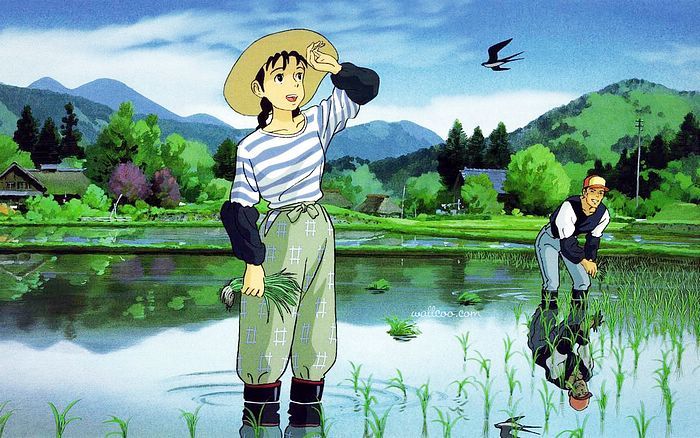
Only Yesterday is based on a 1982 manga by Hotaru Okamoto and Yuko Tone. The film follows 27-year-old Taeko Okajima, a single office lady embarking on a “vacation” to help harvest safflowers in the Japanese countryside. As she prepares for her trip, she begins remembering episodes from when she was in fifth grade.
These childhood episodes are the actual content of the manga. Takahata invented the framing narrative about the adult Taeko to structure the episodic content into a feature length narrative.
The framing device causes a fundamental shift in the narrative. These are no longer just coming of age incidents in the life of a fifth grade girl. The coming of age narrative really shifts to the 27-year-old woman analyzing these memories and trying to understand how they’ve shaped who she is as an adult then deciding what she wants out of life.
The resulting story is a Ghibli flick to the core, but it’s also a bit unique. It’s a realistic shoujo drama with some romantic comedy thrown in to boot. But added into the mix, perhaps unique to Takahata’s version of the story, is the conflict between modernization and tradition, industry and nature.
Taeko is working in a Tokyo office and using up her year’s vacation to go do hard work in the countryside. The city and country conflict becomes one of the major themes of the movie. Based on the scenes pulled from the manga, this conflict comes from one story about Taeko being disappointed the family didn’t have an old village to visit on summer break. I think it’s also a tellingly Ghibli choice that Taeko is an independent, modern woman who also prefers the traditional, rural world over the congested, urban office world.
I think what this movie really impressed upon me is just how varied Takahata’s works are. This is as far from Grave of the Fireflies as it is from Hols: Prince of the Sun. His movies don’t even look that similar.
The voice overs for the 1982 sections were recorded before animation, something unusual for anime. This was to allow the animators to try to animate the cheek muscles with more realism, trying to make the characters look more adult. The 1966 sections were done traditionally and with a style closer to Ghibli’s house style.
The Ghibli house style used in the 1966 sections provides an interesting juxtaposition to me. This may be skewed by my Western Millennial background, but I find Taeko’s home life really unpleasant. Her parents seem cold, distant and self-interested. There’s a realism to the parents and to how the older sisters and grandmother behave in that household, but it’s certainly not a portrayal of a warm, loving household. Her mother seems more interested in keeping her father happy and not wasting food. Her father seems more interested in his newspaper. The older sisters are believably bratty but not ill-intentioned, and the grandmother is a quiet woman who chooses her moments.
I’m not sure if my interpretation is similar to Takahata’s intention. There’s quite a time bias to overcome. What really makes me question it is that Taeko seems to dismiss it all. She’s a happy, well-adjusted adult who is totally independent. She doesn’t seem to harbor any real resentment toward her family. She’s just interested in figuring out what she really wants to do with her life and sorting out other people’s desires and opinions from her own.
I enjoyed Only Yesterday, though it does start to drag a bit in the second hour. Tomorrow, we’re taking on our last Takahata movie for the challenge. It is Takahata’s last movie, The Tale of the Princess Kaguya. Until tomorrow!
 chasetriesagain.com
2 Comments