
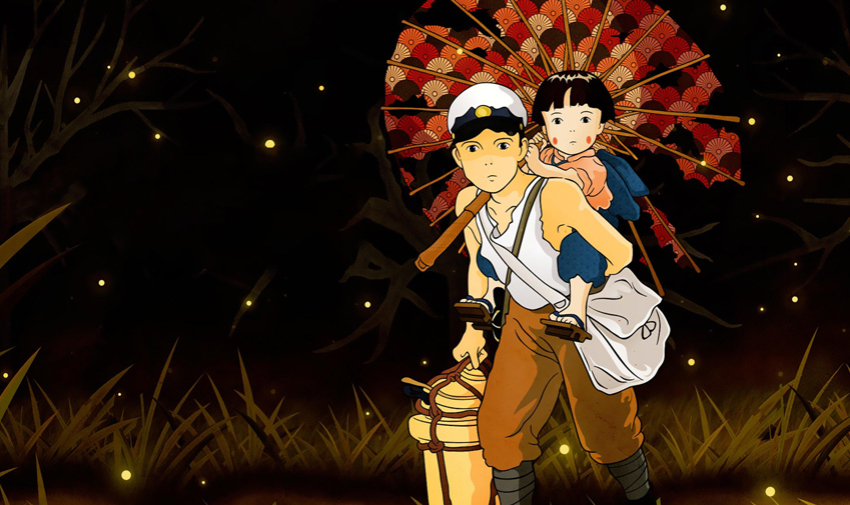
Title: Grave of the Fireflies
Run time: 89 minutes
Released: 1988
Director: Isao Takahata
Studio: Studio Ghibli
I’m not sure how many times I tried to watch Grave of the Fireflies before I was actually able to watch the whole thing through. It’s a dark, painful story about death and war, and Takahata doesn’t shield us from these realities. It’s not a movie meant to send you home smiling, but smiles aren’t the only end to good art.
Premiering as a double feature with Miyazaki’s My Neighbor Totoro 20 years after Hols: Prince of the Sun, Grave of the Fireflies is based on a semi-autobiographical short story by Akiyuki Nosaka. Nosaka is part of the Generation of the Ashes who grew up during and immediately after the horrors of World War II. The movie is a faithful adaptation of what Nosaka calls an apology to the sister he lost to malnutrition shortly after Japan surrendered.
The story follows Seita, a boy of about fourteen, and his little sister Setsuko who is four. Their father is off fighting and likely dying in the war, and their mother dies from injuries sustained during the firebombing of Kobe. The two children go to live with an unpleasant, even cruel aunt, but Seita eventually has enough of her and decides they can make it on their own. Seita spends the remainder of the story doing everything he can to try to take care of his sister, but she dies and he dies.
Nosaka and Takahata sat for an Animage interview during the production of the film. Nosaka said that Seita is an idealization. Nosaka seemed to feel deep guilt for the rest of his life because as a teenager caring for a toddler on his own during a war he wasn’t as patient or kind or generous as the hero of his story.
Takahata said he wanted to adapt Grave of the Fireflies for the screen because he felt that Seita would be easier to identify with than the common stiff-upper-lipped wartime teenager. Nosaka said that Seita is spoiled, making him different from other teenagers of the era, and Nosaka said his own experience was him growing up very fast, very suddenly. I suspect that wartime teenagers weren’t really little stoic heroes, but that they were still temperamental, unsure of themselves teenagers trying to figure out life while the world seemed to fall apart.
There’s been an awful lot said about whether Grave of the Fireflies is an antiwar film. Takahata has said (though not as explicitly as a questionable quote on Wikipedia might suggest) that he doesn’t really consider it one. For Takahata antiwar films have to be created with the intent to stop war and have the ability to do so, but I think this is patchy definition at best. Takahata was an antiwar activist, and the film is set during a war, shows the death of many people include the protagonists and really doesn’t have a single positive thing to say about war or its effects on society.
The rationing for the war is a critical factor in the deaths of Seita and Setsuko. Their aunt cares more about supporting the war effort than comforting and caring for grieving children. The adults who might have helped them can’t or won’t because of the war. If it’s not an antiwar film, then it’s a movie with a powerful antiwar message.
I could spend 3,000 words on Grave of the Fireflies, but if I’m being honest, I really don’t want to. It’s a hard movie for me to talk about. I’ve got a sister ten years younger than me, like Seita and Setsuko. I’m a lot older than Seita now, but I can still remember us at those ages, and it makes almost every scene of that movie a little more difficult. I don’t think I’m unusual in that aspect. I’m going to wrap this up here with a song used toward the very end of the movie. Until tomorrow.
 chasetriesagain.com
Omggggg so nostalgic!! This movie made me cry so much!!! I attempted several times to fully watch it, it’s just such a touching story!!!
LikeLiked by 1 person