
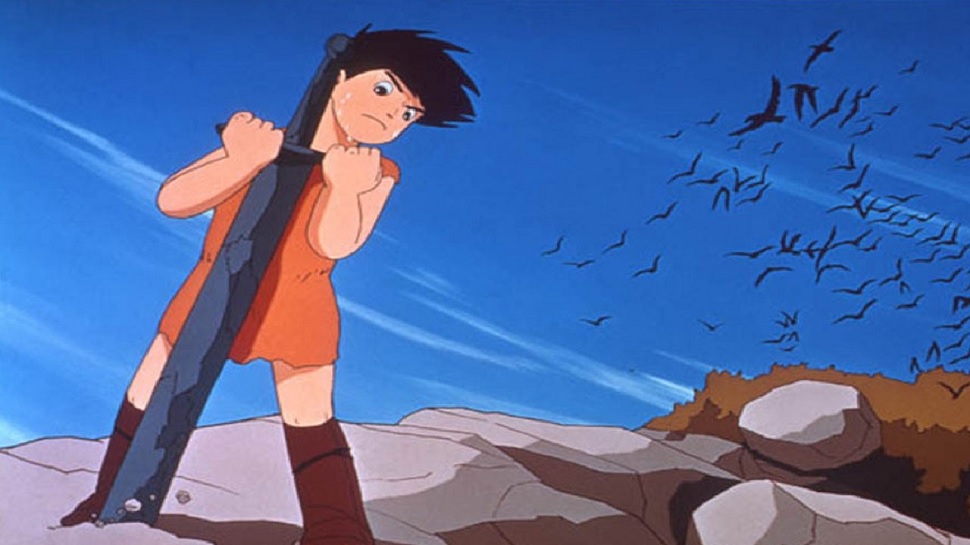
Title: Hols: Prince of the Sun
Run time: 82 minutes
Released: 1968
Director: Isao Takahata
Studio: Toei Animation
Settle in. Get a snack and a drink. Maybe turn some music on. I think we’re going to be here awhile. This post is nearly 3,000 words, and there’s not going to be an intermission. And fair warning: This is a 50 year old movie with a simple story. I’m not going to attempt to hide or avoid spoilers.
Isao Takahata’s first feature film as director is a storied production and an influential piece of animation. It goes by many names: Hols: Prince of the Sun, Horus: Prince of the Sun, The Great Adventures of Horus: Prince of the Sun, The Little Norse Prince and Little Norse Prince Valiant.
Its designs seem simple and dated, but its animation is fluid. It marked the beginning of a creative partnership that spanned parts of six decades. It sparked an auteur movement almost by accident. It ruffled studio feathers. Its production was legendarily troubled. It has shaped anime in ways that are difficult to understand, and I’ll argue that it has influenced media as far apart as The Legend of Zelda and the 1998 Merlin miniseries on NBC.
I’m not sure that I’ve asked this before, but if you’re going to read this post, I want you to pause here. You can watch Hols: Prince of the Sun on Amazon. If you’re in the U.S. it’s $4.99 to rent the digital version. This is an English dub, but based on several sources, it’s very true to the original.
I’m going to be honest with you: It may bore you. Age hasn’t done it wonders, but we’re going to be discussing it in the context of the period. The plot is nothing special compared to today’s anime, and it doesn’t even look all that much like anime. You could easily mistake it for an American movie by a wannabe Disney studio. But hold tight.
We begin with Toei Animation in 1965. Back then they were Toei Doga, and Tezuka, God of Manga, and his cohorts at Mushi Pro were going head to head with them for the new found anime market on television. Toei had been making theatrical films for about a decade, and they were turning their attention toward television.
The feature films they’d made thus far were done cheaply and within eight to ten months. They were targeted at children, and while pretty, lacked substance. Comedic relief was there to distract from the story.
They were looking for a bit of a new direction to take for the big screen, and so a team of young animators was assembled. The director chosen was also quite young at 32. Isao Takahata was fresh off a successful run as director of television anime Wolf Boy Ken, and he’d earned the confidence of executives and colleagues alike.
His team would include Japanese animation luminaries like Yasuo Ōtsuka, a veteran of a few Toei films at this point, as the animation director. Yasuji Mori would work on some of the key animation, specifically designing and animating the movie’s leading lady Hilda. Reiko Okuyama, one of the first women to work in animation, would take on other key animation tasks along with husband Yōichi Kotabe, who eventually went on to help define the look of Super Mario through package design. Another key animator was a brash, young Hayao Miyazaki.
Takahata and Ōtsuka took an egalitarian approach to creating the movie, inviting the input of the entire team in storyboarding and planning. Miyazaki in particular would take them up on their requests for input, becoming a major influence on the end product and sparking a life long partnership with Takahata.
For the basic concept, they went to a puppet play called The Sun Above Chikisani. The play in turn was based on a Yukar epic, part of an oral storytelling tradition belonging to the Ainu, the vanishing indigenous people of Japan’s northernmost island Hokkaido.
The depiction of the Ainu would become the first major battle between Takahata and the studio during the production, and Takahata would lose it. The studio, afraid that depictions of the ethnic minority would bore, offend or scare the Japanese audience, insisted that he translate the story into a vaguely Scandinavian setting.
While the setting and some of the trappings shifted, the goal of the movie remained the same. Takahata and his team weren’t just looking to make kiddie fluff. They wanted to engage adults through animation, and they embedded in Hols themes of societal change (as Japan was seeing at the time) and their own socialist ideals. Indeed, several members of the production were involved with unionization efforts at Toei during the ’60s, Takahata and Miyazaki being leaders of these efforts. This too contributed to the difficulties they faced negotiating with executives.
Before it was all said and done, the studio would cut 30 minutes from the planned length of the movie. This would be trouble enough for any team, but it was especially trying for the perfectionists at work on Hols who were told they were using up too many cels.
At the top of the post I noted that the movie was released in 1968, and a moment ago I mentioned the production began in 1965. Toei, whose previous films were made in less than a year, was getting antsy and put pressure on the team to get Hols finished fast. In the end, they didn’t even have time to fully animate two fight scenes in the middle of the film, instead detailing them through careful filming of still scenes.
Hols got little in the way of advertisement, and when it made it to theaters, it only stayed there for 10 days before the studio pulled it. Whether this was a lack of vision on their part or a way of getting even with the union organizers on staff is a matter of debate. Regardless, despite initial popularity with critics and audiences and its eventual influence, the film was a financial flop.
Takahata was demoted, never to direct at Toei again, and he and the team were all eventually ousted from the studio. Five decades later, I think it’s fair to say that the Hols staff got the last laugh.
Make no mistake, thanks to the tribulations of its production, Hols has its fair share of flaws. Its first 15 to 20 minutes is comically rushed. Later scenes drag. The primary villain is one note. The animal companions seem like they were created to fill a hiring quota. But none of this stopped it from being a revolution in anime.
The story we’re told is simple enough. Its themes are common in folklore. It’s a coming of age story where spring battles winter, a tale of death and rebirth. The hero wields the Sword of the Sun, pulled from the shoulder of a rock giant. After multiple trials he leads a band of villagers to use sun and fire to defeat an ice demon that seeks to destroy the human villages of the land.
Hols and his sword and the people who follow him are spring and fire and life. Grunwald (who at one point early in the movie turns into a Chernabog-style figure) is winter and ice and death. Even Mohg the rock giant is a symbol for fertile earth, hibernating in winter and ready to help life return when spring is on the rise.
But all that is pretty straightforward stuff, and Hols is the movie that saw Japanese animation take a step out of the gigantic shadow cast by Walt Disney. Simple mythological themes aren’t enough to shake off the children’s cartoon label often associated with Disney.
So let’s start with Hols himself. He doesn’t really do a lot of coming of age. We are introduced to Hols mid-fight with a pack of wolves. He gets his magic sword when the fight wakes up Mohg, and immediately after that he is at the bedside of his dying father learning about Grunwald, the village they came from and the quest he’s about to go on.
Already a capable fighter with his hatchet-on-a-rope, we do see Hols taking some time to become a really formidable warrior. But as a person, he’s not all that different at the end of the film. He’s a good kid with a strong sense of justice. When he encounters Grunwald the first time, Grunwald teaches Darth Vader a neat trick. Grunwald has Hols hanging from a cliff, and he offers to help him up if Hols will join him (this movie predates The Empire Strikes Back by 12 years, and I refuse to believe this is a coincidence). In Japanese he literally asks Hols to become his brother (we’re going to come back to that). And of course Hols refuses.
What I’m getting at here is that Hols moral compass, heroism and maturity are established right from the get go. Hols is there to serve as a catalyst and leader for the heroic journey of the village that rescues him after he falls from that cliff (because of course he does) and for Hilda, who is probably the true protagonist of the film. In a way, by the end of the film Hols is less a character and more the morality that Hilda and the village must choose to accept or reject.
Hilda is a complex character. She’s a protagonist, not a heroine. Her parents were killed by Grunwald. She believes she’s cursed, and Grunwald has claimed her as his sister. In fact, our first clue that she might be dangerous is pretty subtle. She suggests that Hols could be her twin.
Hilda is essentially Grunwald’s agent within human society. She uses her beautiful voice and charm to distract and confuse the village that Hols invites her into. Meanwhile, she’s conflicted about her own actions. She doesn’t believe she can be truly human anymore, and her two animal companions wage a war for her soul. Toto is a snowy owl in service to Grunwald who encourages her evil actions. Chiro is a friendly squirrel (I think) who plays on Hilda’s attachment to one of the village children to try to sway her toward a more righteous path.
As you might expect, Hilda chooses the side of the angels after she’s almost brought about the destruction of everything good and light. In fact, she’s willing to sacrifice herself to atone for her mistakes, and she’s surprised when she lives. But the audience is left with the impression that Hilda still has a ways to grow before she’s a true “good guy.”
Hilda is the prototype for a lot of complex anime characters. She is especially important when looking at Miyazaki’s many female characters. She is almost assuredly the model upon which Princess Mononoke’s San is based, but Lady Eboshi from the same movie has her DNA, too. The Witch of the Waste from Howl’s Moving Castle and Yubaba from Spirited Away also share some DNA with Hilda even if you’d never expect it.
But Hilda isn’t our only complex character or source of complex, realistic emotional moments. The chief of the village takes a page from Tolkien’s Théoden. He’s a good guy whose own child is willing to stand up to him when he’s wrong, but he’s got this one oily adviser who is out to get power for himself at the cost of the village. This also makes him the collective voice of the village who grow and change together even when individuals within the village disagree.
ASIDE: Since we’re talking about the village, I also wanted to touch back on the socialist ideals imparted in the movie. While it’s true that the collective here is learning to stand up to the selfish individualist, I felt like these ideas weren’t nearly as prominent as some reviewers make them out to be. But this may simply be a product of my place on the timeline compared to the movie’s place.
Another instance of what Wikipedia calls psychological realism happens not long after Hols arrives in the village. Hols learns of a giant, man-eating pike that is plaguing the village, which relies on fishing to feed itself. Hols grabs some harpoons and heads out to handle it himself. The fight has been called one of the best in anime history. This could be an exaggeration, but it’s still a damn good boss fight (we’ll come back to that). When he returns to the village, the villagers question his success since he has no proof, but are thrilled nonetheless when they start catching fish again almost immediately.
Except for the very young son of the last man the pike killed. His family (lead by his blacksmith grandfather) took Hols in when he washed up. He hugs Hols tightly and weeps when Hols says he killed the pike, but he is very angry and denies that Hols killed the fish. It was the little boy’s job to grow up big and strong and kill the pike. He wanted to avenge his father.
This emotional reality and complexity just didn’t exist in anime of the time. This is the spark that lights that fire. I also glossed over the animal companions. While I feel they’re largely stuck onto the film to meet a quota, Takahata and Co. use them in an interesting way.
Hols has an animal companion, too. He’s a bear, and his name is Koro. Hols and Koro have no conflict. They’re straight arrows directed at ending Grunwald and helping people along the way.
Hilda has two animal companions, and they reflect her inner turmoil. Through Koro, Toto and Chiro, the animators found a way to bring the internal conflicts (and lack thereof) into animated life. While not an entirely new concept even then, it is an interesting use of what were usually just comic relief characters.
One tidbit of trivia I wanted to bring up before I move on to the next arc of this really long post: Pulling swords from stones isn’t exactly a novel concept, but the stones aren’t often giant, living beings. I mentioned Merlin a miniseries that ran on NBC in 1998 earlier. (It stars Sam Neill. It’s not exactly the height of television arts, but I get a kick out of it.) Merlin entrusts Excalibur to a living mountain called the Rock of Ages, and so Arthur gets his legendary sword (and his kingship) in an eerily similar way to Hols. I’m less confident about this one than the Star Wars example earlier, but I’m sticking with it.
I mentioned The Legend of Zelda earlier, and I get the sense that a lot of concepts in the series can be traced back to this movie. Hols himself is a pretty good parallel to Link. He’s kind of a blank slate. He’s a good guy trying to do the right thing and hunting down a bad guy bent on domination and destruction. Like Link, Hols is also tasked with restoring his magic sword to its full power before he can beat the bad guy.
Hols also uses some interesting weapons that I think would be right at home in a Zelda dungeon. His hatchet-on-a-rope gets used like a hookshot and a mace and as a projectile, and Hols figures out how to use fishing spears for one specific boss fight.
Hols interaction with his dying father also reminds me of the start of A Link to the Past. Link’s uncle dies in the very beginning of the game, handing off his sword, shield and quest to Link in the same way Hols’s father gives him the quest to take down Grunwald.
Grunwald also serves as a final boss to Hols in a very Ganon-esque manner. Grunwald, like Ganon, is the villain that the magic sword is meant to destroy. He also has multiple lieutenants the hero must defeat along the way. For Grunwald these lieutenants are the leader of the wolves, the pike and the giant snow mammoth he creates during the final battle. While only the pike plays out like a traditional Zelda boss fight, the other two would fit right in behind a Boss Key.
So that’s my take on Hols: Prince of the Sun. I think it is the single longest post on this blog, and it’s going to be quite a standard to live up to digging into the rest of the shows, movies and directors I’m going to cover. Some have called this movie the Citizen Kane of anime thanks to its at the time revolutionary ideas. I’m not sure I agree with that statement. For one, I really like Citizen Kane, but I generally don’t like to pick “the best thing ever” in any category. But I think I’ve ended up falling in love with the movie despite its flaws. It was quite a piece of history to research, and I feel like I understand the context and journey of anime a little better for having seen it.
Tomorrow, I’m moving on to Grave of the Fireflies so please invest in Kleenex stock. Until then!
 chasetriesagain.com
1 Comment