
Title: Summer Wars
Run time: 114 minutes
Released: 2009
Director: Mamoru Hosoda
Studio: Madhouse
Summer Wars was my introduction to Mamoru Hosoda. I don’t remember exactly when I watched it, but I do remember being crammed onto a couch with several friends. I’m not sure just how many times I’ve watched it sense either.
Summer Wars is one of those stories that really clicked for me. Kenji Koiso is a high schooler with a talent for math and cracking code. Natsuki Shinohara, another student, invites Kenji to her great-grandmother’s 90th birthday celebration over the summer break. She introduces him to her great-grandmother Sakae as her fiancé.
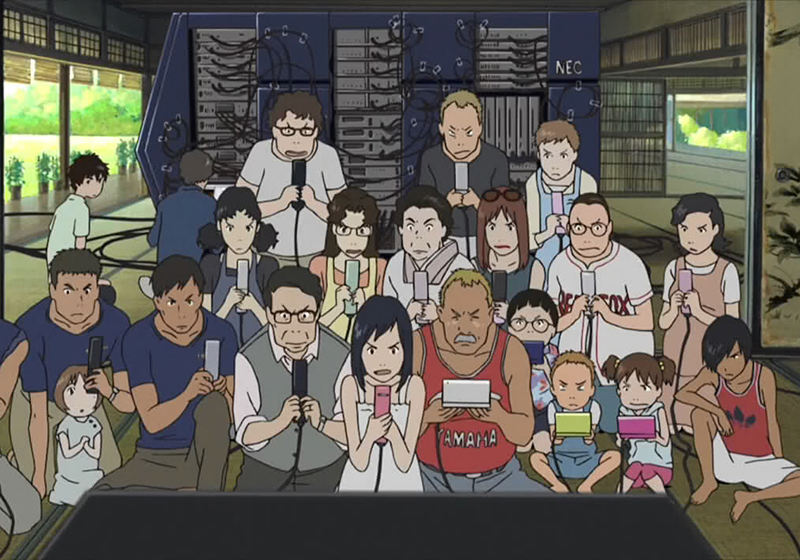
The real protagonist of the film is Sakae and Natsuki’s extended family, the Jinnouchi clan. Descended from samurai, Sakae has instilled the value of public service in her family. Her children, grandchildren, great-grandchildren and in-laws include doctors, police officers, firefighters, and soldiers. Even those who aren’t directly engaged in public service tend to work in businesses integral to modern Japanese society. And 25 or so members of the family have gathered at the ancestral home to celebrate their matriarchs 90th birthday.
I grew up in a small town surrounded by multiple generations of family on both sides. I went to school with second and third and fourth cousins. I had family reunions around holidays where a dozen or so small children would run wild. And, at least it seems to me, a disproportionate number of my relatives work in public service of some sort.
The dysfunctional but well meaning and industrious Jinnouchis hit home for me right from the start. But if you haven’t seen the movie, and you’re expecting a Japanese take on The Waltons, this isn’t it.
Summer Wars is also a sci-fi flick, and in the movie, the world has become dependent on a virtual reality social media platform called OZ. Just about everybody has an account on OZ, and tons of services, from traffic lights to banks, have been at least partially integrated with the platform.
Love Machine, a malign AI created for the United States Armed Forces, gets loose on the web and begins attacking OZ, tricking Kenji, taking over his account and framing him for the disaster that’s now unfolding.
While Kenji does get his good name restored, this doesn’t stop Love Machine. It’s also revealed that Love Machine is the creation of Wabisuke, illegitimate son of Sakae’s husband.
With OZ compromised, traffic falls into a gridlock and various essential services are compromised. Sakae swings into action with a Rolodex and a rotary phone. She begins calling authority figures all over Japan, encouraging and coordinating them as they try to unravel the mess.
There are twists and turns along the way, but I explained this much so I could touch on one of the other major themes of Summer Wars. Sakae and her clan leap into action against a foe that seems unstoppable. They leverage their own abilities and their personal relationships to try to help their country and eventually the world.
Despite the primary villain being an out of control computer program, Summer Wars is not an anti-technology movie. When Love Machine is defeated outright, it’s defeated on its own turf. But the road to that defeat is paved by real world relationships. Our world is interconnected with or without the Internet, and it’s these relationships, familial and otherwise, that are important, not the tool we use to maintain them.
I do find it especially touching that they finally bring Love Machine down via a card game that the family loves, and that the family is willing to wager their own well-being to try to save the day.
All the more scholarly stuff aside, I really like Hosoda’s interpretation of the Internet. It gives me some serious Satoshi Kon vibes, but without the underlying psychological creepiness. The world of OZ also introduces us to Hosoda’s love of anthropomorphic characters.
That’s all I’ve got to say about Summer Wars. It’s pretty. It’s quirky. It’s heartwarming. The next post will be an overview of Mamoru Hosoda, and then we’re moving on to Isao Takahata. Until tomorrow!
 chasetriesagain.com
What ive seen of Hosoda’s works I’ve enjoyed so far so I should probably give this a go
LikeLiked by 1 person