
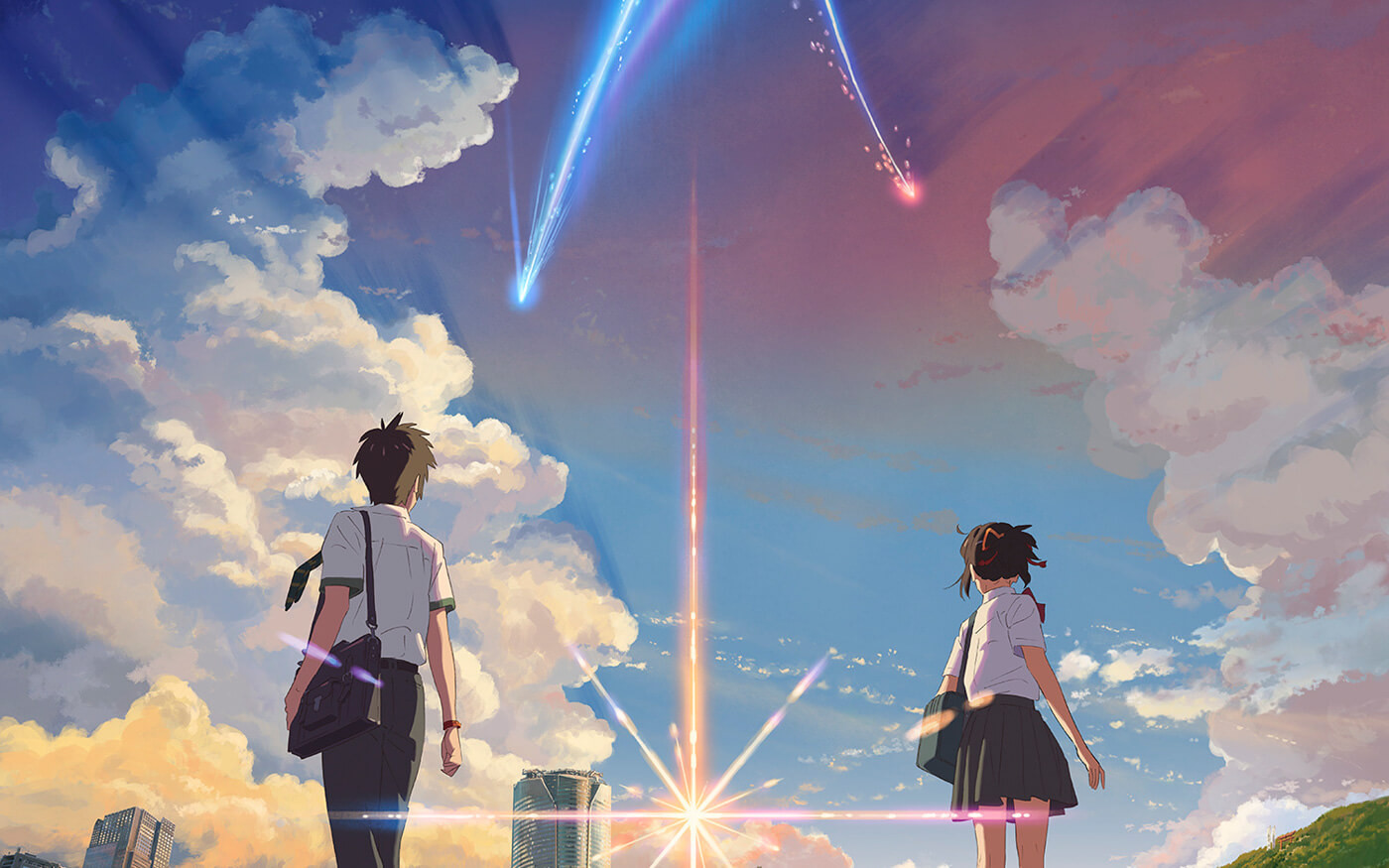
Title: Your Name
Run time: 107 minutes
Released: 2016
Director: Makoto Shinkai
Studio: CoMix Wave Films
I can’t really talk about Makoto Shinkai without talking about Your Name. It is the highest grossing anime film worldwide. Your Name, more than any of his other works, has gained Shinkai the nickname “the new Miyazaki.” Shinkai has asked audiences to stop watching it.
Once again, I’m not going to dig too deeply into the plot. Our protagonists are two teenagers who sometimes swap bodies in their sleep. Complications arise.
I bought the DVD/Blu-ray set of Your Name sometime last year, and I made it about 15 minutes in before I handed off the other disc to my sister ensuring that someone else in my general vicinity would be able to talk about the movie when it was over. I’m glad I did because when it was over, I had a lot I wanted to say.
Now, though, I’m not sure what I’ve got to add to the conversation. In Japan, it’s still behind Miyazaki’s Spirited Away, but its success worldwide has sucked just about every conceivable talking point dry.
Your Name is beautiful. Shinkai and his team lovingly detail city and country environments alike. The story is compelling. Despite giving away the ending right at the start, it gripped me enough that its moments of tension and high emotion still work.
Its focus is telling a story about the sense of familiarity two strangers sometimes share. But it lavishes attention on the contrast between city and country life. Taki is a typical high school boy living in Tokyo, working a part-time job, and harboring a crush on a slightly older woman. Mitsuha is a country girl, a miko no less, dreaming of life in the big city while living at her family’s ancestral shrine.
If you’re at all familiar with Japanese media, the juxtaposition of tradition and modernization is nothing new. It seems to be present in just about every story to come out of modern Japanese media, sometimes as a major theme, sometimes as background. In Your Name, it is a major motif. Mitsuha’s grandmother strives to maintain Itimori’s traditions while her father is focused on revitalizing the town. Mitsuha herself is more interested in the city than her country upbringing while Taki is fascinated with the villages architecture.
I was really impressed with how clearly the two leads personalities shine through even when they’re in different bodies. Mitsuha’s feminine mannerisms as Taki are sometimes very subtle but still distinct from Taki himself.
As in The Garden of Words, Shinkai makes use of wordplay here, but it’s much more reliant on Japanese than the poetry and concepts in the previous film. Yukari, from The Garden of Words, even makes a cameo as Mitsuha’s teacher to explain a bit of integral wordplay that simply doesn’t translate to English. She’s teaching the class an archaic term for twilight that happens to sound very like the phrase “who is that?” in Japanese.
As I said earlier in this post, I don’t feel like I have anything new or revolutionary to say about Your Name. It’s already been talked about plenty. Instead of me going on any further about the movie, I’m going to embed a video from Gigguk below. Until tomorrow.
 chasetriesagain.com