
Reader beware. Paprika is a mystery. To provide proper analysis much of the mystery is going to have to be spoiled. I’ve placed a “Read More” line before the spoilers. Go with caution.
Title: Paprika
Run time: 90 minutes
Released: 2006
Director: Satoshi Kon
Studio: Madhouse
Satoshi Kon’s fourth and final feature film is a psychological thriller that alternates between dreamscape and cityscape. Paprika is based on a 1993 novel of the same name by Yasutaka Tsutsui. If we’re going to begin a discussion about Kon then perhaps there is no better starting place than Paprika.
Paprika has all the essential elements of a Kon story. Its lead is a woman. It makes use of lots of very common visual iconography. Its reality becomes less and less reliable throughout the film. It deals with themes like the effects of technology and media on individuals as well as groups, the nature of reality and the nature of the self.
We begin by exploring a false lead, Detective Konakawa, a police officer struggling with a murder investigation. We dash through his cinema-inspired nightmares, meeting the enigmatic Paprika, who appears as a sort of dream world psychopomp guiding him through the riddles of his subconscious.
At first we’re lead to believe that the mystery at play in this movie is going to be the unsolved murder that Konakawa is working, but after a brief explanation of a device called the DC Mini, the focus shifts entirely, only returning to Konakawa when his story can be folded back into the larger tale. The plot hinges on the DC Mini, a device that allows the sharing of and even recording of dreams.
The murder, as it turns out, is inconsequential to the story, and is only the trigger for Konakawa’s nightmares, which stem from a much older, more personal ordeal. But I’m not going to spend anymore time here recounting plot. Instead, I want to talk about how Kin gives each character a clear gimmick, usually with strong visuals attached.
(For the record, I have not read the book from which the film was adapted. To make up for this deficiency, I read several reviews of the book. The consensus seems clear. Kon already has a reputation for loose adaptations, and Paprika is no exception, serving more as a base on which Kon built a different story. It seems that if Kon didn’t like an element of the book, it would not have made it to the screen.)
Paprika herself is the dream world disguise of Atsuko Chiba, a psychiatrist working on the DC Mini. But Paprika may be more than just Chiba’s persona for exploring dreams. She seems to have a mind of her own and to sometimes act independently from Chiba.
On the other end of the scale we have the chairman of the facility responsible for the DC Mini, Inui. He seems to despise the project, despite initially supporting it, and he sees himself as a protector of the sanctity of dreams. Inui turns out to be the major villain of the story. He is wheelchair bound with a corpse-like visage, and he is secretly using the DC Mini in an attempt to hijack a new body so that he can walk again. I enjoyed the contrast between his pale, sickly appearance and the green that constantly surrounds him. His office features plants, and he appears within green houses multiple times in reality and dreams. It’s almost as if he’s trying to sap the energy from green, growing things. In the dream world, he even appears as part tree and creates vines and branches to ensnare Paprika.
Inui’s follower is Osanai, another researcher on the DC Mini project. Osanai is obsessed with beauty, and in the dream world he appears in a room full of pinned butterflies, pinning a butterfly-winged Paprika down and attempting to rape her.
Konakawa’s dream world is filled with movie scenes. At first this seems to bother him to an absurd degree. When it’s revealed that he wanted to be a director before he became a police officer, things begin to sink into place. After he comes to terms with his past, he appears dressed as a director in his dreams.
DC Mini inventor Tokita is Chiba’s love interest. His associations are two-fold. He is morbidly obese, and he shows a complete lack of control when eating. He is also very child-like, obsessed with toys and gadgets and a theme park from his youth. When reality and the dream collide, he appears as a giant robot.
There’s also red-herring villain Himuro who turns out to be Inui and Osanai’s first victim. He harbors a secret crush on Osanai, and he seems to idealize himself as a tiny doll. Himuro himself is hardly a character. We only encounter the clutter and shape of his mind during the story.
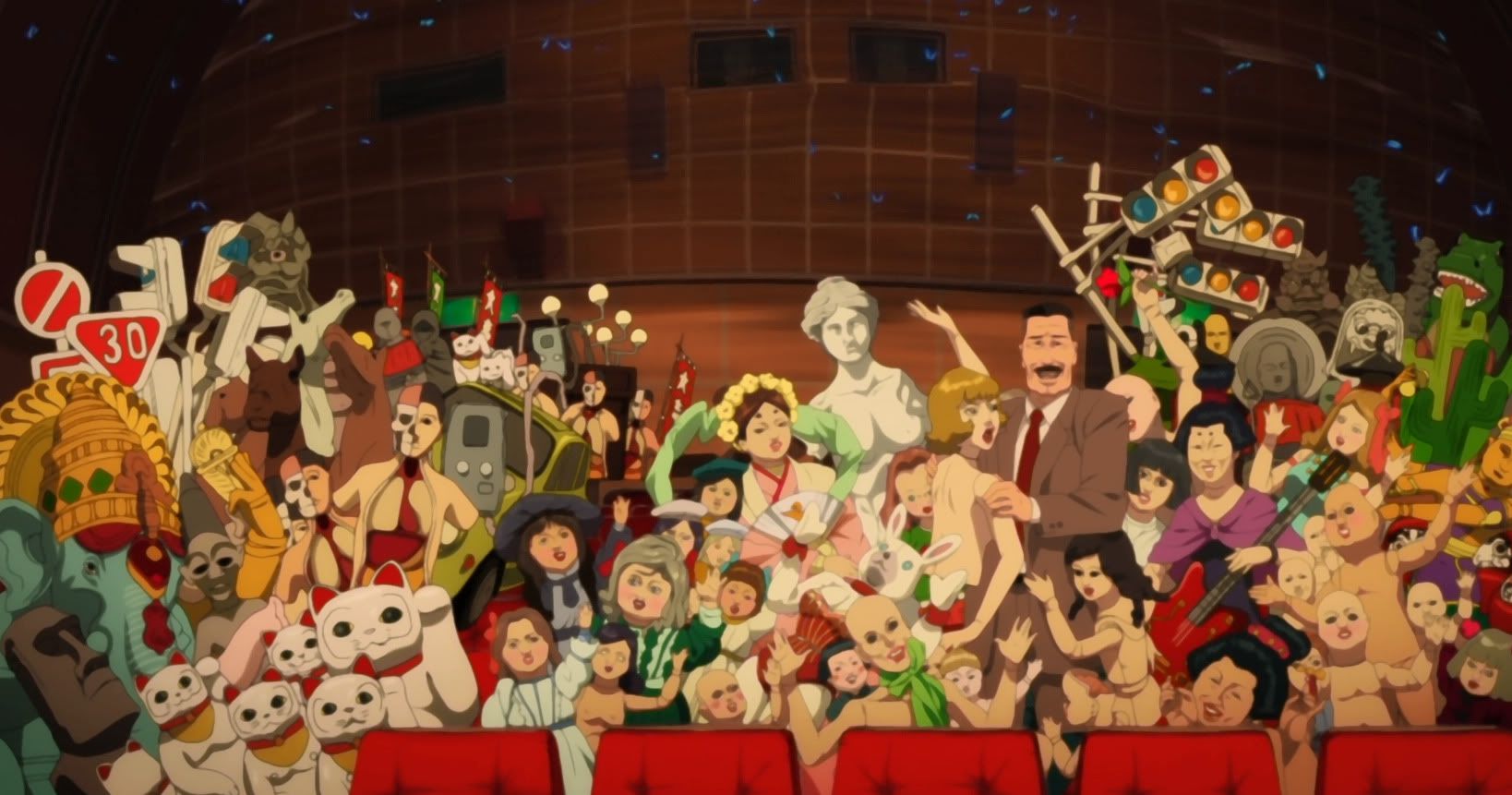
Throughout the movie, an infectious dream initially seeded in Himuro grows more and more out of control. It features a parade of toys and icons and everyday objects that grows with each person who gets caught up in it. The film climaxes with a truly bizarre psycho-physical battle that, even when the dreams fade, leaves very real damage throughout Tokyo. These collected images, finale and aftermath remind me of another of Kon’s works, his series Paranoia Agent.
This is all quintessential Kon, exploring society and the self through powerful visual metaphors. But that’s all I’ve got for tonight. Tomorrow we should be talking about Kon’s Millennium Actress.
 chasetriesagain.com
1 Comment