
Typing in 3-16-6 Minami-Nagasaki in Google Map s will not, as it turns out, provide much in the way of results. The address, mysterious though it may be, now belongs to a publisher of scientific textbooks. But in a nearby alleyway there is a monument set near what would have been the backdoor to a building demolished over 30 years ago.
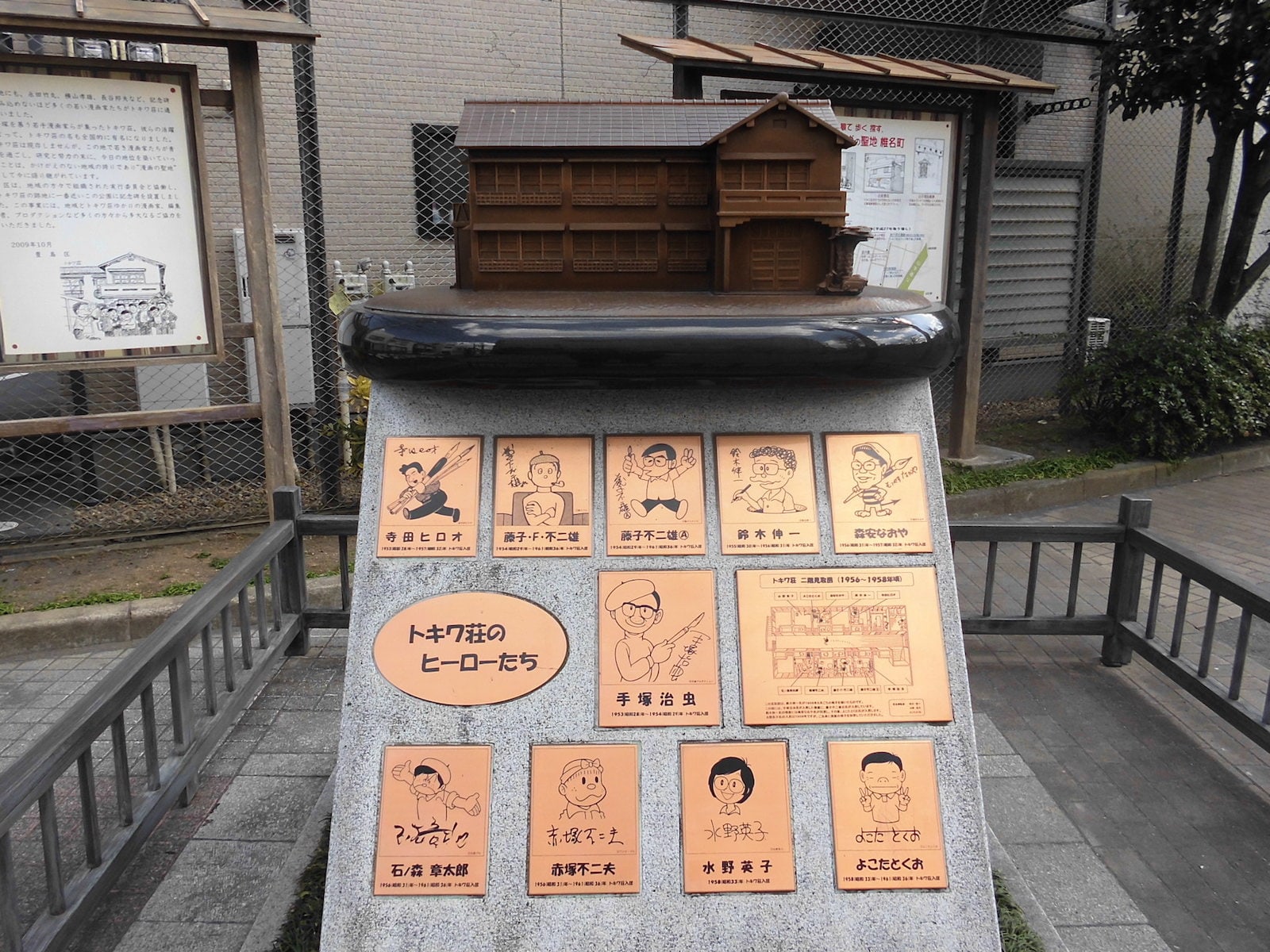
The building it honors has another monument in a nearby park (pictured above). Said park will also play host to a replica of the building containing a museum. The building in question was called Tokiwa-sō, and it made manga.
In the early 1950s Tokiwa-sō was an unassuming apartment building in a traditional Japanese style. It was a simple two story wooden building in Tokyo’s Toshima ward most notable for having survived the firebombing of Tokyo during World War II. Residents resorted to local bathhouses because there were no baths in the building, only sinks with cold water and toilets.
But starving artists aren’t a uniquely Western concept, and so the building attracted a few young mangaka looking for a place to stay. From 1952 until it was demolished in 1983 Tokiwa-sō served as a veritable commune of rookie artists learning and collaborating as they tried to make it in the industry.
The most noteworthy of Tokiwa-sō’s tenants was Osamu Tezuka who moved into the building in 1953. It was Tezuka who really got the ball rolling on the collaborative nature of the residence. Tetsuwan Atom (Astro Boy) was already underway at Weekly Shonen Magazine, and Tezuka began employing aspiring young artists as his assistants to help him keep up with the work. This model would become the industry standard and continues to be used today.
Some of Tezuka’s assistants would also take rooms at Tokiwa-sō. This included Hideko Mizuno, one of the first widely successful women manga artists. But Tezuka’s lasting impression on Tokiwa-sō was when he moved out in 1954 and offered his room to manga duo Fujiko Fujio. This began a cycle of the mangaka in residence helping fill empty rooms with more artists so that the second floor of the building was a hive of artistic integrity.
Fujiko Fujio would go on to create the iconic Doraemon series. Cyborg 009, Super Sentai and Kamen Rider creator Shotaro Ishinomori spent a few years in a Tokiwa-sō apartment. Gag Manga King Fujio Akatsuka also lived there.
Though Tokiwa-sō was torn down in 1982, its legacy lives on even outside the world of monuments and museums. The Tokiwa-sō Project helps rookie mangaka get their start and even provides housing assistance. There are at least two apartment buildings in Japan inspired by Tokiwa-sō that offer housing for aspiring manga artists, including one in Kyoto and one in Niigata.
What I love about this story though, is that it is essentially an accident. I can’t speak for Japanese fans, but for a Western audience, Tokiwa-sō is an obscure place that isn’t exactly synonymous with manga or anime. And for Tezuka and the other residents, it doesn’t seem to have been anyone’s plan to turn that apartment block into a piece of history. The artists of Tokiwa-sō shaped an industry by accident just by trying to make good art and tell the stories they were interested in. They weren’t making history. They were making manga.
 chasetriesagain.com
2 Comments