
Once upon a time in 1979, Weekly Shonen Jump began publishing a manga by Yudetamago, the duo of Yoshinori Nakai and Takashi Shimada. Jump was about a decade old at that point, and it focused most of its attention (and still does) on action and comedy. This made Yudetamago’s Kinnikuman a perfect fit for the magazine.
Kinnikuman was first and foremost a parody of Ultraman a famed Japanese superhero series about a size-changing guardian that protected Earth from extraterrestrial menaces. Kinnikuman followed its titular character, an alien from a planet renowned for producing superheroes, on his quest to wrestle his way to the throne that is rightfully his.
While begun as pure parody, Kinnikuman would eventually add some more serious elements after its first arc. Kinnikuman blended semi-serious action, comedy, sports series tropes and superhero-tier conflict, and a fledgling genre was born. Kinnikuman spawned sequel series Ultimate Muscle, which is probably more familiar in the West, but it also helped to create the shonen fighter genre in anime and manga.
While it would eventually spread beyond the Shueisha publication, the shonen fighter was conceived and incubated in the pages of Weekly Shonen Jump for much of the ’80s, and many of the most popular entries into this genre still come from Jump today.
In 1983, another progenitor of the shonen fighter genre hit the pages of Weekly Shonen Jump. Fist of the North Star, by writer Buronson, was the polar opposite of Kinnikuman. Its hero wandered a post-apocalyptic wasteland, trying to protect the innocent from gangs and warlords using the deadly martial arts style he has inherited. Its grim art (by artist Tesuo Hara) featuring heavily muscled men in semi-realistic form and shading posed a stark contrast to the brighter visuals of Kinnikuman.
Then things really took off. In 1984, Akira Toriyama debuted Dragon Ball. Dragon Ball, like Kinnikuman before it, was a parody, this time of the martial arts genre. Its characters were children or at least childlike, its world was bouncy and high energy, and its fights were of fun but well-considered. Dragon Ball introduced a level of progression to its fights that gave audiences an extra opportunity to invest in the characters. This sense of progression during and between fights allowed characters to grow, but it could get out of control. It would become a core component of shonen fighter series, but progression without proper planning would also become a central weakness for the genre.
In 1986, Jump began publishing Saint Seiya and introduced armor-clad pretty boys to the shonen fighter arsenal. The following year, JoJo’s Bizarre Adventure by Hirohiko Araki joined the pantheon of Weekly Shonen Jump fighter series as a clear parody of Fist of the North Star. JoJo’s is still a pretty unique creature in the world of anime and manga, using that vital sense of progression and change across multiple generations of a family to keep the story fresh and stave off some of the power-creep that progression often causes when left unchecked.
These five shows would lay the foundation for a genre that is as inseparable from the core of anime and manga as mechas and magical girls. A shonen fighter series can be just about anything. They can be isekai shows or the battles can happen in mechas. There’s a lot of hard overlap between shonen fighters and sports series. The contestants can be magical girls or parts of a harem.
When the anime adaptations of the Dragon Ball series (specifically later entry Dragon Ball Z) hit the States in the mid ’90s, shonen fighter tropes became virtually synonymous with anime as a whole for an entire generation of fans. This was reinforced by shows like Pokémon and Yu-Gi-Oh! also fit the mold and helped establish the link between the medium and this specific genre.
The Big 3 manga from Weekly Shonen Jump all fit this category. Ongoing One Piece, decayed Bleach, and Naruto and sequel series Boruto: Naruto Next Generations are all shonen fighter series and they loom large in the imaginations of casual and hardcore anime fans alike.
Protagonists tend to be male, and they usually fit into one of two categories. They will either be brooding, dark good guys like Ichigo from Bleach and Yami Yugi from Yu-Gi-Oh! or they will be over-the-top hams like Naruto and One Piece’s Monkey D. Luffy. You can expect them to be motivated to help and protect their friends, to go beyond their limits, to transform or display some other power and often to eat a lot of food.
Shonen fighter series do have their weakness. The aforementioned runaway power progression is one of them. The further beyond Superman a shonen protagonist gets, the harder it is for audiences to invest in them and the more useless the rest of the cast becomes. This can seriously derail a story and handicap attempts to build tension. Shonen protagonists of either variety can also become obnoxious if not written (and voiced) with care. Then there’s the risk of having too many background characters active at once (see Bleach). This can really water a show down and take the focus away from where the author wants it.
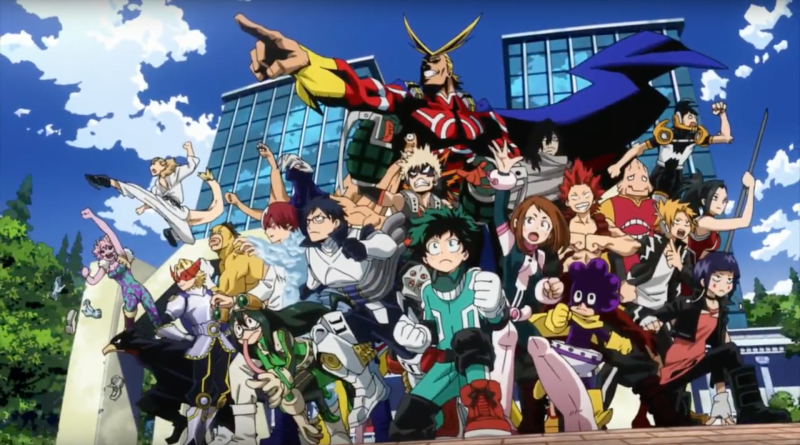
And while the sun has mostly set on two of Jump’s Big 3, other series are rising to feel those niches. Alongside older ongoing fair like One Piece and Hunter x Hunter, you can catch the much-lambasted Black Clover and the much-beloved My Hero Academia.
If you’re interested in giving a shonen fighter a try, My Hero Academia is a great place to start. It really puts American-style heroes through a Japanese lens, and it has a lot of fun doing it. There are lots of characters with great designs (background and otherwise), and there are lots of different powers on display. And, by making its protagonists teenagers in a world with plenty of established heroes, it gives itself a great bag of tools for coping with and implementing character progression inside and outside of combat situations.
Anyway, that’s all I’ve got. Tomorrow we’re hitting the halfway mark. Until then!
 chasetriesagain.com
1 Comment