
I started typing the title for this entry 20 minutes before I actually got started. It’s been a long week, and I’m short on attention and energy. I was going to write a post with some suggestions for anime YouTubers to check out, with their flashy visuals and “audio.” Then I really wanted to talk about a couple of Cowboy Bebop-related things, but I’m still resisting that temptation. I’ve also considered talking about some of the things I don’t like about anime, but that deserves more time to develop than I have tonight.
So here we are, it’s nearly 10 p.m., and I’m trying to decide which topic out of about a dozen I have the time and energy to develop tonight, suffering from too many ideas and a little writer’s block. And that’s how we get here.
Mangaka Tite Kubo created Bleach way back in 2001. It ran for 15 years. I haven’t read all of Bleach, and I haven’t watched all of its anime adaptation. It sticks out to me though, because I read a good bit of the early run thanks to my public library, and I don’t read a lot of manga.
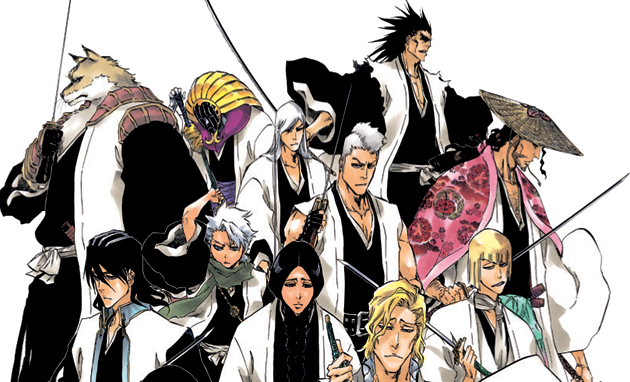
I was in middle school when I read those early Bleach chapters, and that was quite some time ago. I’ve checked in enough on Bleach in the intervening years to get the impression that it has some major problems, not least of which is Kubo’s tendency to introduce large groups of characters all at once.
Kubo seems to love using loads and loads of characters. At one point Bleach had in the neighborhood of 250+ speaking characters. This isn’t the largest cast in anime and manga by a long, long shot, but Kubo’s aforementioned tendency to dump five or six or more into the plot at one time and follow up in just a few chapters with five or six more makes his cast noticeably unwieldy.
It also seems that many of these characters fall into pretty recognizable types. He likes tough big guys that are stoic but friendly, tiny girls concealing major power, odd-looking men with strange powers, hot chicks with… big assets, hot chicks with small assets, and we end up seeing variations on most of these themes for just about every group he inserts into the story.
Kubo has said before that he creates characters as a means to break through writer’s block, and I’m sympathetic. I love creating new characters, giving them a backstory and figuring out how they fit into the narrative I’m trying to write. In the video game world this tendency is called Alt-itis, and I’ve got it bad. I can’t even get through the Skyrim tutorial without thinking about the other characters I could be playing as.
Thing of it is, Alt-itis is dangerous, it makes it difficult to ever really finish telling the tale you set out on. In video games this is an easy to recognize issue. When you get half way through the game and then load the character creation screen back up, it becomes increasingly possible that you’ll never actually see the end of the game.
In writing, it’s a little sneakier than that. After all, introducing a new character to the story doesn’t prevent you from completing the story. But characters, even side characters, have narrative direction, and when their direction points away from the conclusion of the story, they become loose threads. Most works of fiction are going to have a few loose threads, after all, the author didn’t write an epilogue about the unnamed waitress who brought the coffee in the third chapter and never appeared again. But loose threads for prominent characters are riskier business than loose threads for bit parts.
Loose threads for prominent characters are usually carefully considered gambles. The more of these prominent loose threads an ending has, the greater the risk the audience will find the ending unsatisfying. So when you’ve got so many standout characters, like Kubo does, there’s an instinct to try to get as many narratives pointed in the same direction as possible.
This can get clunky fast if you’re not prepared to use the George R. R. Martin solution for having too many characters with contrasting goals. And, despite writing about an organization of sword-wielding psychopomps, Kubo is a much more merciful overlord for his fictional creations than Martin.
But I can forgive his Alt-itis and all the trouble it causes for one simple reason. Despite a limit to facial variations, Kubo produces consistently striking and compelling designs for just about every character to appear in Bleach over the years. I was hoping to find a gallery of his character designs, but I’ve yet to sniff out one that meets my expectations. In the mean time, take a look at the two character designs below for Byakuya Kuchiki and Renji Abarai. I appreciate just how much you can infer about them from their design.

If you’re interested in checking out Bleach (and I might just be revisiting it after this post), you can watch it free and legally at the Viz Media website. Until next time.
 chasetriesagain.com